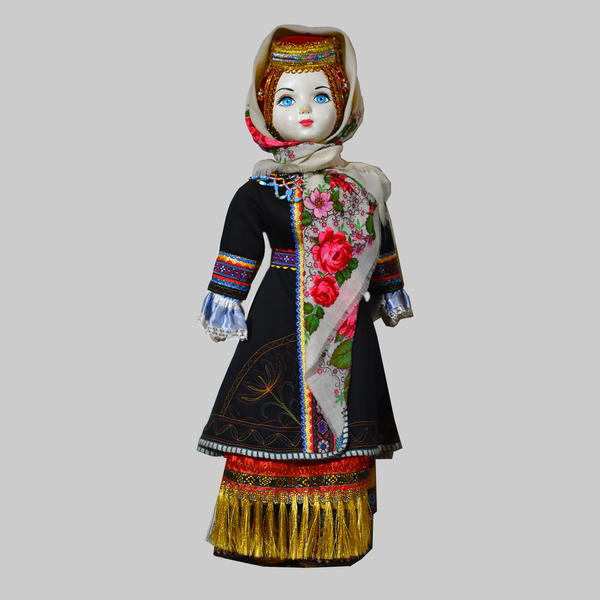
The blue-eyed doll in a folk costume attracts attention with unusual eye-colored beads, a luxurious kerchief over the garment richly embroidered with sequins and golden braid. These details are traditional for Boguchar District. Back in the 19th century, each village of the District had its own traditions, rites, songs, men’s and women’s costumes intended for various occasions. One costume was only to be worn to the church, another on festive occasions, and still another one at harvest time. This also applied to winter clothing, which the doll is wearing.
The basis of the winter version of the women’s outfit with the symbolic name ‘Boguchar Ukrainian woman’ was the so-called ‘pair’ - a waistcoat (a close-fitting sleeveless garment) and a warm woolen skirt, which was made from purchased fabric and generously decorated with golden braid. The set included a traditional embroidered white gown, an apron that served as a veil, a handbag with women’s trifles, and a large kerchief painted with roses. Beads of various shapes and colors complemented the image.
The basis of the winter version of the women’s outfit with the symbolic name ‘Boguchar Ukrainian woman’ was the so-called ‘pair’ - a waistcoat (a close-fitting sleeveless garment) and a warm woolen skirt, which was made from purchased fabric and generously decorated with golden braid. The set included a traditional embroidered white gown, an apron that served as a veil, a handbag with women’s trifles, and a large kerchief painted with roses. Beads of various shapes and colors complemented the image.
The traditional wedding ritual - covering the bride’s head with a kerchief - had a sacred meaning: from the moment the girl became a married wife her hair was always covered with a kerchief. According to an ancient belief, a woman’s hair hides witchcraft power, so a woman could appear with an uncovered head only in front of her husband; even close relatives who she shared a house with - a father-in-law and a mother-in-law - were not supposed to see her without a kerchief.
Every woman had several favorite kerchiefs, they were bought and given as presents, and such gifts were always welcome. Boguchar settlers from Ukraine, unlike Russian beauties, did not wear red scarves, but only white or milky colored ones, with fringes and a variety of floral patterns, but the most popular pattern were roses. In very cold weather women complemented their outfits with a white shawl.
A poneva – a woolen skirt, was an essential element of the women’s costume. It was sewn both from a rough home spun cloth made from long sheep’s wool, and a finer fabric which was purchased. The usual coloring of the poneva was ‘black eyes’ – the background of the black soil color with red stripes forming squares. The stripes symbolized the division of the earth by roads, clearings and rivers.
The traditional dowry of each Boguchar Ukrainian girl included at least twelve sets of ponevas and embroidered gowns. Festive clothings usually did not wear out, so they were often passed on by inheritance. In the 20th century, some families inherited richly embroidered ponevas; they ripped the seams of the garments and used the pieces as wall carpets or bedspreads.
The embroidered hemp gown was considered to be both a festive and an underwear garment. At the end of the 19th century the gown consisted of two parts connected by a transverse seam. The upper part was called a ‘torso’ and the lower part - a ‘hem’ or ‘support’. Usually a home spun canvas was used for a gown: the coarser type was for everyday wear, and the finer - for festive clothes.