In the traditional Ob-Ugrian families, toys were considered to be of high importance. From an early age, the Khanty taught their children how to make toys. While making a toy, the child understood the toy’s functions better. The child also learned the technology of manufacturing the toy, and later learned to use the thing he or she had made during the game. The Khanty used natural materials to make toys, such as clay, birch bark, wood, leather, and fur. Even the bones of fish, birds, and animals, their heads, paws, feathers, skins, tails, ears, and beaks could become toys.
The traditional toys for boys were small copies of real-life objects such as bows, arrows, traps, nooses, and sleds. From early childhood, the Khanty learned to hold a knife properly to make the small skis. Such activities prepared children for the mastering the crafts in the future.
The most popular toy for girls of the Khanty and Mansi peoples was a doll called “akan”. The traditional doll of the Ob Ugrians did not have a face, since the facial features were not depicted. The Khanty believed that having a face could make the doll “alive”, dangerous and possibly hurt the child.
The child’s mother, grandmother, or older sister made the first dolls for the girl. When the girl got older, she learned to make the toys herself. She sewed toy clothes and made jewelry for the dolls. With each new doll, the girl mastered new subtleties of traditional sewing.
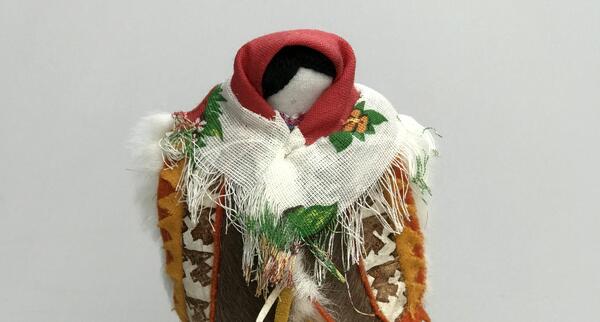
Dresses for akan were sewn from scraps of fabric, fur, leather, and beads. The Khanty girls made dress and forehead ornaments and even false braids for their dolls.
Some dolls were made entirely of fabric. The face was made of a tightly compressed monochrome cord, and the neck was made of eight colored stripes.
The akan’s head was sometimes made from the upper part of the beak of a waterfowl, for example, a duck, goose, or swan. Sometimes they also attached a piece of fur from the frontal part of the bird.
Small beaks about 5 centimeters long were used to make baby dolls. Female dolls were made from medium-sized duck beaks that were about 10 centimeters long. The largest beaks, mostly swan ones, were used to make male dolls.
The dolls of the Khanty people were very diverse — boys and girls, men and women, old men and old women. Female dolls were distinguished by especially diverse and bright costumes.
The color of the doll’s clothes was symbolic. Bright dresses were sewn for akans representing young women. If the doll was a “grandmother”, it was dressed up in a national costume of subdued tones. The clothing of the male akans was dominated by blue, dark green and black colors. The northern peoples did not use white. According to their beliefs, it was the color of the highest deities and spirits.
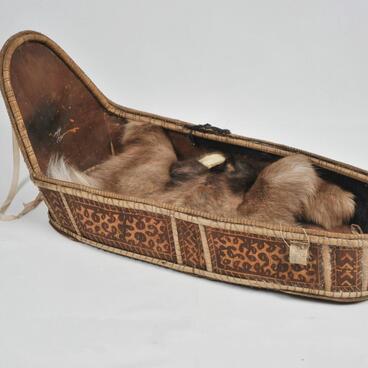
Every girl had her own set for playing with dolls. Usually, it included small handbags and bags for storing doll clothes and jewelry. Some girls had birch bark boxes made specifically for storing doll costumes.
The traditional toys for boys were small copies of real-life objects such as bows, arrows, traps, nooses, and sleds. From early childhood, the Khanty learned to hold a knife properly to make the small skis. Such activities prepared children for the mastering the crafts in the future.
The most popular toy for girls of the Khanty and Mansi peoples was a doll called “akan”. The traditional doll of the Ob Ugrians did not have a face, since the facial features were not depicted. The Khanty believed that having a face could make the doll “alive”, dangerous and possibly hurt the child.
The child’s mother, grandmother, or older sister made the first dolls for the girl. When the girl got older, she learned to make the toys herself. She sewed toy clothes and made jewelry for the dolls. With each new doll, the girl mastered new subtleties of traditional sewing.
Dresses for akan were sewn from scraps of fabric, fur, leather, and beads. The Khanty girls made dress and forehead ornaments and even false braids for their dolls.
Some dolls were made entirely of fabric. The face was made of a tightly compressed monochrome cord, and the neck was made of eight colored stripes.
The akan’s head was sometimes made from the upper part of the beak of a waterfowl, for example, a duck, goose, or swan. Sometimes they also attached a piece of fur from the frontal part of the bird.
Small beaks about 5 centimeters long were used to make baby dolls. Female dolls were made from medium-sized duck beaks that were about 10 centimeters long. The largest beaks, mostly swan ones, were used to make male dolls.
The dolls of the Khanty people were very diverse — boys and girls, men and women, old men and old women. Female dolls were distinguished by especially diverse and bright costumes.
The color of the doll’s clothes was symbolic. Bright dresses were sewn for akans representing young women. If the doll was a “grandmother”, it was dressed up in a national costume of subdued tones. The clothing of the male akans was dominated by blue, dark green and black colors. The northern peoples did not use white. According to their beliefs, it was the color of the highest deities and spirits.
Every girl had her own set for playing with dolls. Usually, it included small handbags and bags for storing doll clothes and jewelry. Some girls had birch bark boxes made specifically for storing doll costumes.