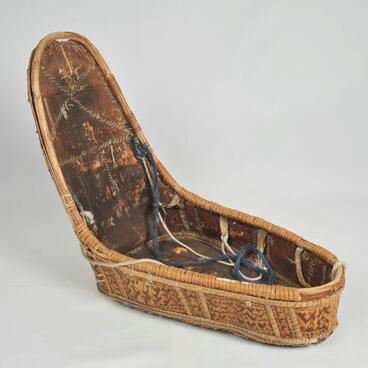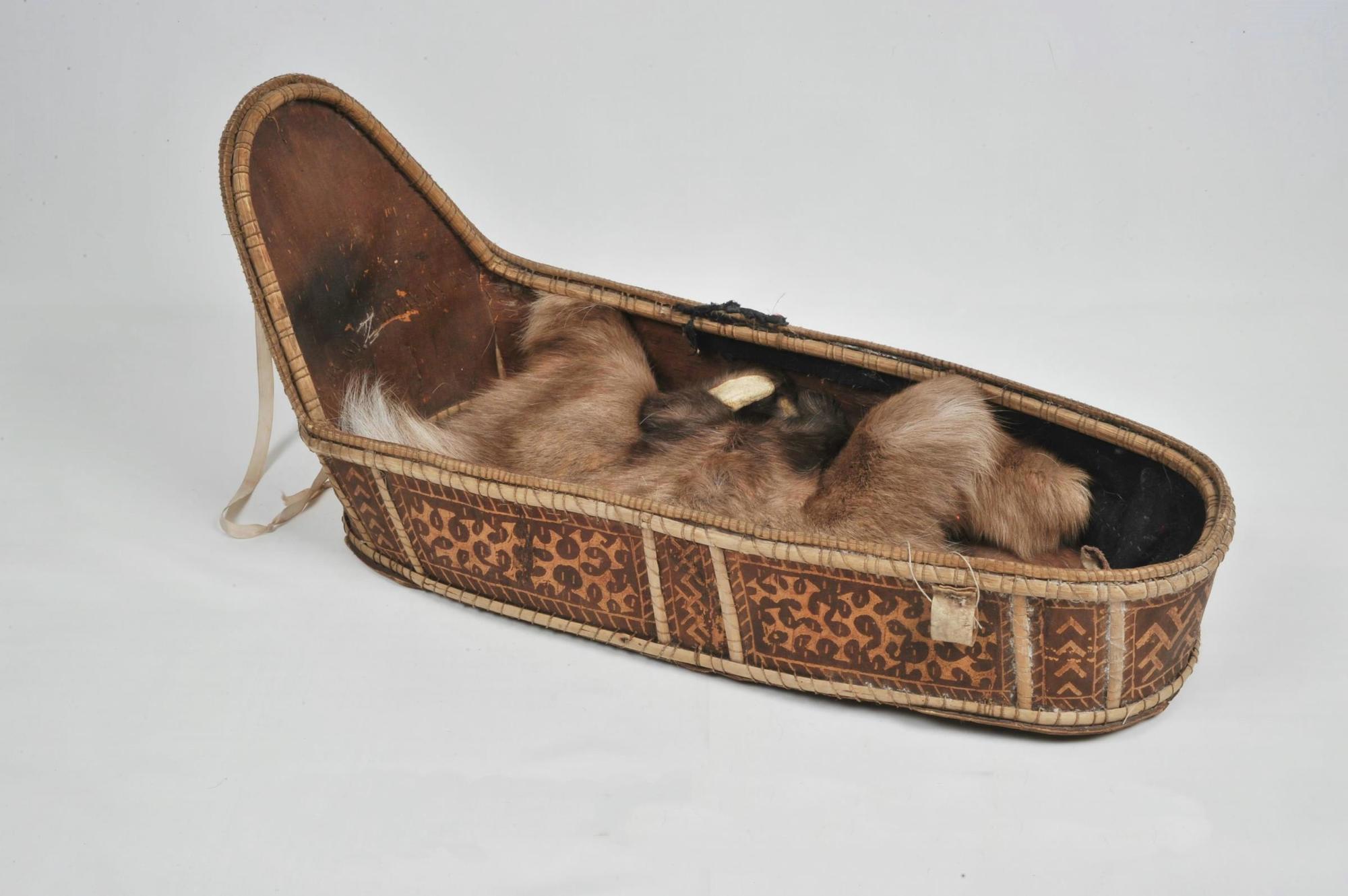


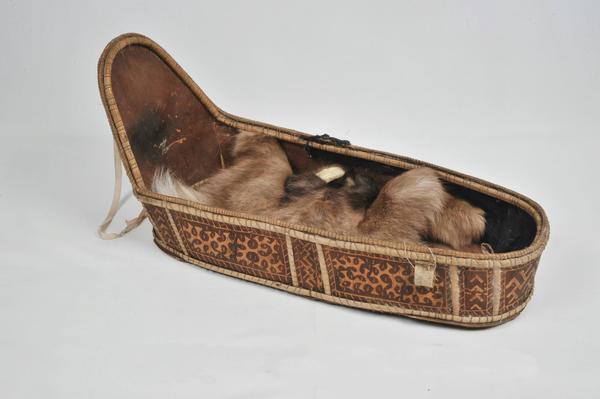
The night cradle is called ‘ontup’ in the Khanty language. The baby cradle that is on display in the museum was made at the beginning of the 20th century. It is hand sewn from a piece of birch bark.
The sides and the sloping headboard of the cradle are strengthened with bird cherry strips. The upper and lower edges are strengthened with rims, which are also made of bird cherry wood. All the cradle elements are sewn with tendon threads.
At the bottom of the cradle is a mat made of deerskin. Straps are sewn to the sides from the inside. This lacing keeps the sleeping child in a horizontal position. Leather loops are attached to the upper edge of the sides and to the headboard — ropes are used to hang the cradle to the ceiling.
The cradle is decorated with a traditional geometric ornament of the northern peoples in the scraping technique. First, such ornaments are applied to the birch bark with the spine of a knife, after which the bark is slightly moistened. The brown pellicle is removed with the knife edge, there is a white layer underneath.
As a rule, the inhabitants of the North lived in large families in the past. There was only one cradle in the house, no matter how many children the family had. It was made for the birth of the first child and then passed on to younger brothers and sisters.
The Khanty people had a special tradition. They made two cradles. The first one was an afternoon cradle, in which the child sat and played during the day, and the second one was a night cradle, in which he or she slept.
The night cradle was a birch bark box with rounded corners. The Khanty put the shavings of young pine trees, which absorbed moisture and did not allow intertrigo to appear on the baby’s skin. There were matches (a symbol of fire) in the cradle, which protected the baby against evil spirits. The “wood grouse hen” ornament was always applied at the head of the cradle. It was believed that this bird protected the baby’s sleep and made sure that his soul had some rest in a dream. According to the beliefs of the Khanty, the wood grouse hen accompanied a person in a dream from his or her birth to the end of life.
Various legends were associated with the cradle. For example, fairy-tale heroes hid in cradles from those who chased them. Also, according to legends, a cradle could resurrect the perished and make the old people young again.
The sides and the sloping headboard of the cradle are strengthened with bird cherry strips. The upper and lower edges are strengthened with rims, which are also made of bird cherry wood. All the cradle elements are sewn with tendon threads.
At the bottom of the cradle is a mat made of deerskin. Straps are sewn to the sides from the inside. This lacing keeps the sleeping child in a horizontal position. Leather loops are attached to the upper edge of the sides and to the headboard — ropes are used to hang the cradle to the ceiling.
The cradle is decorated with a traditional geometric ornament of the northern peoples in the scraping technique. First, such ornaments are applied to the birch bark with the spine of a knife, after which the bark is slightly moistened. The brown pellicle is removed with the knife edge, there is a white layer underneath.
As a rule, the inhabitants of the North lived in large families in the past. There was only one cradle in the house, no matter how many children the family had. It was made for the birth of the first child and then passed on to younger brothers and sisters.
The Khanty people had a special tradition. They made two cradles. The first one was an afternoon cradle, in which the child sat and played during the day, and the second one was a night cradle, in which he or she slept.
The night cradle was a birch bark box with rounded corners. The Khanty put the shavings of young pine trees, which absorbed moisture and did not allow intertrigo to appear on the baby’s skin. There were matches (a symbol of fire) in the cradle, which protected the baby against evil spirits. The “wood grouse hen” ornament was always applied at the head of the cradle. It was believed that this bird protected the baby’s sleep and made sure that his soul had some rest in a dream. According to the beliefs of the Khanty, the wood grouse hen accompanied a person in a dream from his or her birth to the end of life.
Various legends were associated with the cradle. For example, fairy-tale heroes hid in cradles from those who chased them. Also, according to legends, a cradle could resurrect the perished and make the old people young again.