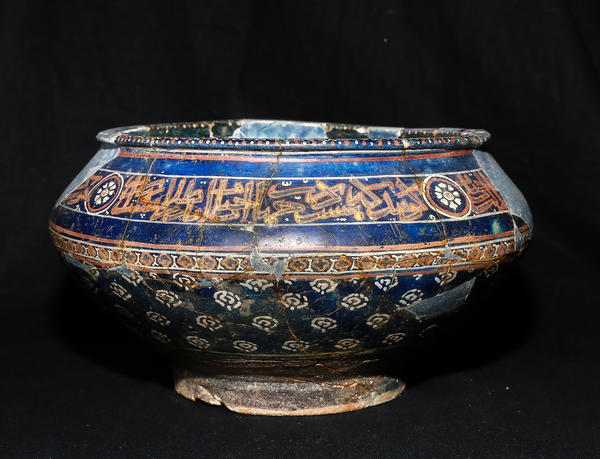
GulabdAn is a sample of medieval ceremonial tableware. The vessel from the Astrakhan Museum Reserve collection was found in the course of archaeologic excavations in 1976 at the site of SelItrennoye ancient settlement in the KharabalInsky District of the Astrakhan Region.
GulabdAn is translated from Persian as ‘a vessel for rose water’ (Gul — rose, flower; ab — water, dan — vessel). Water with rose petals was poured into such a vase guests could moisten their fingers after the meals. Such vessels were used by the nobility of the Golden Horde; they were considered a symbol of luxury and a high rank of the owner.
GulabdAn is daintily decorated. It is blue inside and has a medallion with an eight-pointed star and petals in the middle. There are onion-shaped medallions intermittent with trefoils at a higher level.
The vessel is dark blue outside. It is decorated with white rosettes at the bottom, then with a belt of blue trefoils with a gold border, and with a frieze with Persian text at the top. The ornamental ligatured script is gilded and reads: ‘… They say: life in the world originated from water… ’
Researchers studied the glazed ceramics of the Golden Horde and came to the conclusion that the traditions were influenced by the ceramic craft of various medieval states of the Central Asia, Transcaucasia and Crimea. At the same time, the items made by the Golden Horde craftsmen feature with a special ornament: artists depicted a variety of details on the items and combined them on various vessels in an almost unique way.
KAshin bowls were one of the most common types of glazed ceramics. KAshin is crushed quartz sand with white clay, lime and other admixtures, melted at 1000–1200°C. It was decorated with black paintings under turquoise glaze. The process of making KAshin ceramics came to the Golden Horde through the Central Asia from Iran and Syria in the XIV century.
KAshin ceramics ornaments were strictly regulated. The artists used ancient plots and symbols of the peoples that were part of the Golden Horde. These were floral patterns: lotus, flower rosette, shamrock, vine, palmettes that are palm leaf-shaped ornaments. Geometric shapes such a six-pointed star, grid, squares, circles, stripes and images of animals were popular as well. Leopard, leopard, hare, crane, eagle, duck were especially often painted on ceramics. And also, as in our case, epigraphic patterns were used to decorate the dishes — inscriptions in Arabic. Often, drawings were supplemented with abstractions, including elements of ‘peacock eyes’, dots, commas, S shapes, and so on.
GulabdAn is translated from Persian as ‘a vessel for rose water’ (Gul — rose, flower; ab — water, dan — vessel). Water with rose petals was poured into such a vase guests could moisten their fingers after the meals. Such vessels were used by the nobility of the Golden Horde; they were considered a symbol of luxury and a high rank of the owner.
GulabdAn is daintily decorated. It is blue inside and has a medallion with an eight-pointed star and petals in the middle. There are onion-shaped medallions intermittent with trefoils at a higher level.
The vessel is dark blue outside. It is decorated with white rosettes at the bottom, then with a belt of blue trefoils with a gold border, and with a frieze with Persian text at the top. The ornamental ligatured script is gilded and reads: ‘… They say: life in the world originated from water… ’
Researchers studied the glazed ceramics of the Golden Horde and came to the conclusion that the traditions were influenced by the ceramic craft of various medieval states of the Central Asia, Transcaucasia and Crimea. At the same time, the items made by the Golden Horde craftsmen feature with a special ornament: artists depicted a variety of details on the items and combined them on various vessels in an almost unique way.
KAshin bowls were one of the most common types of glazed ceramics. KAshin is crushed quartz sand with white clay, lime and other admixtures, melted at 1000–1200°C. It was decorated with black paintings under turquoise glaze. The process of making KAshin ceramics came to the Golden Horde through the Central Asia from Iran and Syria in the XIV century.
KAshin ceramics ornaments were strictly regulated. The artists used ancient plots and symbols of the peoples that were part of the Golden Horde. These were floral patterns: lotus, flower rosette, shamrock, vine, palmettes that are palm leaf-shaped ornaments. Geometric shapes such a six-pointed star, grid, squares, circles, stripes and images of animals were popular as well. Leopard, leopard, hare, crane, eagle, duck were especially often painted on ceramics. And also, as in our case, epigraphic patterns were used to decorate the dishes — inscriptions in Arabic. Often, drawings were supplemented with abstractions, including elements of ‘peacock eyes’, dots, commas, S shapes, and so on.