

Crosses are among the mass finds of archaeological research, which confirms their widespread use by the population in different periods of time. Pectoral icons and encolpions also became widespread. Encolpions were small boxes which came in rounded, rectangular or cruciform shapes.
The specificity of the pre-Mongolian crosses lies in the rare use of subjects, in other words, in the absence of images that represented the crucifixion of Christ or the Mother of God. However, from the 13th century, the number of crosses with the image of the Savior gradually began to increase.
Crosses in Russia came in different forms. Even in Byzantium, there had not been so many different types of Christian crosses. Such crosses rarely had straight arms, and if they did, they were most often devoid of any ornament.
Crosses with rounded ends were very popular as well as those whose ends looked like a flower with three petals. This form of the cross is often called Russian, however, researchers found such objects more in the Balkans and in the territory of Byzantium.
Crosses were mainly made by casting. Some experts suggest that there were no separate centers for the production of crosses in Russia, and casting workshops were scattered throughout the state.
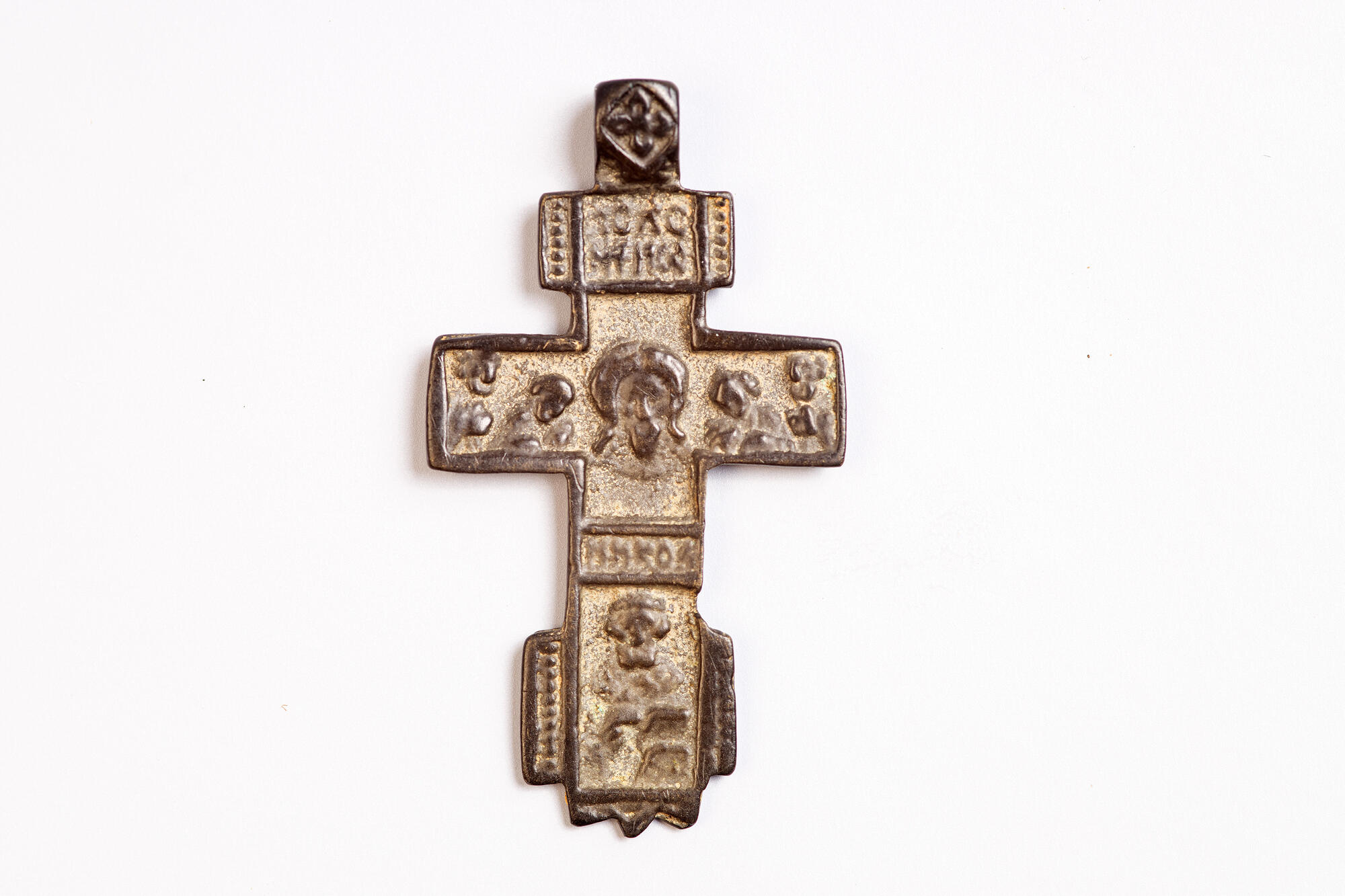
The pectoral cross from the exhibition is made of copper; in the center is the image of the Savior Not Made by Hands. On the right is the Virgin, and on the left — John the Theologian. The artisan separated the image of the Savior from the image of Nicholas the Wonderworker below with a sign “NIKOΛ” in a rectangular frame.
The image of St. Nicholas is one of the most common ones. There are cases when he was revered as the “fourth person” of the Trinity, and icon painters sometimes depicted him in the place of Christ. On double-sided crosses, St. Nicholas could be depicted on one of the sides. Foreigners who visited the Muscovite state in the 17th century wrote that everyone honors St. Nicholas and pays him “divine honors.”
The reverse side of this item is smooth. The upper part was created in the form of a faceted bead. At the lower end of the cross, the artisan made small decorative cutouts. The cross was dated from the 15th to the 16th century.
The specificity of the pre-Mongolian crosses lies in the rare use of subjects, in other words, in the absence of images that represented the crucifixion of Christ or the Mother of God. However, from the 13th century, the number of crosses with the image of the Savior gradually began to increase.
Crosses in Russia came in different forms. Even in Byzantium, there had not been so many different types of Christian crosses. Such crosses rarely had straight arms, and if they did, they were most often devoid of any ornament.
Crosses with rounded ends were very popular as well as those whose ends looked like a flower with three petals. This form of the cross is often called Russian, however, researchers found such objects more in the Balkans and in the territory of Byzantium.
Crosses were mainly made by casting. Some experts suggest that there were no separate centers for the production of crosses in Russia, and casting workshops were scattered throughout the state.
The pectoral cross from the exhibition is made of copper; in the center is the image of the Savior Not Made by Hands. On the right is the Virgin, and on the left — John the Theologian. The artisan separated the image of the Savior from the image of Nicholas the Wonderworker below with a sign “NIKOΛ” in a rectangular frame.
The image of St. Nicholas is one of the most common ones. There are cases when he was revered as the “fourth person” of the Trinity, and icon painters sometimes depicted him in the place of Christ. On double-sided crosses, St. Nicholas could be depicted on one of the sides. Foreigners who visited the Muscovite state in the 17th century wrote that everyone honors St. Nicholas and pays him “divine honors.”
The reverse side of this item is smooth. The upper part was created in the form of a faceted bead. At the lower end of the cross, the artisan made small decorative cutouts. The cross was dated from the 15th to the 16th century.




