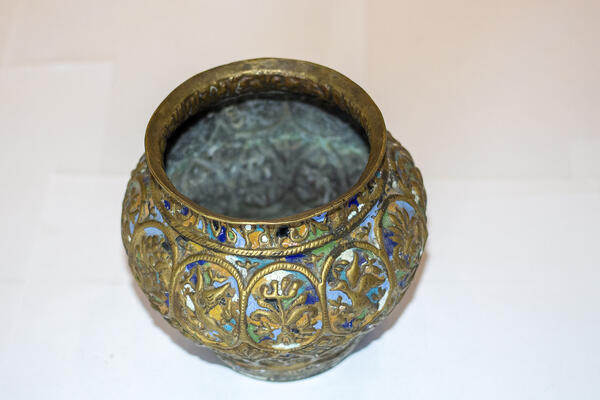
This exhibit is one of several loving cups (bratinas) that are on display at the Museum “The Smolensk Fortress”. It was made in the Urals in the 18th century. That was the time when Russian copper mining began to flourish, and artisans started to manufacture unique products of high artistic quality.
Since the time of Emperor Peter I, Russia developed mining and processing its own raw materials applying the latest European solutions. Russian industrialists also invested in this business, and the copper industry was among the most promising ones.
It was much more profitable to sell finished products rather than just raw materials. The metallurgical plants of the Demidovs were concentrated in the western Urals. Numerous items from the collections of contemporary Russian museums were created there.
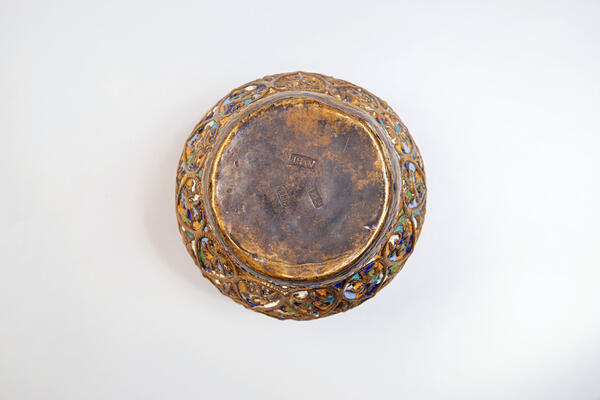
Historians and collectors especially value Ural products because they have factory stamps. This bratina has three marks: SIBIR, “1754”, and “MVG”. SIBIR was used to mark Demidov’s products, the second mark refers to the year of manufacture, and the initials “MVG” are the maker’s mark.
In total, researchers managed to identify 43 marks with the initials of the artisans who worked at the Ural factories. The initials “MVG” were also found on earlier items, which were made in the 1740s.
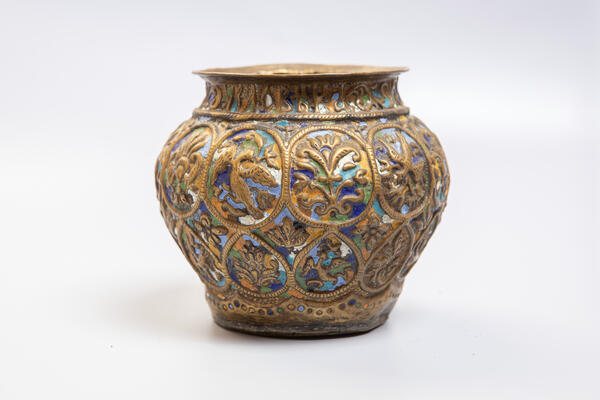
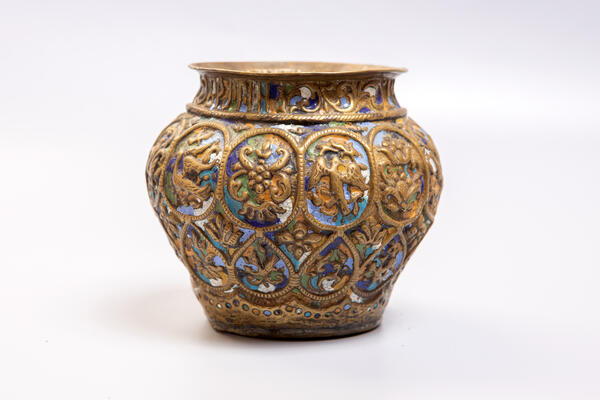
This bratina has a classic spherical shape, a wide neck and a flat bottom. The artisan richly decorated the vessel with white, yellow, blue and green enamel. Demidov’s products were always elaborately decorated, and the design was often based on plots from old manuscripts.
Demidov’s patterns were distinguished by featuring separate framed images and rendering complex surface texture. The mostly floral pattern would sometimes feature the images of birds or fantastic beasts.
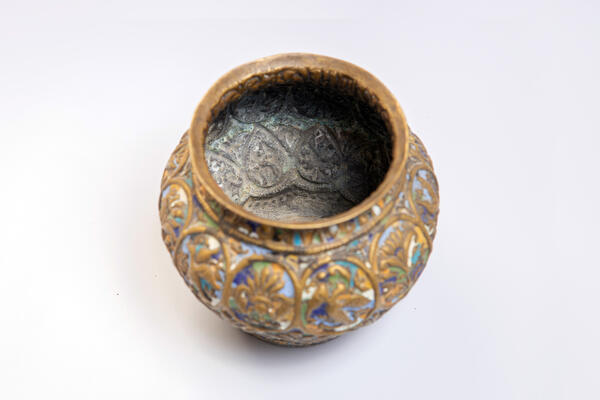
Such products were often made from copper — it was malleable, ductile, strong and could be used to create a huge number of decorative designs. Copper utensils were often lined with a tin coating on the interior to prevent them from tarnishing.
Since the time of Emperor Peter I, Russia developed mining and processing its own raw materials applying the latest European solutions. Russian industrialists also invested in this business, and the copper industry was among the most promising ones.
It was much more profitable to sell finished products rather than just raw materials. The metallurgical plants of the Demidovs were concentrated in the western Urals. Numerous items from the collections of contemporary Russian museums were created there.
Historians and collectors especially value Ural products because they have factory stamps. This bratina has three marks: SIBIR, “1754”, and “MVG”. SIBIR was used to mark Demidov’s products, the second mark refers to the year of manufacture, and the initials “MVG” are the maker’s mark.
In total, researchers managed to identify 43 marks with the initials of the artisans who worked at the Ural factories. The initials “MVG” were also found on earlier items, which were made in the 1740s.
This bratina has a classic spherical shape, a wide neck and a flat bottom. The artisan richly decorated the vessel with white, yellow, blue and green enamel. Demidov’s products were always elaborately decorated, and the design was often based on plots from old manuscripts.
Demidov’s patterns were distinguished by featuring separate framed images and rendering complex surface texture. The mostly floral pattern would sometimes feature the images of birds or fantastic beasts.
Such products were often made from copper — it was malleable, ductile, strong and could be used to create a huge number of decorative designs. Copper utensils were often lined with a tin coating on the interior to prevent them from tarnishing.