The altar cross, along with the Gospel and the antimins, is a mandatory element of the holy altar. With this cross, the priest blesses the flock and consecrates the water on the feast of the Epiphany; the faithful kiss it at the end of the Liturgy, at the wedding and other solemn services.
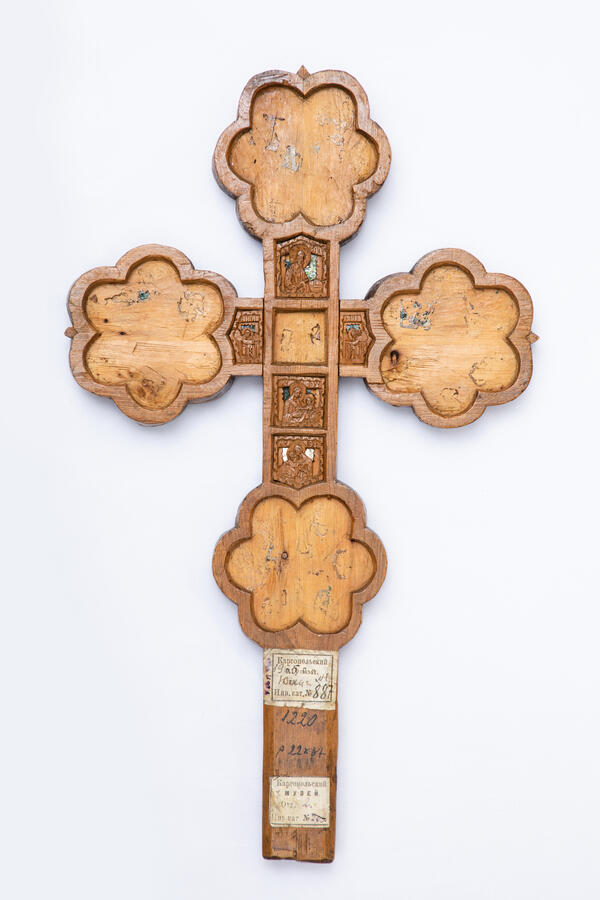
On the front side of the cross, in the middle part, there is a figure of the crucified Christ as a reminder of the pinnacle of His feat, the redemptive sacrifice for the salvation of the human race. Each carved scene depicts its own plot.
On the right is “The Incredulity of Thomas”. According to the Gospel, he doubted the story of the other disciples that they had seen the risen Jesus, because he was not present at the time. Having seen the Teacher and being convinced of the truth of what was happening, Thomas, who, according to John Chrysostom, “was once weaker than others… in faith, ” became the most zealous and tireless of the apostles of Christ.
The scene on the left depicts the myrrh-bearing women who were the first to come to the Holy Sepulchre to anoint the body of Jesus, and to whom an angel appeared with the news of the Resurrection of Christ.
The plot of the lower rosette is “The Descent from the Cross”, an episode of the Passion following the Crucifixion and preceding the Lamentation of Christ.
The museums of Kargopol and Arkhangelsk house a considerable number of carved crosses, which are united by common characteristic details, including unusual six-bladed rosettes that complete the branches of the crosspiece. The museums received these exhibits from the surrounding churches. Researchers believe that such artifacts were made by a specific workshop of one of the regions in the Russian North. Its exact location has not yet been established.
Apparently, the scenes for the rosettes were carved separately, one after the other, and then mounted on the blanks of crosses or folding icons, made to order or for the market. Judging by the abundance of preserved artifacts, the demand for such products was great.
The crosses could not be dated to a precise period:
the lower boundary is considered to be the end of the 17th century,
the upper — the 18th century.