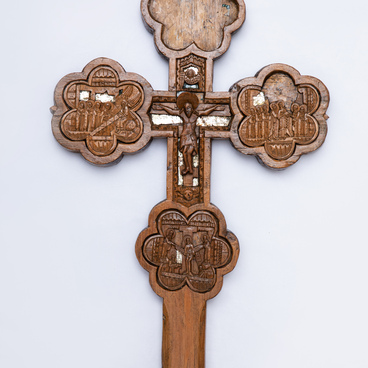
Soft monastic caps, similar to those presented in the exhibition of the Kargopol Museum, were a common headdress not only of monks, but also of the Orthodox clergy in general.
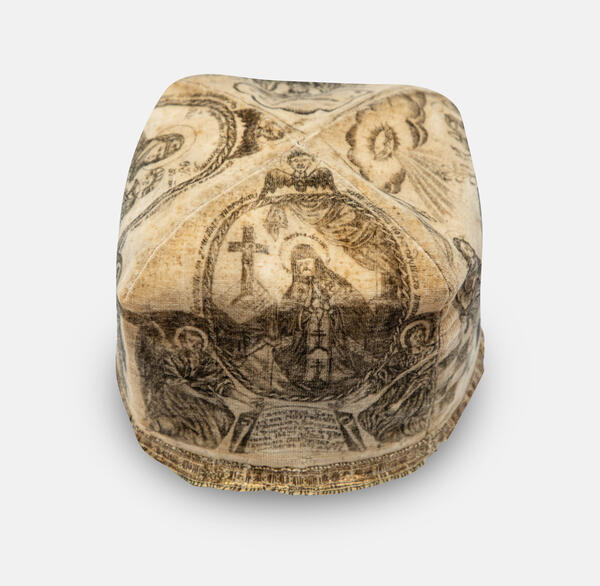
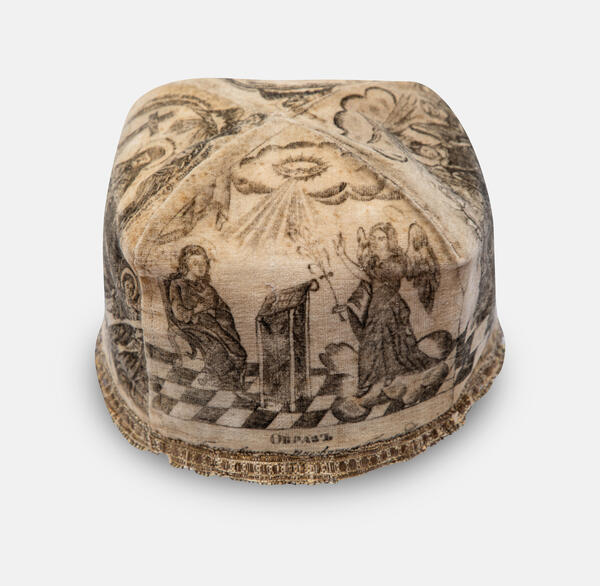
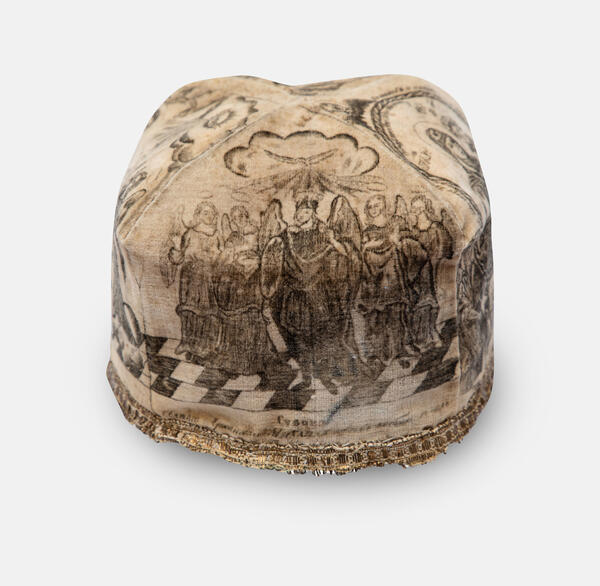
The cap is sewn from two pieces of velvet fabric and decorated on four sides with images. The first is the scene of the Annunciation: the Virgin Mary sits on a chair, in front of Her is a throne with an open Gospel and Gabriel the Archangel, announcing the “good news”. The second represents Archangel Michael surrounded by the angelic host. On the third side there is an image of Our Lady of the Way in an oval frame. The fourth image, also enclosed in an oval, features a schemamonk praying before the Cross.
On the outer edge of the frame is an inscription: “Servant of God Mitrofan praying to Christ for our souls.” The mentioned saint, Bishop of Voronezh and Yelets, born as Mikhail, was brought up “in the immaculate piety of the Eastern Church, in the Orthodox faith”. He was married and when his wife died took vows under the name Mitrofan. Having gained recognition for his strict monastic life, in 1682 he became a bishop, supported Peter I, who built a shipyard in Voronezh, and participated in the Azov campaign of 1696. As a schemamonk, Mitrofan took the name of Macarius, and in 1832 he was recognized as a saint.
The text on the printed stamp on the wrong side of the cap (“Factory of the Brothers KRESTOVNIKOV”) indicates that the fabric for this item of clothing was made at this factory.
The brothers Alexander, Xenophont and Konstantin Krestovnikov founded their partnership in 1831. As honorary citizens of Moscow and merchants of the first Moscow guild, they owned a weaving and spinning factory in the village of Polyana in the Moscow Uyezd, where they employed 175 workers. American cotton was purchased for the production of high-quality yarn. The factory’s products received many awards at various exhibitions, including the Legion of Honor at the 1889 World’s Fair.
In 1861, the factory was officially made supplier
of the Court of His Imperial Majesty, and its owners received the highest
permission to mark their products with the image of the state emblem.