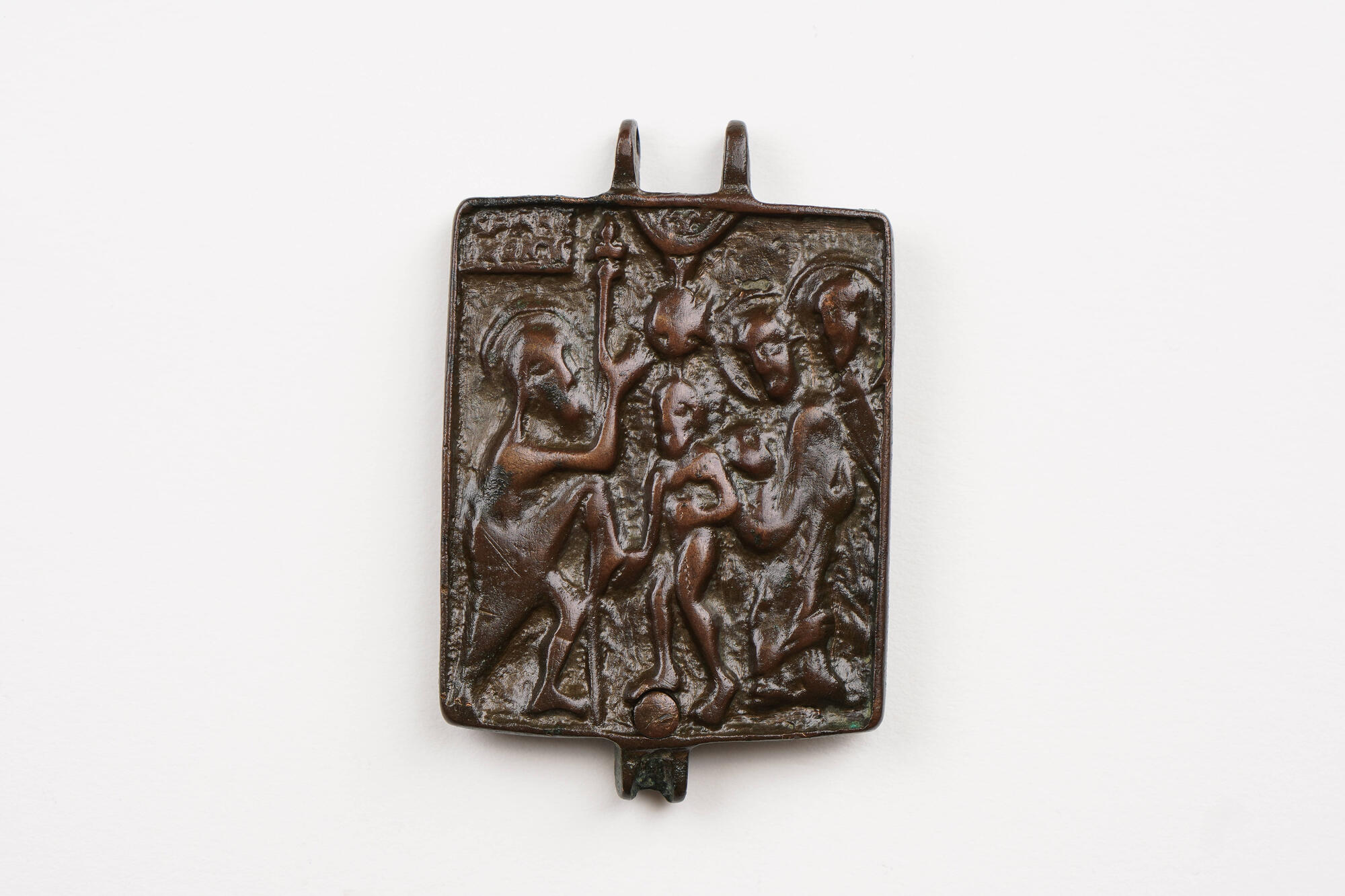


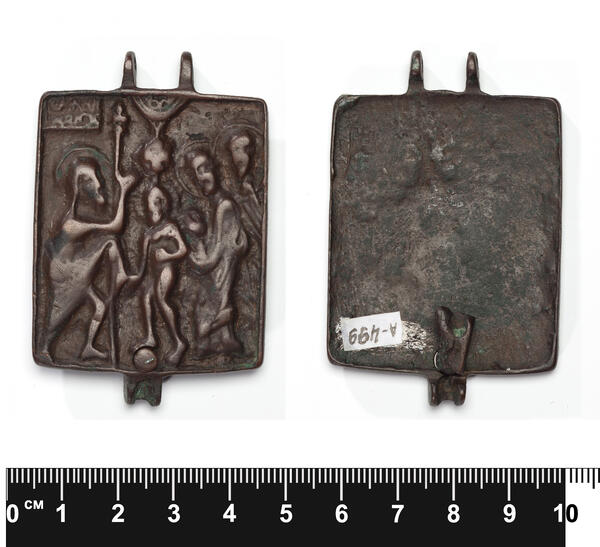
The exhibition presents the reverse side of the encolpion icon “The Baptism of Christ”. The item has a rectangular shape and a thin rim. On the upper edge, there are hinge loops with rounded holes. On the bottom edge, there is one loop. The icon features the scene of the Epiphany. In the center is the naked figure of Christ. On the left is John the Baptist with a rod in his hand, on the right are two angels. The casting is fine and clear.
The icon was found on the Kulikovo field in the village of Monastyrshchino in 1994. The drawing of a similar icon was first published in an article by Stepan Dmitrievich Nechaev, the first explorer of the Kulikovo Field. Similar products have been attributed to the Novgorod handicraft goods of the late 13th — early 14th centuries.
The Baptism of Christ (or Epiphany) is one of the oldest holidays celebrated by the Christian Church. It was established to commemorate an important event of the Gospel story — the baptism of Jesus Christ in the Jordan River by John the Baptist. This is one of the main twelve Orthodox holidays, which takes place annually on January 19 (January 6, old style).
The images of the Epiphany conveyed not only the Baptism of Jesus Christ in the Jordan performed by John the Baptist, but also the appearance of the Son of God to the world as one of the persons of the Holy Trinity, which was evidenced by the Father and the Holy Spirit, who descended on Christ in the form of a dove.
One of the oldest images of Baptism has been preserved in the early Christian catacombs in Rome, where Jesus is depicted as a young beardless youth. However, later it became customary to depict the Savior in this scene as a more mature person.
From the 16th and 17th centuries, the icons of the Baptism of Christ began to feature angels standing on the opposite bank of the Jordan and usually occupying the right side of the composition. All the images of the Epiphany focus mainly on the figures of the Savior and John the Baptist, who puts his right hand on the head of Jesus. The posture of Christ can vary. In early icons, his figure was often shown in frontal view, but later on, the icons that depicted Christ in a slight turn and movement, as if He was taking a step, became most popular. This scene was directly based on the Gospel, which says that, having been baptized, Jesus “went up straightway out of the water” (Matt. 3:16).
The icon was found on the Kulikovo field in the village of Monastyrshchino in 1994. The drawing of a similar icon was first published in an article by Stepan Dmitrievich Nechaev, the first explorer of the Kulikovo Field. Similar products have been attributed to the Novgorod handicraft goods of the late 13th — early 14th centuries.
The Baptism of Christ (or Epiphany) is one of the oldest holidays celebrated by the Christian Church. It was established to commemorate an important event of the Gospel story — the baptism of Jesus Christ in the Jordan River by John the Baptist. This is one of the main twelve Orthodox holidays, which takes place annually on January 19 (January 6, old style).
The images of the Epiphany conveyed not only the Baptism of Jesus Christ in the Jordan performed by John the Baptist, but also the appearance of the Son of God to the world as one of the persons of the Holy Trinity, which was evidenced by the Father and the Holy Spirit, who descended on Christ in the form of a dove.
One of the oldest images of Baptism has been preserved in the early Christian catacombs in Rome, where Jesus is depicted as a young beardless youth. However, later it became customary to depict the Savior in this scene as a more mature person.
From the 16th and 17th centuries, the icons of the Baptism of Christ began to feature angels standing on the opposite bank of the Jordan and usually occupying the right side of the composition. All the images of the Epiphany focus mainly on the figures of the Savior and John the Baptist, who puts his right hand on the head of Jesus. The posture of Christ can vary. In early icons, his figure was often shown in frontal view, but later on, the icons that depicted Christ in a slight turn and movement, as if He was taking a step, became most popular. This scene was directly based on the Gospel, which says that, having been baptized, Jesus “went up straightway out of the water” (Matt. 3:16).