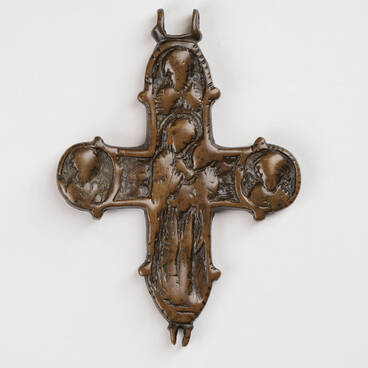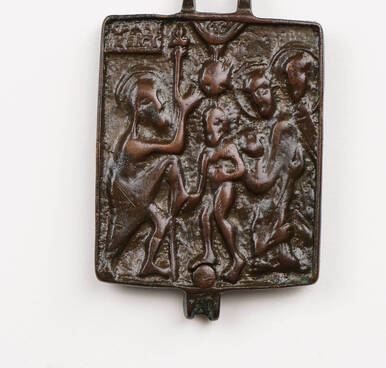
The word “encolpion” is translated from Greek as “on the chest”. An encolpion cross could be opened and closed and consisted of two parts. This pendant was to store the relics that were believed to protect the owner from misfortune and harm. Hence, its second name — the reliquary cross. Inside such crosses, modern scientists find residual fragments of decayed wood, fabric, threads, hair, and plants, as well as a variety of aromatic oils, including resins or wax.

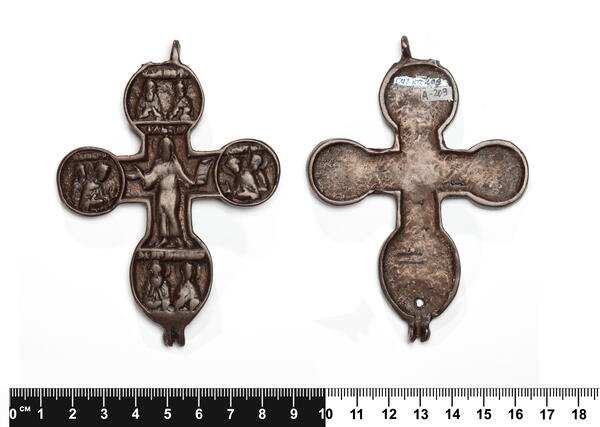
Reverse side


1 / 2
Encolpion cross
Creation period
the 14th–15th centuries
Dimensions
9x6,7x0,3 cm
Technique
non-ferrous metal, casting
Collection
Exhibition
1
Open in app#3
#4
The cross or encolpion hanging on the bishop’s chest means the seal and confession of faith, and that it hangs on the chest means confession from the whole heart.
Saint Symeon of Thessalonica explained the meaning of the encolpion in the following way
#2
The first encolpion crosses appeared in Rus in the 10th century when Christianity was adopted and its strength began to grow. Initially, encolpions were brought from Byzantium or from the countries of Asia Minor. In the 12th and 13th centuries, encolpions began to be made in Rus. Initially, the center of this production was the Principality of Kiev. Wearing such crosses had to do with a special tradition that had come to Russia from Byzantium: each baptized person was marked by a cross. The crosses were revered: people passed them from generation to generation, took good care of them, and sometimes donated to the church — it was a very expensive item.
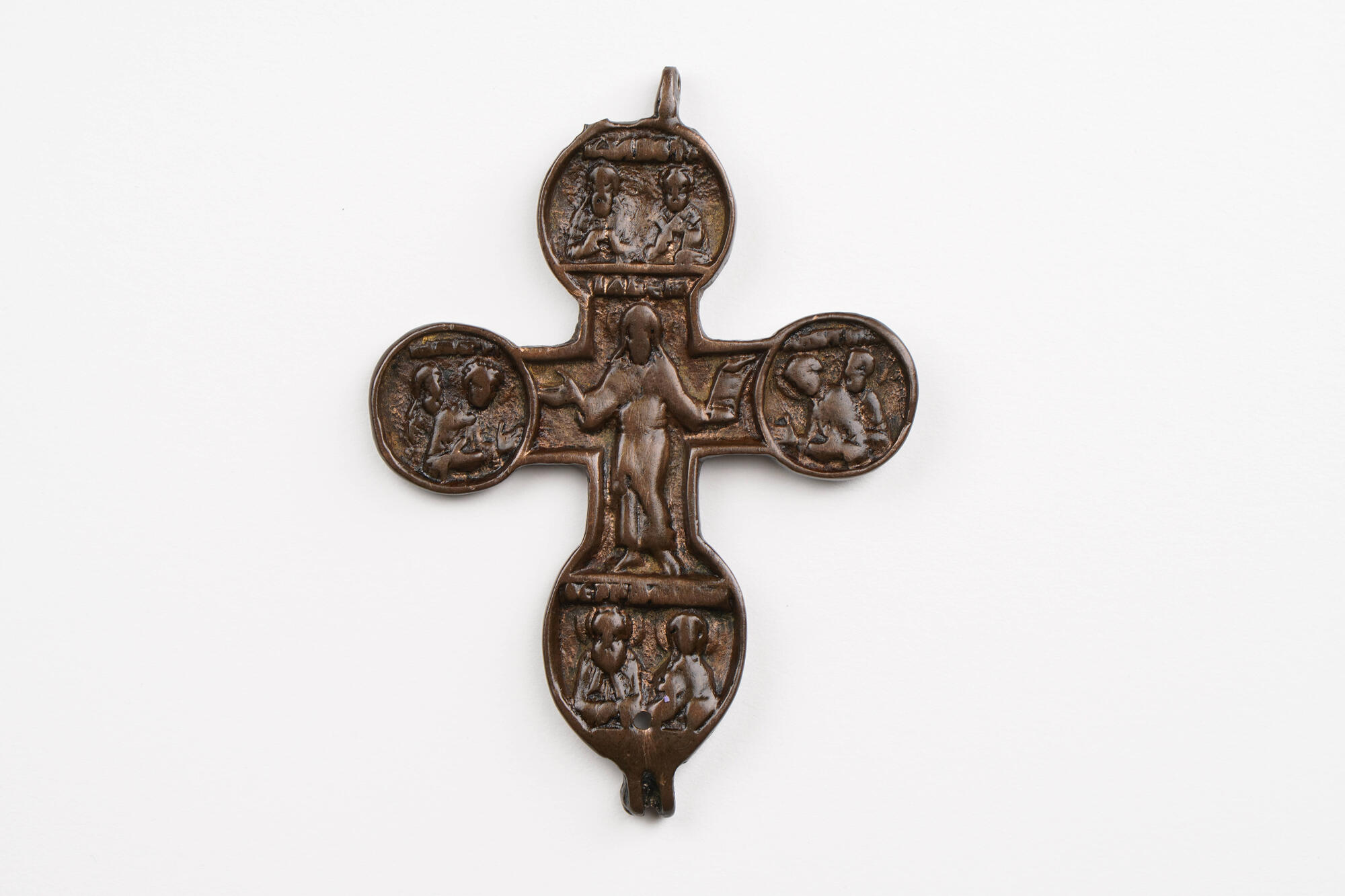
The collection of the State Museum-Reserve “Kulikovo Field” includes the lower part of an encolpion cross from the 14th to 15th centuries. The cross has four extremities — the arms have rounded ends and cross each other at a straight angle. In the center is the image of the prophet Elijah with a scroll in his left hand; the round medallions at the end of each limb feature half-length images of two saints. The top and bottom ends have double suspension loops. This encolpion cross entered the collection of the State Museum-Reserve “Kulikovo Field” from the collection of the Counts Olsufyev. It was discovered in the 1880s.
The prophet Elijah is equally highly revered by Christians, Jews and Muslims. This becomes evident in his iconography — there are several ways to depict him in icons.
The collection of the State Museum-Reserve “Kulikovo Field” includes the lower part of an encolpion cross from the 14th to 15th centuries. The cross has four extremities — the arms have rounded ends and cross each other at a straight angle. In the center is the image of the prophet Elijah with a scroll in his left hand; the round medallions at the end of each limb feature half-length images of two saints. The top and bottom ends have double suspension loops. This encolpion cross entered the collection of the State Museum-Reserve “Kulikovo Field” from the collection of the Counts Olsufyev. It was discovered in the 1880s.
The prophet Elijah is equally highly revered by Christians, Jews and Muslims. This becomes evident in his iconography — there are several ways to depict him in icons.
#5
Ministry of Culture of the Russian Federation
read morehide
00:00
00:00
1x
Encolpion cross
Creation period
the 14th–15th centuries
Dimensions
9x6,7x0,3 cm
Technique
non-ferrous metal, casting
Collection
Exhibition
1
 Point your smartphone camera to open in the app
Open in app
Share