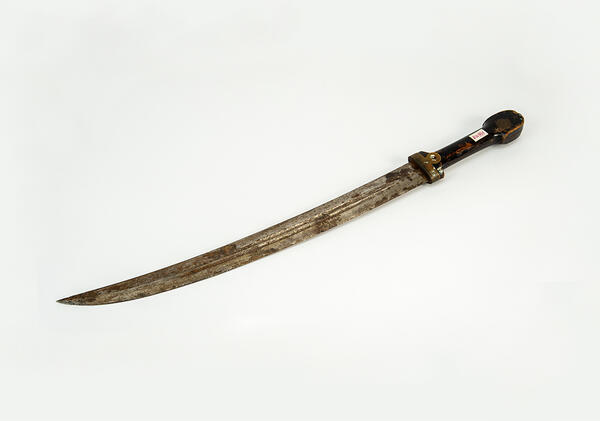
The collection of the Verkhnyaya Pyshma Historical Museum houses a combat dagger ‘Bebut’. It became part of the armament in the Russian Empire. The dagger was found during excavations in the village of Mostovsky in 2004.
The Bebut has a slightly curved steel blade that is 58 centimeters long, two-sided sharpening and longitudinal fullers along each side. The handle of the dagger is made of wood, its middle part is narrowed for a more comfortable grip.
The Bebut had a wooden scabbard: it was painted black or had leather exterior. Above were suspension rings and a tip ¬– they were used to attach the dagger to the sword belt.
Each product was stamped with the name of the factory that made the weapon and the number of the military unit in which the dagger’s owner served. It was put both on the knife and on the scabbard.
The Bebut blade from the museum collection also has the manufacturer’s stamp ‘Zlatoust, op. Fabre. 1917 (1912)’ in a circle. It stands for the ‘Zlatoust Arms Factory’. On the back, there are two letters — ‘A-A’.
In 1902, the Russian Imperial Army adopted new rapid-fire guns. The soldiers of the artillery troops who used these guns, were often close to the enemy on the battlefield. They used a saber sword with a long cutting edge for defense and in hand-to-hand combat. However, the saber was heavy and ill-suited for quick maneuvers.
Then the Commission of the Main Artillery Directorate proposed to arm artillerymen with daggers. Some members of the commandment were against the suggestion since Russian soldiers did not know how to wield daggers, except for the military in the Caucasus. In addition, the dagger had a short blade and, unlike the saber, could not be used to dig trenches.
However, 25 out of 30 commission members voted in favor of the rearmament. The process was not fast-paced: in 1907, the gendarmes received the Bebut, and a year later, the junior ranks of the machine-gun subunits. In 1909, the dagger replaced the sabers for all the lower ranks of the artillery troops, and in 1910 — for the mounted scouts of the infantry regiments.
Officially, the Bebut was in service by the Russian army until the revolution in 1917, but in fact it was used for much longer, even during the Soviet years.
The Bebut has a slightly curved steel blade that is 58 centimeters long, two-sided sharpening and longitudinal fullers along each side. The handle of the dagger is made of wood, its middle part is narrowed for a more comfortable grip.
The Bebut had a wooden scabbard: it was painted black or had leather exterior. Above were suspension rings and a tip ¬– they were used to attach the dagger to the sword belt.
Each product was stamped with the name of the factory that made the weapon and the number of the military unit in which the dagger’s owner served. It was put both on the knife and on the scabbard.
The Bebut blade from the museum collection also has the manufacturer’s stamp ‘Zlatoust, op. Fabre. 1917 (1912)’ in a circle. It stands for the ‘Zlatoust Arms Factory’. On the back, there are two letters — ‘A-A’.
In 1902, the Russian Imperial Army adopted new rapid-fire guns. The soldiers of the artillery troops who used these guns, were often close to the enemy on the battlefield. They used a saber sword with a long cutting edge for defense and in hand-to-hand combat. However, the saber was heavy and ill-suited for quick maneuvers.
Then the Commission of the Main Artillery Directorate proposed to arm artillerymen with daggers. Some members of the commandment were against the suggestion since Russian soldiers did not know how to wield daggers, except for the military in the Caucasus. In addition, the dagger had a short blade and, unlike the saber, could not be used to dig trenches.
However, 25 out of 30 commission members voted in favor of the rearmament. The process was not fast-paced: in 1907, the gendarmes received the Bebut, and a year later, the junior ranks of the machine-gun subunits. In 1909, the dagger replaced the sabers for all the lower ranks of the artillery troops, and in 1910 — for the mounted scouts of the infantry regiments.
Officially, the Bebut was in service by the Russian army until the revolution in 1917, but in fact it was used for much longer, even during the Soviet years.