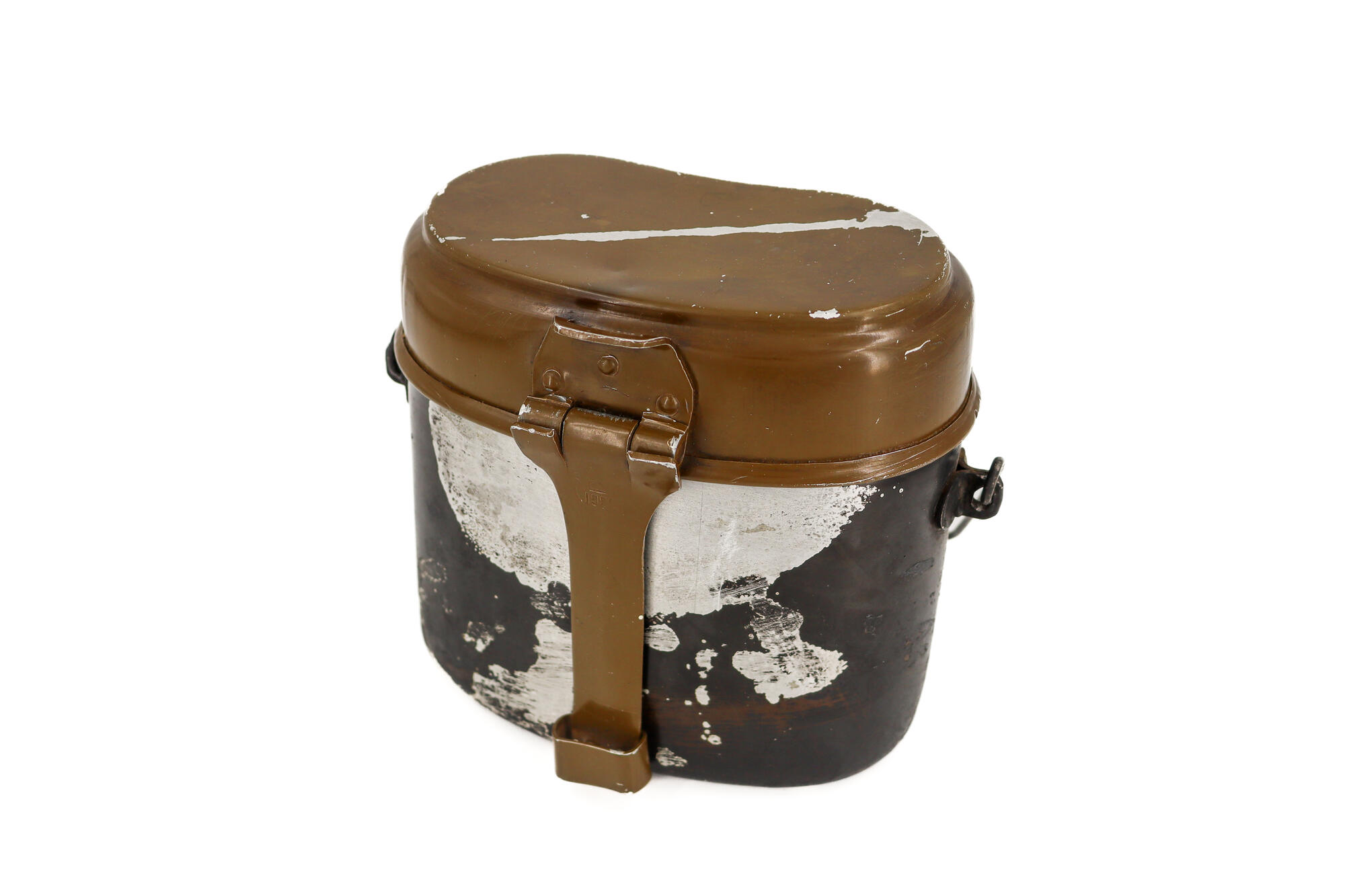


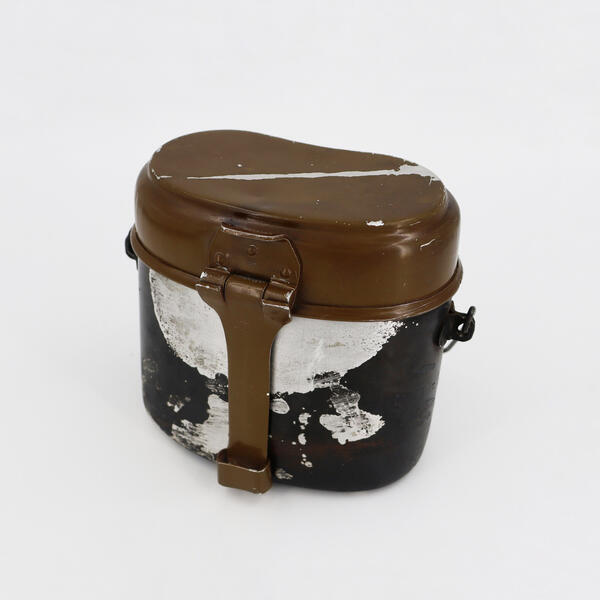
A mess kit — a collection of cookware for the military — was used mainly for eating and transporting food, much less often — for cooking. By the time the USSR joined the Second World War, it had two types of mess kits: cylindrical (round) and bean-shaped (oval).
Camping cookware was produced from various materials, including tinned sheet metal, copper, brass, and aluminum, mainly in Leningrad at the “Krasny Vyborzhets” plant. By 1927, the production had switched to aluminum only and continued using it for mess kits for the Red Army.
In 1936, a mess kit of a new oval shape was introduced, and the production of round ones was suspended, however, warehouses still had a fairly large stock of cylindrical containers that had already been produced. As a result, the Soviet army used mess kits of both designs.
The oval shape of the 1930s was borrowed from the Germans. Soviet and German cookware differed in volume (the German one was larger) and in the number of fastening rivets for the handle of the container lid. Also, Soviet mess kits had no indications that marked every 0.5 liters.
This mess kit had a handle that secured the lid when carried. It had designated holes for a spoon. When worn on a waist belt, a mess kit was pressed to the body with its concave side. It was equipped with a fabric cover, unlike the German mess kit. Its functions were listed as “transportation, heating and consuming of soups and second courses”. Mess kits consisted of two main parts: an aluminum body with a capacity of 1.3 liters, and a half-liter lid that could be used as a cup or a pan.
As the German troops approached Leningrad in the summer of 1941, the mess kit production was transferred to the Perm region to Ferrous Metallurgy Plant No. 700, also known as the Lysva Metallurgical Plant. This enterprise produced enameled dishes for the national economy, and ammunition shells and steel military helmets for the army.
By that time, aluminum had become scarce, and steel coated with tin was used as a material for mess kits instead. Tin was used to cover both their outer and inner surfaces. However, in the middle of the war, it was decided to tin only the inner one to save money. Between 1941 and 1945, the Lysva Metallurgical Plant produced around 20 million mess kits.
Camping cookware was produced from various materials, including tinned sheet metal, copper, brass, and aluminum, mainly in Leningrad at the “Krasny Vyborzhets” plant. By 1927, the production had switched to aluminum only and continued using it for mess kits for the Red Army.
In 1936, a mess kit of a new oval shape was introduced, and the production of round ones was suspended, however, warehouses still had a fairly large stock of cylindrical containers that had already been produced. As a result, the Soviet army used mess kits of both designs.
The oval shape of the 1930s was borrowed from the Germans. Soviet and German cookware differed in volume (the German one was larger) and in the number of fastening rivets for the handle of the container lid. Also, Soviet mess kits had no indications that marked every 0.5 liters.
This mess kit had a handle that secured the lid when carried. It had designated holes for a spoon. When worn on a waist belt, a mess kit was pressed to the body with its concave side. It was equipped with a fabric cover, unlike the German mess kit. Its functions were listed as “transportation, heating and consuming of soups and second courses”. Mess kits consisted of two main parts: an aluminum body with a capacity of 1.3 liters, and a half-liter lid that could be used as a cup or a pan.
As the German troops approached Leningrad in the summer of 1941, the mess kit production was transferred to the Perm region to Ferrous Metallurgy Plant No. 700, also known as the Lysva Metallurgical Plant. This enterprise produced enameled dishes for the national economy, and ammunition shells and steel military helmets for the army.
By that time, aluminum had become scarce, and steel coated with tin was used as a material for mess kits instead. Tin was used to cover both their outer and inner surfaces. However, in the middle of the war, it was decided to tin only the inner one to save money. Between 1941 and 1945, the Lysva Metallurgical Plant produced around 20 million mess kits.