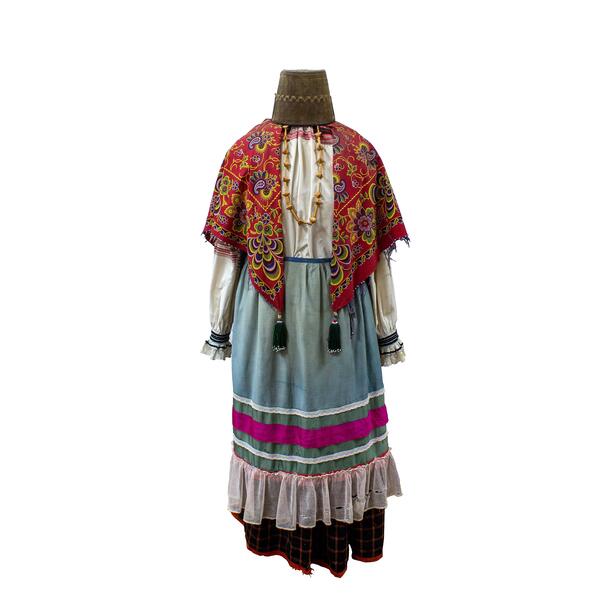
The museum houses a traditional costume of a Voronezh peasant woman of the early 19th century. Although each settlement of the Voronezh Governorate added elements of their own, the design, colors, and ornaments of the traditional costume remained the same throughout the entire region.
In the 19th century, women wore wool embroidered shirts. The sleeves and the upper part of the garment were decorated with ornaments and sometimes had gold stitchwork or paillettes. As a rule, the shirts of married women had more decorations. This homespun garment was called “stanushka” and was an integral part of a woman’s costume.
‘Ponyova’ — a woolen skirt consisting of several fabric pieces with a richly decorated hem — was worn over the shirt. In order to make a ponyova, three or more equal cloth pieces were sewn together, wrapping the hips. A special fold had a string inside, to adjust the size of the skirt. Ponyova was usually made of black fabric with thin horizontal and vertical lines of red, or sometimes blue color. The black squares symbolized black soil fields, while the lines imitated ravines, roads, paths, land borders, and rivers. Each settlement chose its own size for the squares, which was believed to indicate whether locals had small or large lands. The costume also included an apron known as ‘zapon’ and a ‘pokromka’ belt.
During festivities, women wore colorful headdresses called ‘kichka’ (or ‘soroka’) and ‘kokoshnik’. Village folk liked to dress up, that is why each woman had a wide range of kerchiefs and shawls for every occasion. Married women always had to hide their hair as taking off one’s headdress was considered a great shame. That rule did not apply to single women, who wore wreathes — bands made of light material and decorated with buttons and embroidery.
Another popular headdress among women was a “shlychka”. It was a small round cap with a wide band. The band was attached to a gathered kerchief that was tightened at the back with special ribbons. Usually, the headdress was red. It was sewn with lace, paillettes, beads, or soft worsted weight yarn. The shlychka covered the hair made into a bun or a braid. Locks of black duck feathers were attached on the sides under the headdress. Sometimes white feathers with curled tips were painted black and used instead.
In the 19th century, women wore wool embroidered shirts. The sleeves and the upper part of the garment were decorated with ornaments and sometimes had gold stitchwork or paillettes. As a rule, the shirts of married women had more decorations. This homespun garment was called “stanushka” and was an integral part of a woman’s costume.
‘Ponyova’ — a woolen skirt consisting of several fabric pieces with a richly decorated hem — was worn over the shirt. In order to make a ponyova, three or more equal cloth pieces were sewn together, wrapping the hips. A special fold had a string inside, to adjust the size of the skirt. Ponyova was usually made of black fabric with thin horizontal and vertical lines of red, or sometimes blue color. The black squares symbolized black soil fields, while the lines imitated ravines, roads, paths, land borders, and rivers. Each settlement chose its own size for the squares, which was believed to indicate whether locals had small or large lands. The costume also included an apron known as ‘zapon’ and a ‘pokromka’ belt.
During festivities, women wore colorful headdresses called ‘kichka’ (or ‘soroka’) and ‘kokoshnik’. Village folk liked to dress up, that is why each woman had a wide range of kerchiefs and shawls for every occasion. Married women always had to hide their hair as taking off one’s headdress was considered a great shame. That rule did not apply to single women, who wore wreathes — bands made of light material and decorated with buttons and embroidery.
Another popular headdress among women was a “shlychka”. It was a small round cap with a wide band. The band was attached to a gathered kerchief that was tightened at the back with special ribbons. Usually, the headdress was red. It was sewn with lace, paillettes, beads, or soft worsted weight yarn. The shlychka covered the hair made into a bun or a braid. Locks of black duck feathers were attached on the sides under the headdress. Sometimes white feathers with curled tips were painted black and used instead.