Font
Color
Graphics
Изображение точки

To see AR mode in action:

1. Install ARTEFACT app for iOS or Android;

2. Find the exhibition «A Hundred Years of a Hard-Working Town»

3. Push the «Augmented reality» button and point your phone's camera at the exhibit;

Скрыть точки интересаПоказать точки интереса
Показать в высоком качестве

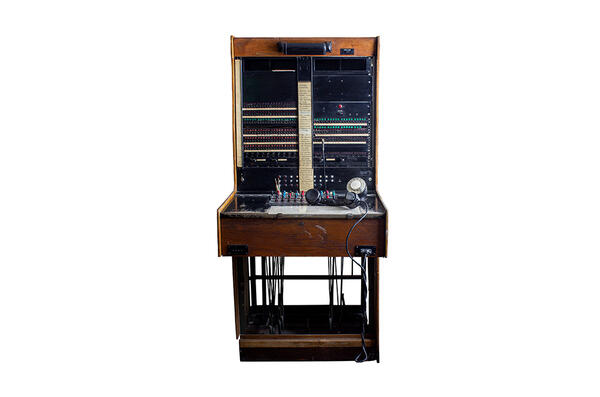
Switchboard

Creation period
1960
Dimensions
150x70x100 cm
Technique
factory production
0
Open in app
#6
Switchboard
#4
The museum’s collection includes a manual telephone switchboard. It was donated to the museum by Alexander Smirnov, head of the town’s signals office. In the 1970s — 1980s, the device was used to connect callers from Kotovsk with subscribers from other cities and regions. The switchboard is still in working condition.
 
On March 7, 1876, an American and Canadian scientist Alexander Graham Bell was awarded a patent for a device that transmitted speech signals via cables. Three days later, the device was successfully tested.

Alexander Bell addressed his assistant by saying:
#8
Mr. Watson, come here, I want to see you.
#7
That moment marked the start of the telephone era. The new device was modified by numerous inventors in various countries. In 1878, the first manual telephone switchboard was launched with 21 subscribers. It was located in the town of New Haven, Connecticut.

Telephone communication developed rapidly, and its quality improved all the time. More and more people were getting used to the new means of fast communication and wanted to have telephones at home. Instead of a dial, the first telephones had an induction crank. The user had to rotate the crank to call an operator who established the connection with the necessary subscriber. Many switchboard operators were young women with a nice voice and long arms, as they had to reach far-away switchboard jacks and plugs.

A telephone switchboard consisted of subscribers’ line equipment, cord pairs, and equipment used by the operator. Usually, one switchboard had 100–140 line sets and 15–20 cords. It meant that the switchboard could be connected to 140 telephones and allowed up to 20 calls at the same time.

The operator’s equipment comprised devices that were used by the operators to talk with subscribers, including headphones, carbon microphones, and a source of current for sending ringing signals over a line. When a call was received, a special lamp would light up on the switchboard. To respond to the connection request, the operator would switch the key into the ‘O’ position. After answering the call, the operator inserted the plug into the associated jack and switched the key into the ‘B’ position, sending the signal into the corresponding line.
#5
View in the State Catalogue
read morehide
00:00
00:00
1x

Switchboard

Creation period
1960
Dimensions
150x70x100 cm
Technique
factory production
0
Point your smartphone camera to open in the app
Share
VkontakteOdnoklassnikiTelegram
Share on my website
Copy linkCopied
Copy
Open in app
To see AR mode in action:
  1. Install ARTEFACT app for 
  2. iOS or Android;
  3. Find and download the «Paintings in Details» exhibition
  4. Push the «Augmented reality» button and point your phone's camera at the painting;
  5. Watch what happens on your phone screen whilst you flip through the pictures.
 
We use Cookies
Cookies on the Artefact Website. We use cookies to ensure that we give you the best experience on our website. If you continue without changing your settings, we'll assume that you are happy to receive all cookies on the Artefact website. However, if you would like to, you can change your cookie settings at any time.
Learn more about useHide
Content is available only in Russian

X

Нашли опечатку?...

%title%%type%