The woolly rhinoceros is a type of extinct mammal that evolved about 200 thousand years ago in Central Asia and spread throughout northern Eurasia. They died out about 10 thousand years ago, like other large mammals of the mammoth fauna, due to climate change and, possibly - human help.
The average lifespan of rhinos was 40–45 years. They led a solitary lifestyle and made a pair for procreation once every few years. Babies were born weighing 40-60 kg and in the first 5 years of life they practically gained the dimensions of adults. Woolly rhinos grew up to 2.2 m in height and 3 tons in weight.
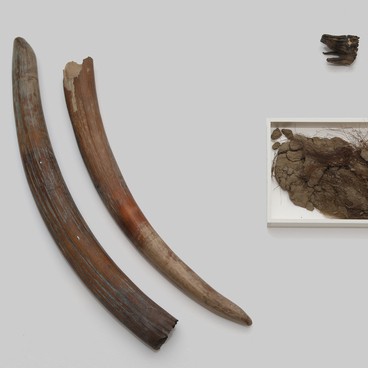
Ancient rhinos adapted well to the harsh cold weather. The protruding parts of the body - the ears and tail - were shorter than those of rhinos from hot latitudes: this reduced heat loss. The skin in some places reached a thickness of 1.5 cm, and on top it was covered with an undercoat and thick long dark wool. From the horn-type substance, identical to that of the hair and hooves, two horns grew on the skull. They were borne by both males and females. The front horn is long, it could reach 1.4 m, the second - half as much. The horns helped rhinos to protect themselves from predators, to get food from under the snow in winter and also helped males in tournament battles. The attachment point of the horns to the skull can be recognized by two small rough surfaces on the nasal bones.
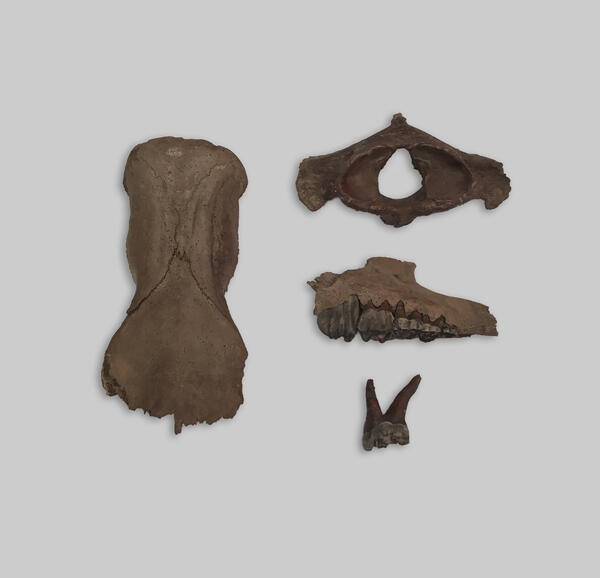
The diet of the ancient giants consisted of grasses, lichens, branches of trees, including conifers - the powerful teeth of the woolly giant grind them with ease. The peculiarity of the rhinoceros jaw is the complete absence of canines and incisors. Large chewing teeth grew hollow inside, their ribbed surface was covered with a thick layer of enamel.
About 15 thousand years ago, the climate began to warm: humidity increased, and open tundra-steppe landscapes with herbaceous vegetation, where large herbivores lived, turned to swamp and overgrew with taiga. In winter, more snow fell, and it became more difficult to get food during this period. The number of some species, including the woolly rhinoceros, began to decline sharply.
By that time, ancient people had discovered new technologies and invented weapons that could pierce the skin of even giant animals. For primitive hunters, rhinoceroses were a valuable trophy because they provided meat, hides and bones. According to some scientists, it was people who put an end to the existence of woolly rhinos.
The average lifespan of rhinos was 40–45 years. They led a solitary lifestyle and made a pair for procreation once every few years. Babies were born weighing 40-60 kg and in the first 5 years of life they practically gained the dimensions of adults. Woolly rhinos grew up to 2.2 m in height and 3 tons in weight.
Ancient rhinos adapted well to the harsh cold weather. The protruding parts of the body - the ears and tail - were shorter than those of rhinos from hot latitudes: this reduced heat loss. The skin in some places reached a thickness of 1.5 cm, and on top it was covered with an undercoat and thick long dark wool. From the horn-type substance, identical to that of the hair and hooves, two horns grew on the skull. They were borne by both males and females. The front horn is long, it could reach 1.4 m, the second - half as much. The horns helped rhinos to protect themselves from predators, to get food from under the snow in winter and also helped males in tournament battles. The attachment point of the horns to the skull can be recognized by two small rough surfaces on the nasal bones.
The diet of the ancient giants consisted of grasses, lichens, branches of trees, including conifers - the powerful teeth of the woolly giant grind them with ease. The peculiarity of the rhinoceros jaw is the complete absence of canines and incisors. Large chewing teeth grew hollow inside, their ribbed surface was covered with a thick layer of enamel.
About 15 thousand years ago, the climate began to warm: humidity increased, and open tundra-steppe landscapes with herbaceous vegetation, where large herbivores lived, turned to swamp and overgrew with taiga. In winter, more snow fell, and it became more difficult to get food during this period. The number of some species, including the woolly rhinoceros, began to decline sharply.
By that time, ancient people had discovered new technologies and invented weapons that could pierce the skin of even giant animals. For primitive hunters, rhinoceroses were a valuable trophy because they provided meat, hides and bones. According to some scientists, it was people who put an end to the existence of woolly rhinos.