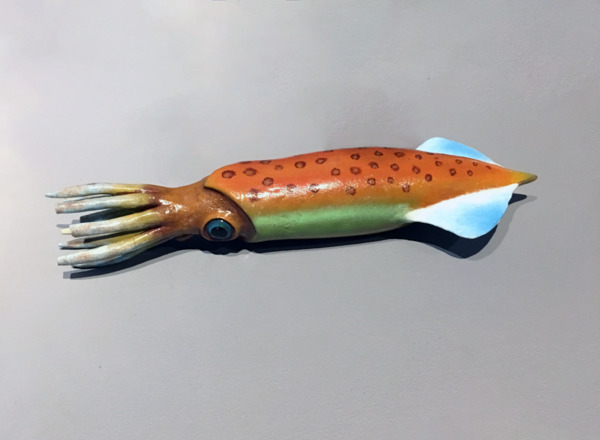
Belemnites are extinct cephalopods. They were contemporaries of the dinosaurs and flourished in the Cretaceous period. In the foothills of the Northern and Subpolar Urals, their shells are found in large numbers: An ancient warm sea washed on this territory 150 million years ago. Belemnites are relatives of modern octopuses, cuttlefish, but they are especially similar to squids. Just like squid, belemnites lived in schools and hunted fish and molluscs. 8-10 tentacles with small chitinous hooks helped them to grasp prey. Some adult males developed additional hooks up to 8 cm long.
In a calm state, belemnites moved with the oscillation of their mantle and diamond-shaped fins: they could develop a speed of up to 0.5 m / s. During the hunt, the mollusks switched to jet thrust: it was provided by a siphon, which released a powerful jet of water. In case of danger, belemnites injected pigment from an ink sac into the water and hid in this cloud of paint. Like modern squids, females laid eggs - up to 1000 per batch. Babies hatched less than 2 mm long and could reach 3 m as they grew. But on average, belemnites rarely exceeded 45 cm.
Like modern squids, belemnites had a shell inside the soft body, but it was more rigid and consisted of three parts. The first was in the form of a wide plate and provided strength to the body, the second consisted of hollow chambers and was responsible for buoyancy, and the third resembled a blunt spear blade and was required as a counterweight to heavy tentacles and a head.
The third section of the shell is called the rostrum or beak. The similarity of the beak with weapons gave the mollusks their name: ‘belemnon’ in translation from Greek means ‘dart’ or ‘arrow’. Some belemnite beaks retained their colour. From them it was possible to find out that the mollusks often had bright colors and an intricate pattern of stripes and dots.
The structure of the beaks allowed scientists to identify several hundred species of belemnites. About 200 of them belonged to the Cylindroteutidae family. Cephalopods of this family preferred arctic waters. Beaks of these mollusks are presented in the collection of the ‘Museum of Nature and Man’.
In a calm state, belemnites moved with the oscillation of their mantle and diamond-shaped fins: they could develop a speed of up to 0.5 m / s. During the hunt, the mollusks switched to jet thrust: it was provided by a siphon, which released a powerful jet of water. In case of danger, belemnites injected pigment from an ink sac into the water and hid in this cloud of paint. Like modern squids, females laid eggs - up to 1000 per batch. Babies hatched less than 2 mm long and could reach 3 m as they grew. But on average, belemnites rarely exceeded 45 cm.
Like modern squids, belemnites had a shell inside the soft body, but it was more rigid and consisted of three parts. The first was in the form of a wide plate and provided strength to the body, the second consisted of hollow chambers and was responsible for buoyancy, and the third resembled a blunt spear blade and was required as a counterweight to heavy tentacles and a head.
The third section of the shell is called the rostrum or beak. The similarity of the beak with weapons gave the mollusks their name: ‘belemnon’ in translation from Greek means ‘dart’ or ‘arrow’. Some belemnite beaks retained their colour. From them it was possible to find out that the mollusks often had bright colors and an intricate pattern of stripes and dots.
The structure of the beaks allowed scientists to identify several hundred species of belemnites. About 200 of them belonged to the Cylindroteutidae family. Cephalopods of this family preferred arctic waters. Beaks of these mollusks are presented in the collection of the ‘Museum of Nature and Man’.