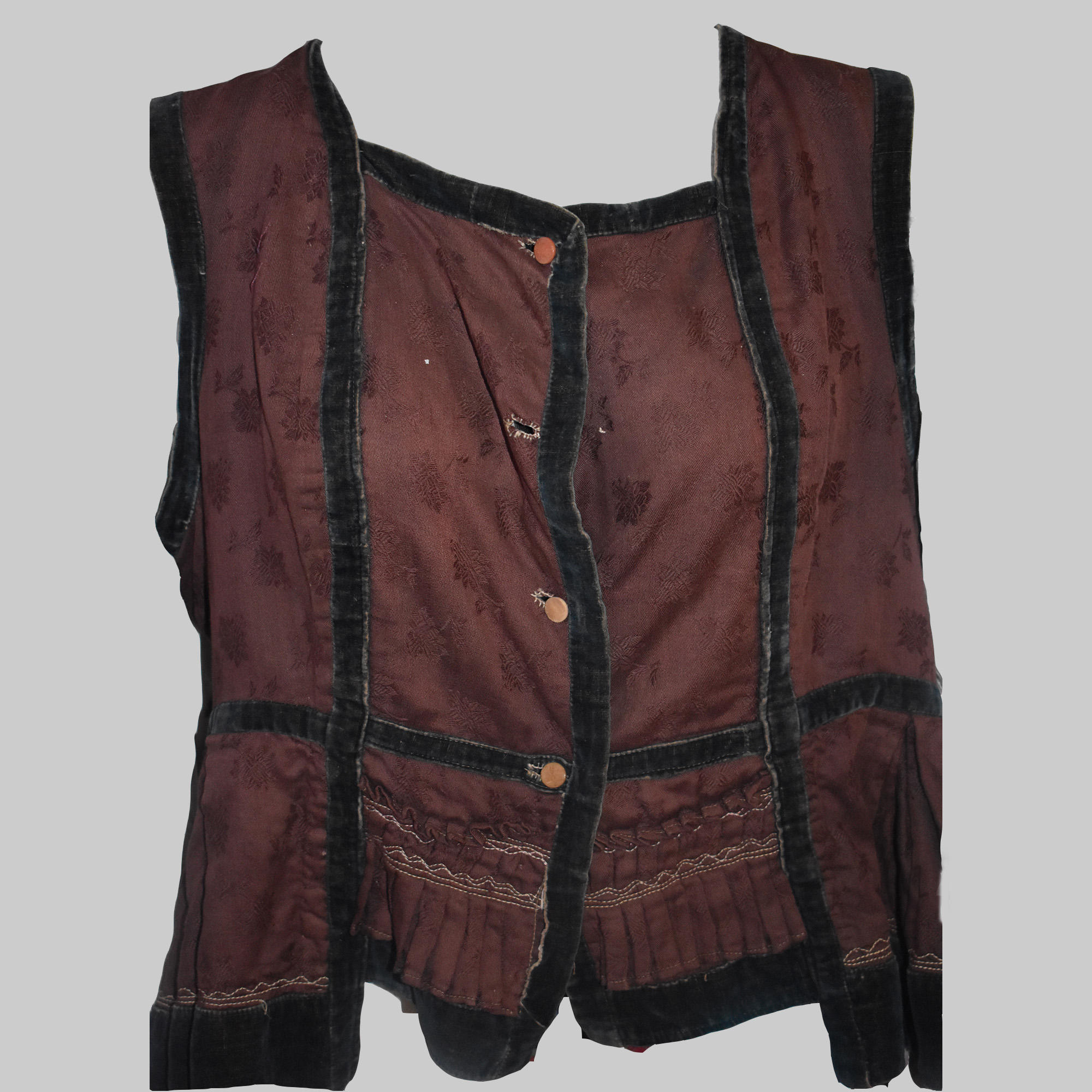


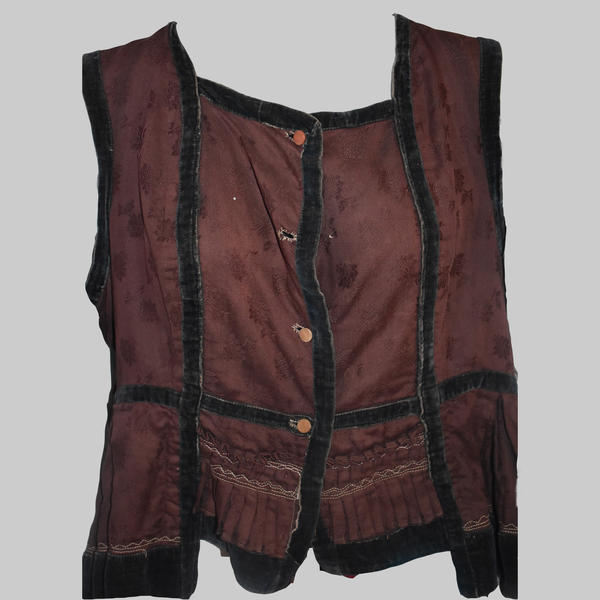
The basis of the folk corset “Boguchar Khokhlushka” is a dark brown corset with lining. Its lower part is decorated with black plisse secured with buttons at the front. In summer, a chintz shirt was put on under the vest. The sleeves were decorated with multi-tiered red and black cross-stitching; the bottom of the sleeve was decorated with an embroidered cuff. In the photo, you can see a migrant from Ukraine in a festive dress with a corset.
Among the main features of traditional Russian dress of the Voronezh Province was the variety of options, fabrics, colours and shapes, depending on the specifics of the area, age and social status of its owner, and many other factors.
Thus, floral ornaments prevail in the embroidery of the costume shown in the photo. Plant motifs are characteristic precisely for the outfits of the Ukrainian population; they appeared in Russia in the second half of the 19th century under the influence of Ukrainian immigrants, as well as in connection with the spread of patterns for embroidery. In traditional Russian embroidery, geometric rhombuses, circles and squares are more often used as symbols of the sun, a cross is a symbol of man and a double cross is a symbol of a family.
The embroidery is performed with a red thread for a reason. The colour red has always been associated by Russian people with celebration; it is the colour of fertility, sun, fire and power.
Among the main features of traditional Russian dress of the Voronezh Province was the variety of options, fabrics, colours and shapes, depending on the specifics of the area, age and social status of its owner, and many other factors.
Thus, floral ornaments prevail in the embroidery of the costume shown in the photo. Plant motifs are characteristic precisely for the outfits of the Ukrainian population; they appeared in Russia in the second half of the 19th century under the influence of Ukrainian immigrants, as well as in connection with the spread of patterns for embroidery. In traditional Russian embroidery, geometric rhombuses, circles and squares are more often used as symbols of the sun, a cross is a symbol of man and a double cross is a symbol of a family.
The embroidery is performed with a red thread for a reason. The colour red has always been associated by Russian people with celebration; it is the colour of fertility, sun, fire and power.
Layering is a characteristic feature of the female dress of the Voronezh Province. A large number of skirts and several layers of shirts not only kept their owners warm during cold Russian winters but also gave the female figure volume, status, helped create the image of a mother and head of the family.
Moreover, the festive dress included about 20 elements, while the everyday one had only 7. The clothes of a married woman were more “decent”, more modest than those of young girls; the latter were even allowed not to cover their heads completely, using just small headpieces with hard brocade headbands.
Peasants sewed most of their everyday clothes from homespun canvas and wool, combining purchased and hand-made material. The choice of materials was limited, which is why creating a unique, beautiful costume was considered a real skill. Girls were taught embroidery from early childhood, especially how to make a straight line and easily transfer patterns to the canvas.
Today, women’s dress from the past can tell a lot about the characteristics of the people of that era.