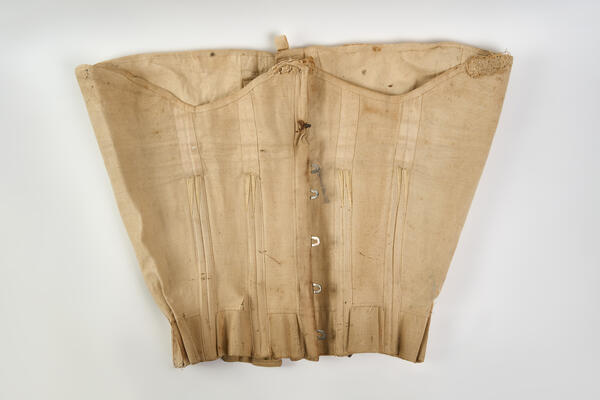
A corset is a piece of undergarment designed as a wide belt that tightens the abdomen and chest and thus shapes the body.
There is an assumption that the ancestors of corsets appeared long before our era. For example, they were known to representatives of the Crete-Mycenaean culture, who lived in the III millennium BC. This, in particular, is evidenced by the images of people on frescoes of that period.
The ancient Greeks wore a corset-like girdle as part of their outer garments rather than their undergarments. In the early Middle Ages, Europeans — both men and women — used tightening belts.
In the 13th century, a waist band appeared — a wide belt, which was an attribute of women’s dress only. This piece of clothing raised the bust and emphasized the waist.
The modern corset, designed to demonstrate the conical shape of the female figure, is believed to have appeared in the 16th century.
After another two centuries, these garments became almost cylindrical, more lightweight and comfortable, allowing women to move freely. The corsets of this period made it easier for the court ladies to keep their back straight, which was important when they had to stand for many hours at official receptions.
In the 19th century, the ideal of female beauty was the hourglass figure, which revived the fashion for rigid and geometric shapes: it implied a clear contrast between the volume of the hips, bust and waistline. Such a result could only be achieved with the help of a tight corset with sewn-in elastic plates made of steel strips or whalebone. At that time, the corset acquired the status of underwear.
While styles of outerwear evolved, hourglass silhouettes remained popular throughout the century. Corsets and narrow waists did not go out of fashion until the 20th century.
The corset from the museum and cultural center
“House of the Merchant Grigory Tetyushinov” belonged to the merchant’s
grandniece Cleopatra Petrovna Lugakovskaya. In 2011 the corset was donated to
the museum by her granddaughter Irina Mikhailovna Oberemko.