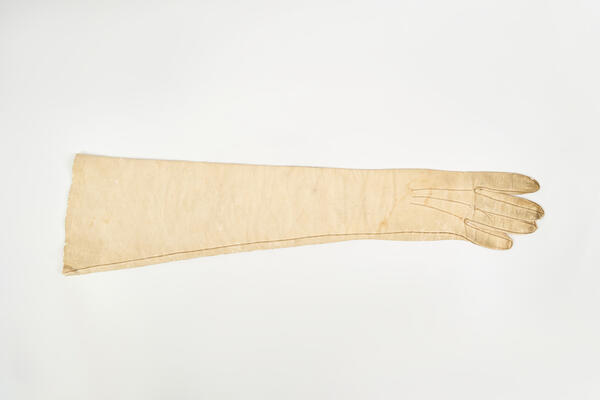
The most ancient gloves that have been discovered by the archaeologists date back to the 14th century BC. They were found during the study of the tomb of Pharaoh Tutankhamen. Gloves were used not only in ancient Egypt, but also in Assyria, in ancient Greece and Rome, and later in Europe.
Gloves became common due to practical reasons: people have always wanted to keep their hands warm, clean and safe from possible damage.
Gloves were worn as a fashion accessory in the 13th century. In the 16th century, there was a strong popularity of long gloves, reaching up to the elbow and above, and it lasted until the beginning of the 20th century. They were made of leather, fabric and knitted wool. In the Middle Ages, a new material for women’s gloves — kidskin — came into use.
Kidskin is soft, thin leather that is made from the skins of young goats or lambs. In Russia, kidskin appeared in the first half of the 18th century, but its production was established on an industrial scale only by the mid-19th century.
Soft, pliable, yet durable, leather has been used for musical instruments and arts and crafts, but its qualities have made it the most popular material for gloves.
With the advent of thin kid gloves, a new rule of etiquette was introduced whereby ladies were required to wear gloves outside the house and only remove them when they returned home. If a woman showed up in a public place gloveless, it was a demonstration of bad taste.
There were also special rules for using gloves at the table. In order not to remove the accessory completely during a meal, there were special holes on the wrists of long gloves that could be unbuttoned. In this way, the woman could pull the hand free. Since the glove itself remained on, etiquette was not breached.
The kidskin glove from the museum exhibition
belonged to Cleopatra Petrovna Lugakovskaya, the grandniece of merchant Grigory
Vasilyevich Tetyushinov. In 2011 the gloves were donated to the museum by her
granddaughter Irina Mikhailovna Oberemko.