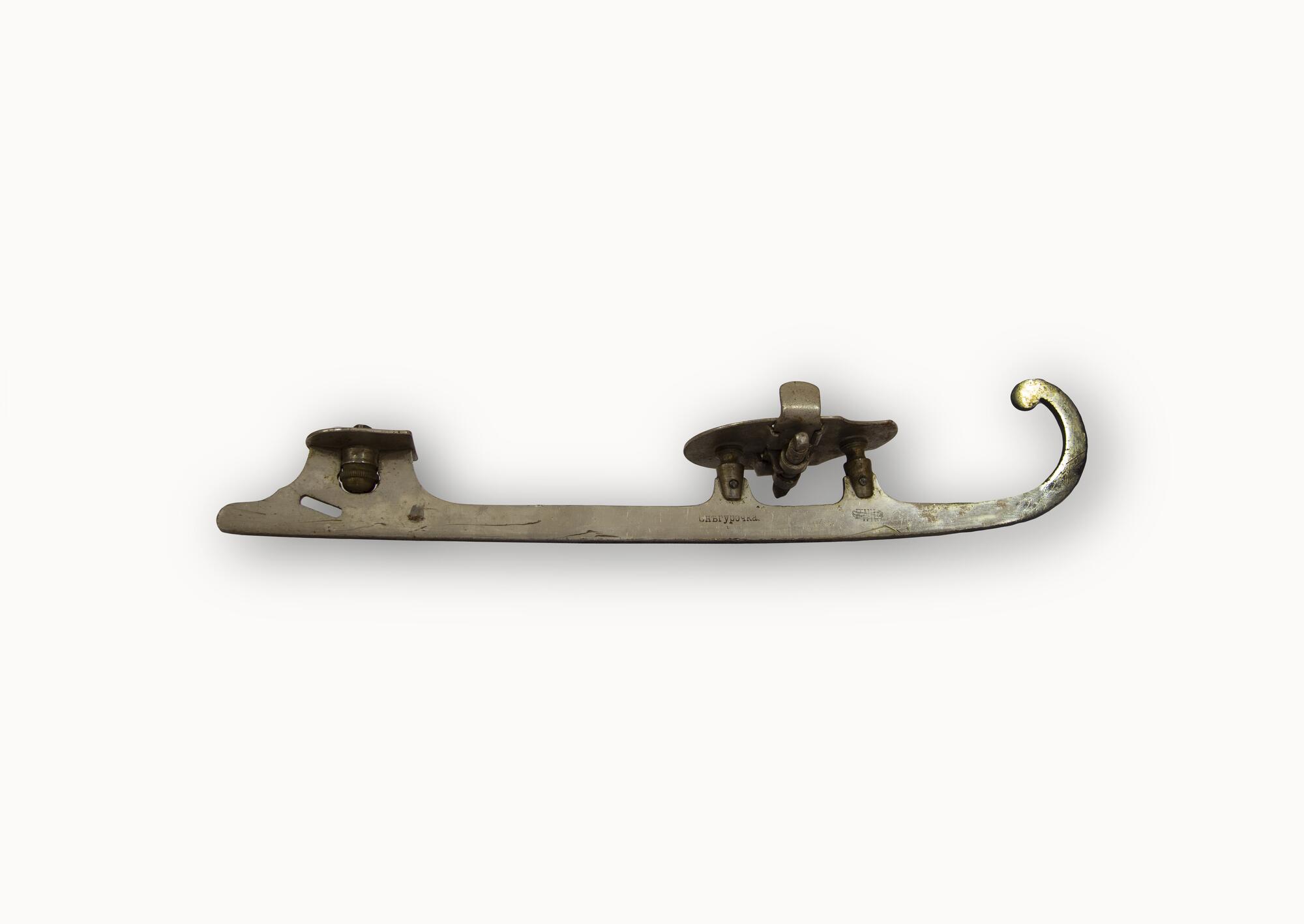


Several types of skates were produced for mass skating in the Russian Empire. Removable skates “Snegurochka” were great for beginners. They came in two types: single- and double-runner ice skates. Single-runner skates had a relatively thick (4 mm) and strongly curved runner that was 37 mm high. The runner was transversely sharpened. The relatively thick and low runner provided high stability, which was of great importance for beginners.
In terms of attaching the skates, they were removable. They were attached to the shoes with the help of a heel holder (a rod with an oval head) on the heel and two plates on the sole, moved by a special wrench. The skates came with two diamond-shaped heel plates, eight countersunk screws (for attaching the plate to the heel of the shoe) and a wrench. The sole, heel, sole and heel plates were made of sheet steel 1.8 mm thick (2.5 mm for sole plates). The sole and heel were connected to the runner by electric welding or by riveting.
These skates have a single runner, steeply bent upwards in the toe area. The blade is attached to two plates designed to attach the skate to the sole and heel of the boot. The sole plate has protruding stops at the ends, the heel plate is provided with protrusions, which, when fastened, enter the heel grooves. The runner features an inscription “Snegurochka”.
In 1850, all-metal skates appeared. Their short blades resembled sledge runners and were also rounded upwards. The Russian skater Alexander Panshin (1863–1904) invented similar skates without a curved curl, with a tube to which an elongated blade was soldered. This design allowed to develop high speed on ice. In 1899, Alexander Nikitich wore such skates when he became the first Russian world champion in speed skating in the multisport competition.
The design of modern speed skates was proposed in 1892 by the Norwegian Hagen, who inserted a steel skid into the steel tube of the skates. In Russia, skates of this design were nicknamed “begashi” from the Russian word “begat” meaning “to run”.
In terms of attaching the skates, they were removable. They were attached to the shoes with the help of a heel holder (a rod with an oval head) on the heel and two plates on the sole, moved by a special wrench. The skates came with two diamond-shaped heel plates, eight countersunk screws (for attaching the plate to the heel of the shoe) and a wrench. The sole, heel, sole and heel plates were made of sheet steel 1.8 mm thick (2.5 mm for sole plates). The sole and heel were connected to the runner by electric welding or by riveting.
These skates have a single runner, steeply bent upwards in the toe area. The blade is attached to two plates designed to attach the skate to the sole and heel of the boot. The sole plate has protruding stops at the ends, the heel plate is provided with protrusions, which, when fastened, enter the heel grooves. The runner features an inscription “Snegurochka”.
In 1850, all-metal skates appeared. Their short blades resembled sledge runners and were also rounded upwards. The Russian skater Alexander Panshin (1863–1904) invented similar skates without a curved curl, with a tube to which an elongated blade was soldered. This design allowed to develop high speed on ice. In 1899, Alexander Nikitich wore such skates when he became the first Russian world champion in speed skating in the multisport competition.
The design of modern speed skates was proposed in 1892 by the Norwegian Hagen, who inserted a steel skid into the steel tube of the skates. In Russia, skates of this design were nicknamed “begashi” from the Russian word “begat” meaning “to run”.