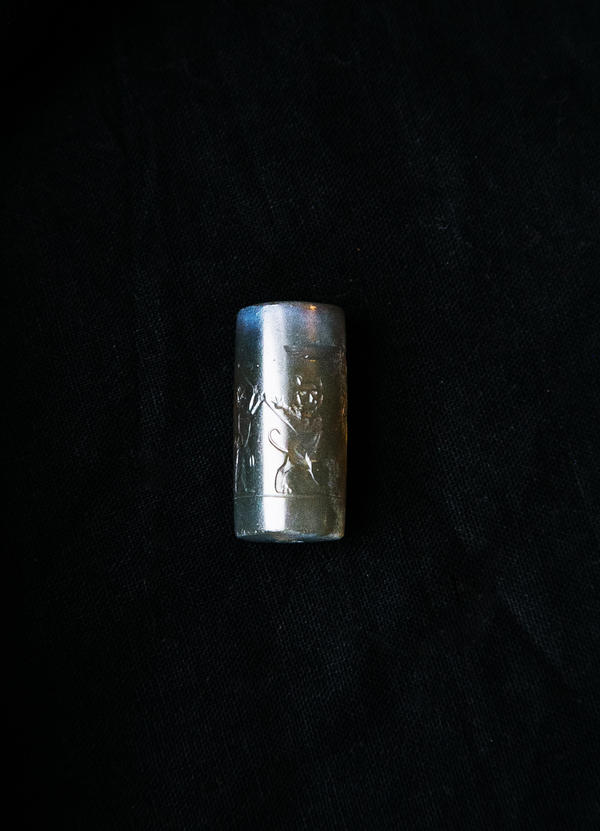
The сylindrical stamp was found in the BEra burial mound near the KOsika village in the YenotAyevsky District. This burial was opened and destroyed in 1984, when a water culvert trench was laid there.
The stamp is a cylinder drilled along its centre line and made of a translucent bluish gray chalcedony. A scene where a king is fighting with lions is carved on the side surface. There is a bearded man under the ‘winged disc’. He is wearing a Persian dress, and a toothed tiara on his head. His arms are outstretched to strangle two lions speared at their backs by two warriors. Scenes of the confrontation between the king and lions are often found on the stamps of the Achaemenid time — VI–IV centuries BC. Researchers believe that under the Achaemenids, only officials of the king administration used cylindrical stamps, while private individuals had ring-shaped seals, stamps, and signet rings.
The Achaemenids are an ancient Asian state that existed in 550–330 BC. The Persian dynasty of Achaemenids originated from Achaemen, the leader of the union of the Persian tribes. A descendant of Achaemenus, Cyrus II the Great, who ruled in 558–530 BC in Pars and Anshan (Northern Elam), founded a huge Persian empire. The empire consolidated most of the countries of the Near and Middle East. The population of the Achaemenid Empire ranged from 25 to, presumably, 50 million people, which at that time corresponded to a half of the world’s population. In 330 BC, under the blows by the Alexander the Great’s army, the Achaemenid state ceased to exist.
The American archaeologist Erich Schmidt has identified the prints of seven stamps with royal names; each time the royal name appears next to the scene of a hero’s triumph over predators or monsters. Such “royal” stamps were owned if not by the kings themselves, then to their close relatives and high-ranking officials. At the same time, as the researchers notice, the item from the Astrakhan Museum Reserve collection has an interesting feature: usually rulers are fighting one-on-one against formidable predators, but here warriors helped the main character.
In 2005, the cylinder-shaped stamp from the Astrakhan Museum Reserve collection was exhibited at the Astrakhan Steppe Treasures show at the National Museum of the Palazzo Venezia in Rome.
The stamp is a cylinder drilled along its centre line and made of a translucent bluish gray chalcedony. A scene where a king is fighting with lions is carved on the side surface. There is a bearded man under the ‘winged disc’. He is wearing a Persian dress, and a toothed tiara on his head. His arms are outstretched to strangle two lions speared at their backs by two warriors. Scenes of the confrontation between the king and lions are often found on the stamps of the Achaemenid time — VI–IV centuries BC. Researchers believe that under the Achaemenids, only officials of the king administration used cylindrical stamps, while private individuals had ring-shaped seals, stamps, and signet rings.
The Achaemenids are an ancient Asian state that existed in 550–330 BC. The Persian dynasty of Achaemenids originated from Achaemen, the leader of the union of the Persian tribes. A descendant of Achaemenus, Cyrus II the Great, who ruled in 558–530 BC in Pars and Anshan (Northern Elam), founded a huge Persian empire. The empire consolidated most of the countries of the Near and Middle East. The population of the Achaemenid Empire ranged from 25 to, presumably, 50 million people, which at that time corresponded to a half of the world’s population. In 330 BC, under the blows by the Alexander the Great’s army, the Achaemenid state ceased to exist.
The American archaeologist Erich Schmidt has identified the prints of seven stamps with royal names; each time the royal name appears next to the scene of a hero’s triumph over predators or monsters. Such “royal” stamps were owned if not by the kings themselves, then to their close relatives and high-ranking officials. At the same time, as the researchers notice, the item from the Astrakhan Museum Reserve collection has an interesting feature: usually rulers are fighting one-on-one against formidable predators, but here warriors helped the main character.
In 2005, the cylinder-shaped stamp from the Astrakhan Museum Reserve collection was exhibited at the Astrakhan Steppe Treasures show at the National Museum of the Palazzo Venezia in Rome.