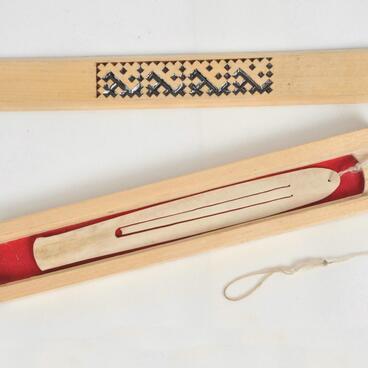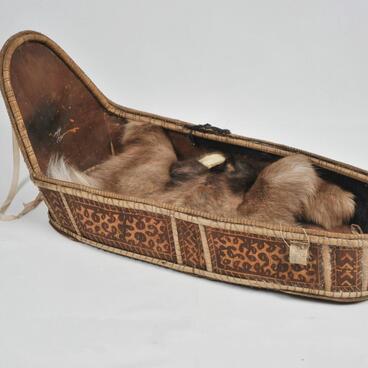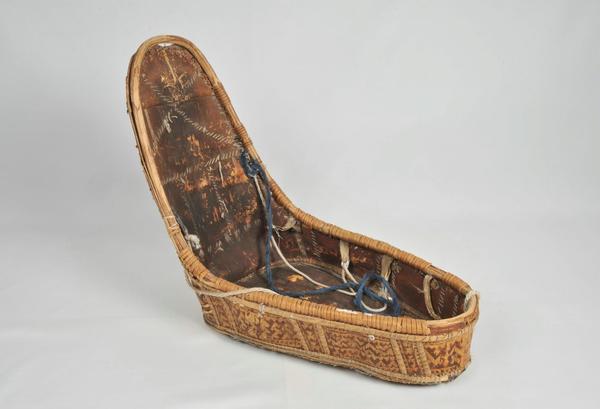
At the museum’s exhibition, you can see an afternoon baby’s cradle, which is called ‘Khatlan ontup’ in the language of the Khanty people. It was made in the village of Vanzevat in the Tyumen region in 1959.
The cradle frame is made of bird cherry tree, and the headboard, bottom, and sides are made of birch bark and sewn with deer tendon threads. The headboard of the cradle is vertical, with a slight slope. There are leather loops at the headboard of the cradle and along its sides — the ropes are put through these loops to hang the cradle. Through the same loops, the lacing is fixed, which keeps the child in the cradle.
The cradle is decorated with a scraped ornament. The ornaments ‘hare ears’ and ‘wood grouse hen’ are carved on the headboard. The hare symbolizes fertility. The wood grouse hen, according to legend, guards the child’s sleep and makes sure that his soul rests in a dream.
A soft skin is usually attached to the headboard, under the child’s head. The Khanty put crushed shavings of young pine, which are called ‘votlup’ in the Khanty language, on the birch bark mat inside the cradle. Pine resin is considered a good antiseptic. It absorbs moisture and does not allow intertrigo to appear on the baby’s skin.
The peoples of the Far North have always had a special attitude to cradles. Legend has it that the soul enters the body of a newborn only after he is given a name. Before that, the child has no defense against the spirits of the lower world, and the cradle protects him from them. If the baby has grown up safely, the Khanty take care of the cradle and hand it down to new generations. The cradle, in which a baby died, is taken away to the forest. It is necessary to bring the cradle into the house and take it outside only with its headboard facing the direction in which the person walks. Also, you should not hand it over above the doorstep.
A baby can sleep in a cradle up to three years. The baby sleeps, sits and plays in it. If a nomadic family moves to a new place, the child is transported in his cradle. The mother puts the cradle on her knees to feed the newborn. When she needs to leave, she hangs the cradle using the belt loops either to the stick of the chum (traditional cone dwelling) or to a hook in the ceiling of the hut. The mother often sits next to the cradle, busy with her needlework, and rocks the cradle with her foot with a special loop.
The cradle frame is made of bird cherry tree, and the headboard, bottom, and sides are made of birch bark and sewn with deer tendon threads. The headboard of the cradle is vertical, with a slight slope. There are leather loops at the headboard of the cradle and along its sides — the ropes are put through these loops to hang the cradle. Through the same loops, the lacing is fixed, which keeps the child in the cradle.
The cradle is decorated with a scraped ornament. The ornaments ‘hare ears’ and ‘wood grouse hen’ are carved on the headboard. The hare symbolizes fertility. The wood grouse hen, according to legend, guards the child’s sleep and makes sure that his soul rests in a dream.
A soft skin is usually attached to the headboard, under the child’s head. The Khanty put crushed shavings of young pine, which are called ‘votlup’ in the Khanty language, on the birch bark mat inside the cradle. Pine resin is considered a good antiseptic. It absorbs moisture and does not allow intertrigo to appear on the baby’s skin.
The peoples of the Far North have always had a special attitude to cradles. Legend has it that the soul enters the body of a newborn only after he is given a name. Before that, the child has no defense against the spirits of the lower world, and the cradle protects him from them. If the baby has grown up safely, the Khanty take care of the cradle and hand it down to new generations. The cradle, in which a baby died, is taken away to the forest. It is necessary to bring the cradle into the house and take it outside only with its headboard facing the direction in which the person walks. Also, you should not hand it over above the doorstep.
A baby can sleep in a cradle up to three years. The baby sleeps, sits and plays in it. If a nomadic family moves to a new place, the child is transported in his cradle. The mother puts the cradle on her knees to feed the newborn. When she needs to leave, she hangs the cradle using the belt loops either to the stick of the chum (traditional cone dwelling) or to a hook in the ceiling of the hut. The mother often sits next to the cradle, busy with her needlework, and rocks the cradle with her foot with a special loop.