

The Khanty and Mansi are one of the most musical northern peoples. Children listen to music from early childhood: immediately after the birth of the child, the mother or grandmother composes a song or dance specifically for him or her.
The music of the small northern peoples mainly consists of ritual chants and instrumental tunes. The Khanty consider the ability to play instruments a unique gift that the higher powers send only to the chosen ones.
Each instrument is associated with a specific ritual or totem. The Khanty legends say that through music a person can communicate with the family ancestors and patron spirits.
The Khanty believe that after death, people turn into sacred spirits. They can take the form of different animals, for example, an ermine, a wolverine, a sable, a beaver or a bear. After some time, the deceased person can be born again as a human being.
Various instruments are popular among the northern peoples. The Khanty often play the seven-stringed harp tor-juh (‘a crane’) and lute, tumran (Jew’s harp), rattles and other percussion instruments. Traditional musical instruments are handmade and natural materials are used — well-dried wood, bones, tendons and hair. People play musical instruments both in everyday life and at religious ceremonies, during which any instrument performs the function of a shaman tambourine.
The tumran is played during the performance of simple songs and women’s ritual dances. It makes soft sounds, similar to animal voices or the thud of hooves. The Khanty believe that such a sound drives away evil spirits and is even able to heal an ill person.
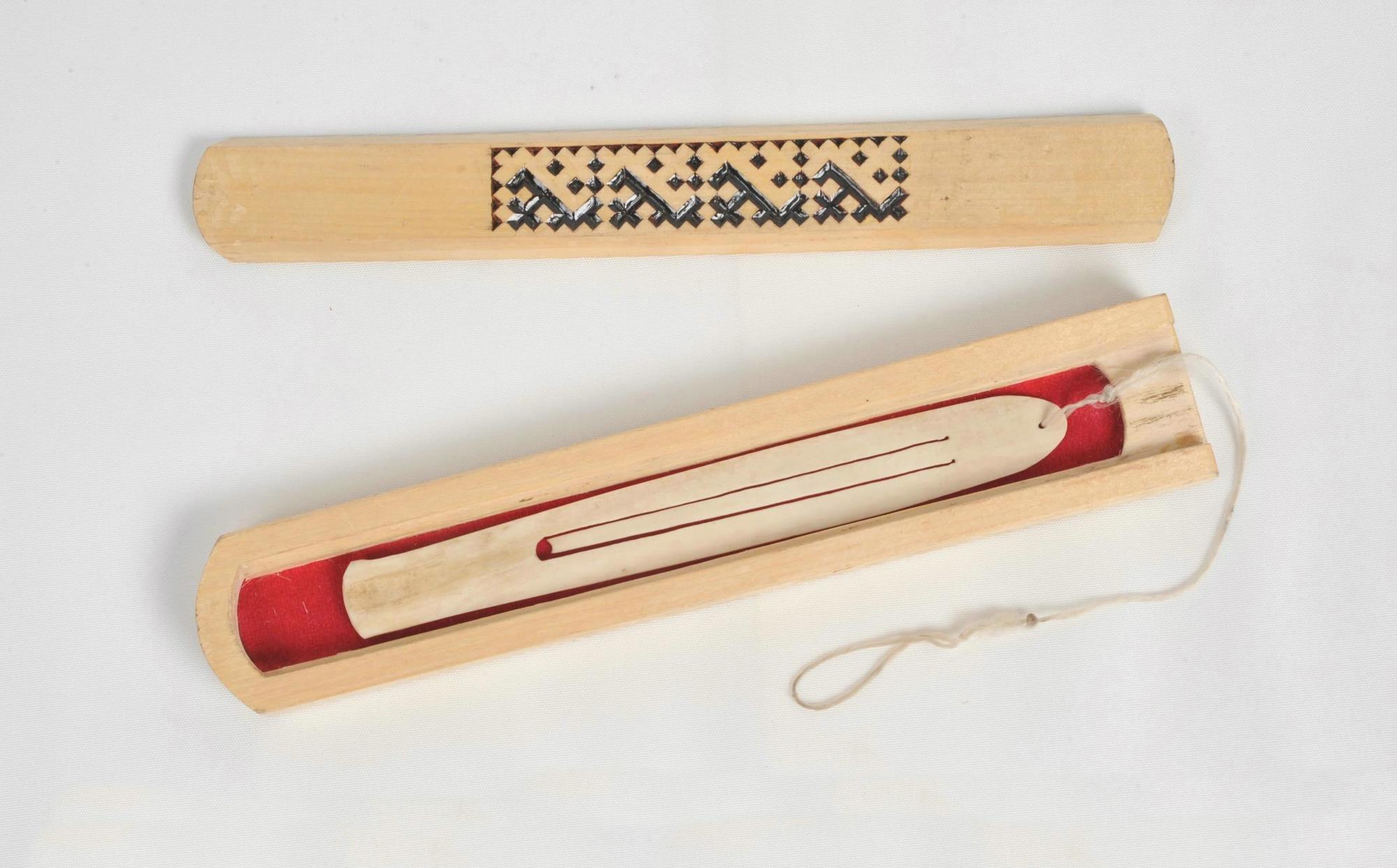
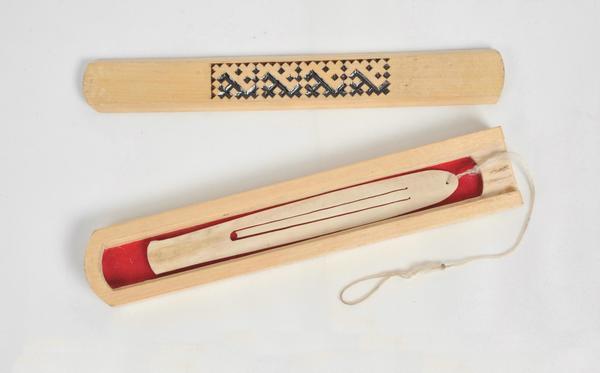
The exhibition presents a tumran made of deer bone in a carved box, made in 2007 by the People’s Master of Russia Yakov Tarlin in the village of Kazym in the Beloyarsky district of Ugra (Khanty-Mansi Autonomous Okrug). The lid of the box slides in and out. The traditional Khanty geometric pattern is carved on it and highlighted with paint.
The music of the small northern peoples mainly consists of ritual chants and instrumental tunes. The Khanty consider the ability to play instruments a unique gift that the higher powers send only to the chosen ones.
Each instrument is associated with a specific ritual or totem. The Khanty legends say that through music a person can communicate with the family ancestors and patron spirits.
The Khanty believe that after death, people turn into sacred spirits. They can take the form of different animals, for example, an ermine, a wolverine, a sable, a beaver or a bear. After some time, the deceased person can be born again as a human being.
Various instruments are popular among the northern peoples. The Khanty often play the seven-stringed harp tor-juh (‘a crane’) and lute, tumran (Jew’s harp), rattles and other percussion instruments. Traditional musical instruments are handmade and natural materials are used — well-dried wood, bones, tendons and hair. People play musical instruments both in everyday life and at religious ceremonies, during which any instrument performs the function of a shaman tambourine.
Experts consider the tumran to be the most ancient folk reed instrument. It is a flat bone plate, tapering at the end. In the middle of the instrument, the reed is cut out, and a string of deer or elk tendons is tied to the base. This thread makes the sounds of a tumran. The instrument is made of a deer leg.
The tumran is played during the performance of simple songs and women’s ritual dances. It makes soft sounds, similar to animal voices or the thud of hooves. The Khanty believe that such a sound drives away evil spirits and is even able to heal an ill person.
The exhibition presents a tumran made of deer bone in a carved box, made in 2007 by the People’s Master of Russia Yakov Tarlin in the village of Kazym in the Beloyarsky district of Ugra (Khanty-Mansi Autonomous Okrug). The lid of the box slides in and out. The traditional Khanty geometric pattern is carved on it and highlighted with paint.