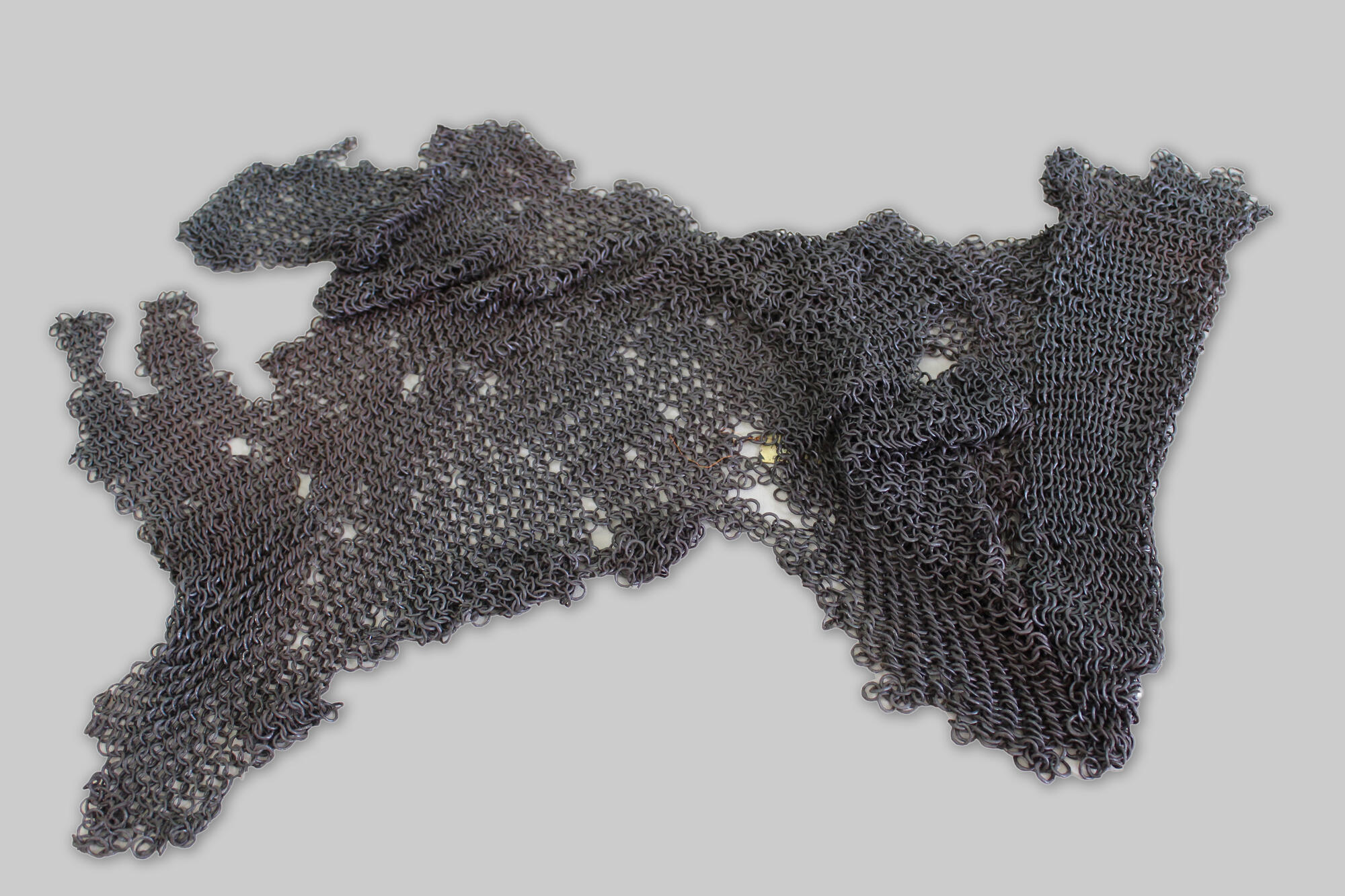


Chain mail — an ancient military armor in the form of a shirt made of metal rings. The so-called ‘iron shirt’ was made by a chain mail specialist. Depending on the size of the armor, with a wire thickness of 1-2 mm and a ring diameter of 10 mm, one such ‘shirt’ took 15-30 thousand rings. Accordingly, the weight of the product ranged from 5 to 15 kg.
Chain mail became widespread both in Europe and Asia due to the simple manufacturing technology. To assemble a chain mail, it required several kilograms of iron, a device for drawing wire, and patience for the monotonous work of making rings and weaving them into the chain mail itself. On average, it took several hundred men -hours to work. Once made, such armor could serve almost forever — if it was damaged, it was enough to patch the chain mail with a handful of new rings.
In Russia, chain mail became widespread in the days of Kiev Rus and was used until the end of the XVII century. The Persian encyclopedist Ibn Rusta, writing in the first third of the X century, notes that the ‘Slavic king’ had ‘beautiful, strong and precious chain mail’. In the miniatures of the Radziwill Chronicle, depicting warriors and battle scenes, according to the Soviet archeologist-Slavist and historian Artemy Artsikhovsky, chain mail, the folds of which are marked by shades of paint, noticeably prevails.
The Russian archaeologist Anatoly Kirpichnikov noted in his writings that in the second half of the XII century, Old Russian chain mail began to be made entirely from riveted rings (earlier they alternated with welded ones), and around 1200 flat rings appeared. By the 70s of the XV century, a new type of finely woven chain mail appeared in Russia, which was called pansyr, and in the XVI century, chain mails consisting entirely of flat rings — baydani — spread.
The fragment presented at the exhibition was found in the Ostyak grave during the construction of Ob — Yenisey canal in 1882-1893. It was presented to the Museum by Baron Bjork Alexis Aminov, a Russian hydraulic engineer, head of the Tomsk railway district and head of the canal construction.
Chain mail became widespread both in Europe and Asia due to the simple manufacturing technology. To assemble a chain mail, it required several kilograms of iron, a device for drawing wire, and patience for the monotonous work of making rings and weaving them into the chain mail itself. On average, it took several hundred men -hours to work. Once made, such armor could serve almost forever — if it was damaged, it was enough to patch the chain mail with a handful of new rings.
In Russia, chain mail became widespread in the days of Kiev Rus and was used until the end of the XVII century. The Persian encyclopedist Ibn Rusta, writing in the first third of the X century, notes that the ‘Slavic king’ had ‘beautiful, strong and precious chain mail’. In the miniatures of the Radziwill Chronicle, depicting warriors and battle scenes, according to the Soviet archeologist-Slavist and historian Artemy Artsikhovsky, chain mail, the folds of which are marked by shades of paint, noticeably prevails.
The Russian archaeologist Anatoly Kirpichnikov noted in his writings that in the second half of the XII century, Old Russian chain mail began to be made entirely from riveted rings (earlier they alternated with welded ones), and around 1200 flat rings appeared. By the 70s of the XV century, a new type of finely woven chain mail appeared in Russia, which was called pansyr, and in the XVI century, chain mails consisting entirely of flat rings — baydani — spread.
The fragment presented at the exhibition was found in the Ostyak grave during the construction of Ob — Yenisey canal in 1882-1893. It was presented to the Museum by Baron Bjork Alexis Aminov, a Russian hydraulic engineer, head of the Tomsk railway district and head of the canal construction.


