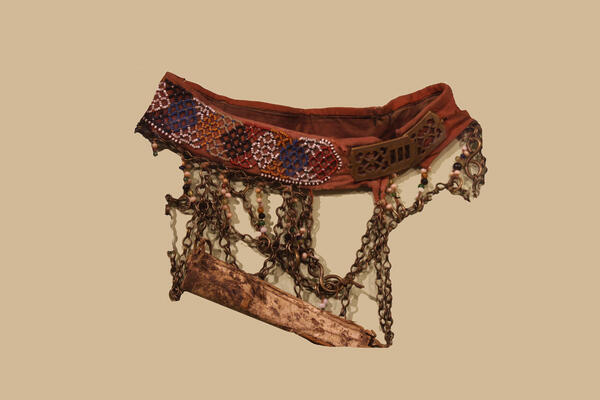
One of the exhibits at the Museum of Yenisey exhibition — a fabric belt with scabbards decorated with beads, and chains with metal buckles. This case for storing and carrying bladed weapons was presented in 1906-1908 to Pavel Voronov, pilot-guide of the ethnographic expedition of the Russian Imperial Geographical Society. He, in turn, gave it to the collection of Alexander Kytmanov, the founder of the Yeniseysk Museum of Local History.
Scabbards for daggers, sabers, swords, bayonets, bayonets, and similar edged weapons were there to avoid the undesirable effects of sharp parts that can not only cause accidental injuries to people and animals, but also damage surrounding objects during storage and transportation. In addition, scabbard protects the weapon in them from the negative effects of the environment — for example, rusting from moisture.
In the manufacture of scabbards for weapons, a variety of materials with great strength were used — hard wood, natural leather, various dense fabrics and metals. Also in their design, provided loops, rings or bundles necessary for attaching the scabbard to clothing or belt. Scabbard for knifes which does not fold, had to have special liners to protect the case from cuts from the inside. The lower part of the scabbard was inserted into a special tip — a buterol. It could be either simple or richly decorated.
In medieval Europe, scabbard, especially large specimens of bladed weapons was firmly attached to a special leather device intended for this — a sword belt. A scabbard with a weapon was usually located at the hip or shoulder of a warrior. Later, scabbards were equipped with a special fuse, which made it possible to avoid unwanted and unexpected release of the blade from the scabbard.
Very often, scabbard acted as an element of clothing, especially festive. When storing specially valuable or skillfully made weapons, the scabbard could become a real work of weapons and applied art — they were decorated with insertions of precious metals and stones.
Scabbards for daggers, sabers, swords, bayonets, bayonets, and similar edged weapons were there to avoid the undesirable effects of sharp parts that can not only cause accidental injuries to people and animals, but also damage surrounding objects during storage and transportation. In addition, scabbard protects the weapon in them from the negative effects of the environment — for example, rusting from moisture.
In the manufacture of scabbards for weapons, a variety of materials with great strength were used — hard wood, natural leather, various dense fabrics and metals. Also in their design, provided loops, rings or bundles necessary for attaching the scabbard to clothing or belt. Scabbard for knifes which does not fold, had to have special liners to protect the case from cuts from the inside. The lower part of the scabbard was inserted into a special tip — a buterol. It could be either simple or richly decorated.
In medieval Europe, scabbard, especially large specimens of bladed weapons was firmly attached to a special leather device intended for this — a sword belt. A scabbard with a weapon was usually located at the hip or shoulder of a warrior. Later, scabbards were equipped with a special fuse, which made it possible to avoid unwanted and unexpected release of the blade from the scabbard.
Very often, scabbard acted as an element of clothing, especially festive. When storing specially valuable or skillfully made weapons, the scabbard could become a real work of weapons and applied art — they were decorated with insertions of precious metals and stones.