A traditional female headdress could reveal the age and family status of the owner, the financial situation in her household, and oftentimes her belonging to this or that governorate.
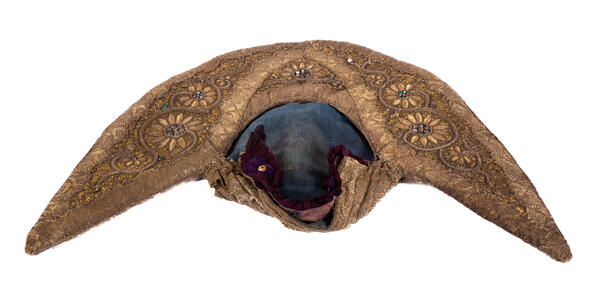
Kokoshniks, like kichkas, were worn only by married women, and the form of the headdress differed noticeably depending on the area. In the central Vladimir, Nizhny Novgorod, Yaroslavl and Kostroma governorates, the “round” (or arc-shaped) kokoshnik was used. It had different names: a “kokoshka”, “kokuy” and even “kokoshnik-nimbus”: it resembled a halo on saints’ images.
The design of this massive headdress is flat, with a base made of wood or cardboard, rounded top and bottom edges shaped as acute or right angles. The front side of the headdress was covered with silk or velvet and richly decorated with beads, bugles and embroidery. The head hollow was often trimmed with a soft net made of strings of small river pearls, mother-of-pearl, beads or bugles. The net fell down on the forehead and covered it sometimes almost to the eyebrows.
When wearing a kokoshnik, its hard part could be positioned perpendicular to the crown with the half-circle upwards, or held in a tilted position. In the latter case the sharp ends were pointed backwards and resembled horns, which gave rise to the popular names: a “tilt” and “two-horned kokoshnik”. Most pictorial images of Russian beauties of the 18th century and the first half of the 19th century show a slightly tilted arc-shaped kokoshnik, though normally the horns are not visible — they are covered by a shawl or headscarf.
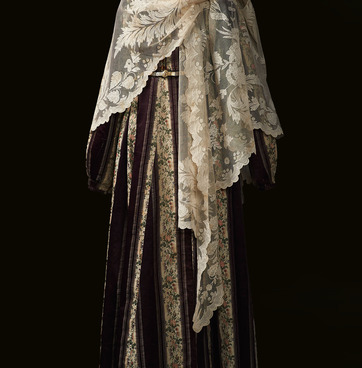
A two-horned kokoshnik was mainly worn by young women on holidays. When going out, they always wrapped a shawl embroidered with gold or silver threads over the headdress in various ways. A long rectangular veil was draped over the top crest of the kokoshnik in such a way that the rest of the cloth hung down freely, covering almost the entire figure. The sides of the headscarf could be pinned under the chin, leaving all four ends dangling freely down.
The arc-shaped kokoshnik was widespread in the villages of the central Russian governorates in the second half of the 18th century. No doubt, such ornate kokoshniks were considered a prestige item of a peasant family, a sign of its material well-being and stability. In the first half of the 19th century, they gradually began to go out of fashion, retaining their role as wedding headwear.