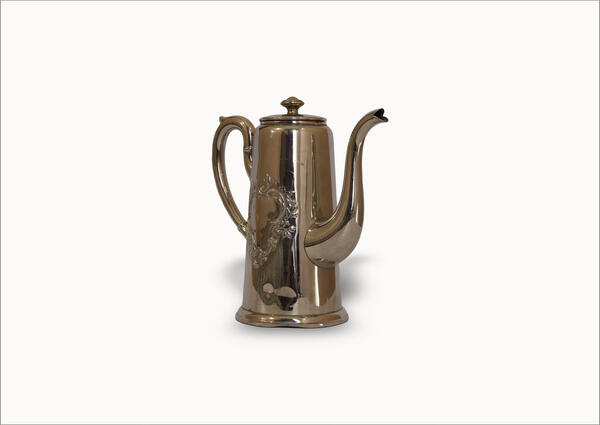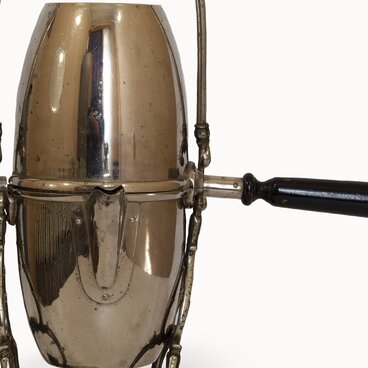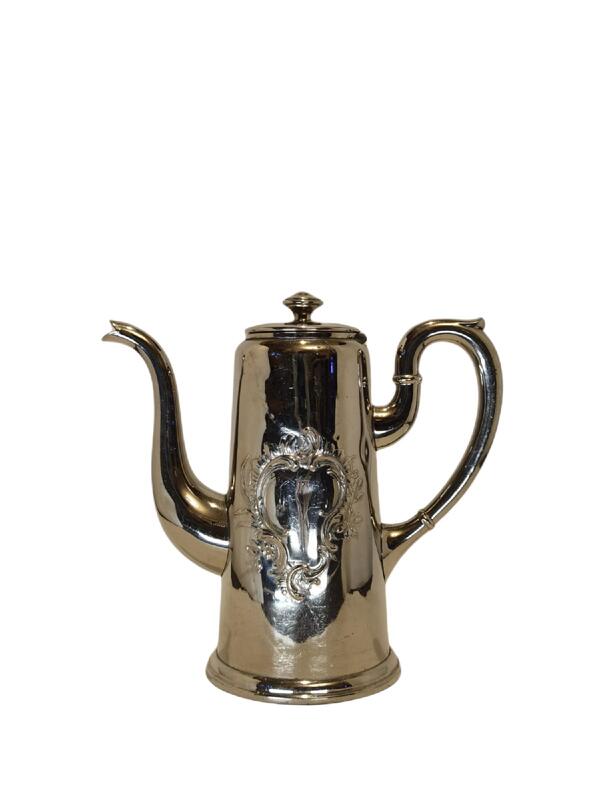
This coffee pot is made of brass in the shape of a truncated cone. It has a low stepped base and features a relief ornament — a rosette with a floral motif. There is a hinged lid with a grip in the center. The curved long spout has a V-shaped cutout at the edge, and the loop-shaped handle has decorative elements. The entire outer surface of the coffee pot is nickel-plated, and the inner surface is tinned.
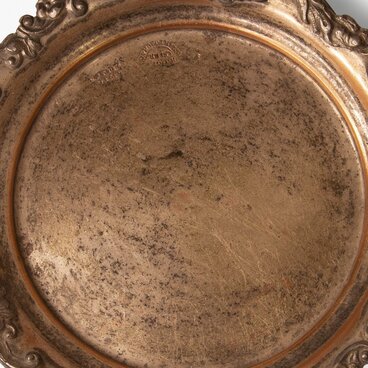
The item was purchased from Mikaella Konstantinovna Olores, born in 1909, who lived in the city of Irbit. The coffee pot was produced by the Württemberg Metalware Factory. On the bottom, there is a stamp in the form of an ostrich in a rhombus with the letters WMF G, as well as the numbers 17 and 8, which, judging by the company’s catalog, is typical for products of 1903–1914.
The Württemberg Metalware Factory was founded by Daniel Straub, an entrepreneur from the city of Geislingen (Kingdom of Württemberg). The company grew from a small iron repair shop, and in 1850 was transformed into a steel mill producing everything needed for the railroads. In 1853, Straub joined the company of the Schweiser brothers, and they began the production of silver-plated tableware. In 1862, at the World Exhibition in London, the company received the Gold medal for silver-plated trays and vessels for cooling wine. In 1866, Straub and his son Heinrich broke off relations with the Schweisers and expanded their own company. However, after the death of his son in 1876, Daniel had to merge with his rival Ritter & Co from Esslingen. The owners of the company, Alfred Ritter and Karl Högel, were the first in Germany to use electroplating in mass production, thereby increasing product quality and reducing costs. After the merger, the company became known as WMF and still exists today.
In 1883, WMF set up its own glassworks and was able to manufacture glassware. In 1886, the company took over the Warsaw company Plewkiewicz & Co, thereby gaining access to the market of the Russian Empire. In 1890, the company bought the Munich electroplating and plastic art enterprise and adopted a new style — Art Nouveau and Secession. It was in this style that the most valuable objects of arts and crafts were made.
The item was purchased from Mikaella Konstantinovna Olores, born in 1909, who lived in the city of Irbit. The coffee pot was produced by the Württemberg Metalware Factory. On the bottom, there is a stamp in the form of an ostrich in a rhombus with the letters WMF G, as well as the numbers 17 and 8, which, judging by the company’s catalog, is typical for products of 1903–1914.
The Württemberg Metalware Factory was founded by Daniel Straub, an entrepreneur from the city of Geislingen (Kingdom of Württemberg). The company grew from a small iron repair shop, and in 1850 was transformed into a steel mill producing everything needed for the railroads. In 1853, Straub joined the company of the Schweiser brothers, and they began the production of silver-plated tableware. In 1862, at the World Exhibition in London, the company received the Gold medal for silver-plated trays and vessels for cooling wine. In 1866, Straub and his son Heinrich broke off relations with the Schweisers and expanded their own company. However, after the death of his son in 1876, Daniel had to merge with his rival Ritter & Co from Esslingen. The owners of the company, Alfred Ritter and Karl Högel, were the first in Germany to use electroplating in mass production, thereby increasing product quality and reducing costs. After the merger, the company became known as WMF and still exists today.
In 1883, WMF set up its own glassworks and was able to manufacture glassware. In 1886, the company took over the Warsaw company Plewkiewicz & Co, thereby gaining access to the market of the Russian Empire. In 1890, the company bought the Munich electroplating and plastic art enterprise and adopted a new style — Art Nouveau and Secession. It was in this style that the most valuable objects of arts and crafts were made.