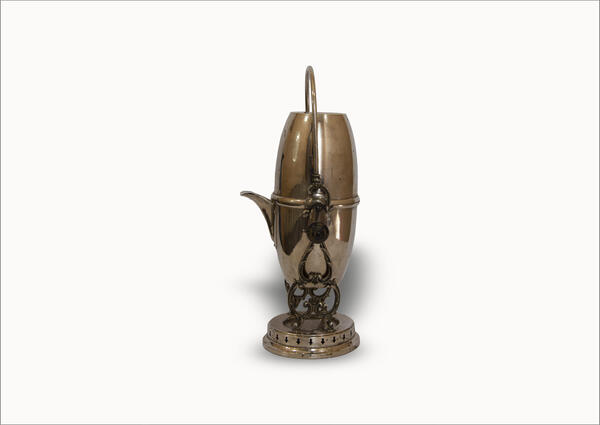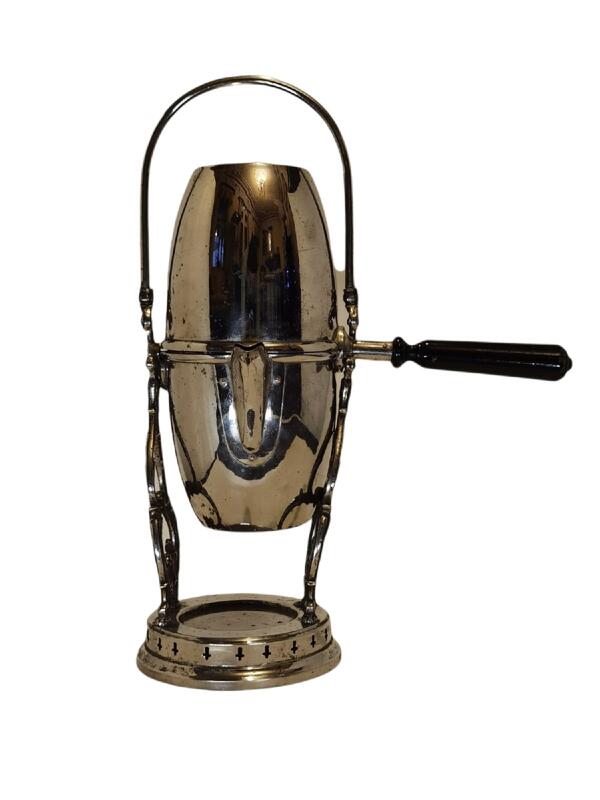
This coffee maker consists of two items: a round base with a place to install an alcohol burner and a curved cast bracket in the form of plant shoots — and an ovoid coffee pot with cut ends. The coffee pot is divided into two parts: in the lower part, there is a tap for coffee, covered with a movable hinged “petal”, in the middle part there is a horizontal handle. The end of the handle is made from wood, chiseled, and painted paint. The outer metal surface of the coffee maker is nickel-plated. The museum bought the coffee pot from T.G. Pohalko, a resident of Tyumen, as an example of antique cookware of the late 19th — early 20th centuries.
The coffee maker from the museum collection belongs to the “percolator” type. Initially, there were only two ways of making coffee: boiling in a cezve and steeping. However, scientific and technological progress has also changed this area of everyday life. In the early 19th century, Benjamin Thompson, Count Rumford, discovered percolation. In 1813, the famous scientist published his essay “Of the Excellent Qualities of Coffee”, revealing the methods of percolation and describing new ways of brewing coffee. In 1889, the American farmer Hanson Goodrich patented a modification of the percolator that had a chamber for boiling water and an upflow central tube for lifting it to the top of the coffee pot.
A coffee percolator works in the following way: boiling water and steam are pushed upward through a tube and overflow into the basket, which holds the roasted coffee grounds. There the water and steam cool down, concentrate and drain back to the lower part through the same perforated basket for the process to repeat itself. In fact, brewing coffee takes an unlimited amount of time, which ultimately leads to coffee beginning to degrade and taste bitter. This explained why the popularity of coffee percolators diminished over time.
Coffee percolators enjoyed great popularity until the middle of the 20th century but were gradually supplanted by drip and geyser coffee makers, French presses, and coffee machines (after espresso had become increasingly popular).
The coffee maker from the museum collection belongs to the “percolator” type. Initially, there were only two ways of making coffee: boiling in a cezve and steeping. However, scientific and technological progress has also changed this area of everyday life. In the early 19th century, Benjamin Thompson, Count Rumford, discovered percolation. In 1813, the famous scientist published his essay “Of the Excellent Qualities of Coffee”, revealing the methods of percolation and describing new ways of brewing coffee. In 1889, the American farmer Hanson Goodrich patented a modification of the percolator that had a chamber for boiling water and an upflow central tube for lifting it to the top of the coffee pot.
A coffee percolator works in the following way: boiling water and steam are pushed upward through a tube and overflow into the basket, which holds the roasted coffee grounds. There the water and steam cool down, concentrate and drain back to the lower part through the same perforated basket for the process to repeat itself. In fact, brewing coffee takes an unlimited amount of time, which ultimately leads to coffee beginning to degrade and taste bitter. This explained why the popularity of coffee percolators diminished over time.
Coffee percolators enjoyed great popularity until the middle of the 20th century but were gradually supplanted by drip and geyser coffee makers, French presses, and coffee machines (after espresso had become increasingly popular).