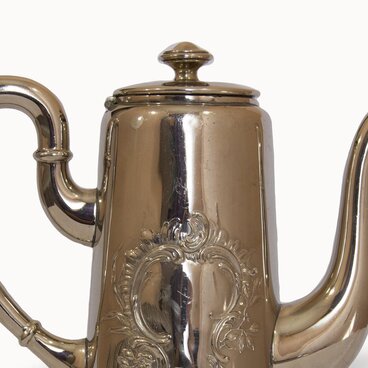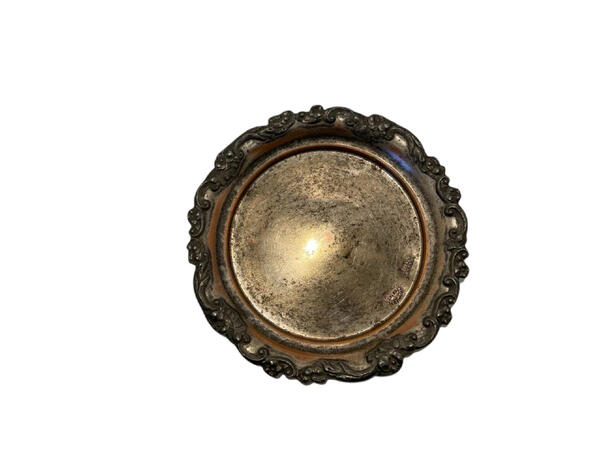
This plate has the mark of the silver plating factory that belonged to Alexander Vasilyevich Ksimantovsky. This factory existed from 1839 to 1860 in Moscow — it was located on Olkhovskaya Street, in the merchant’s own private house.
Alexander Ksimantovsky was a merchant of the 2nd guild and produced tableware, kitchen utensils, trays, candlesticks and other household items. Initially, the Ksimantovskys lived in Rzhev, but then moved to Moscow. Their silver plating factory was one of the first enterprises in Moscow that produced samovars. Unlike other samovar manufacturers, the Ksimantovskys used silver plating instead of electroplating. Elegant shapes and styles, as well as scrollwork silver onlays made the Ksimantovsky samovars and other products look like beautiful works of art. The factory products were displayed at industrial exhibitions and trade shows.
The business was inherited by a relative of Alexander Vasilyevich — Ivan Semyonovich Ksimantovsky. After 1860, there is no information about the factory, but in 1882, the Artistic Bronze and Church Utensils Factory belonging to the former photo artist F.K. Vishnevsky is found at the same address. Most likely, the Vishnevskys were relatives of the Ksimantovskys and inherited their enterprise.
In 1899, the Imperial Russian Technical Society organized an exhibition in St. Petersburg to commemorate the 50th anniversary of inventing electroplating. F.K. Vishnevsky presented a large and varied collection, which occupied one of the leading places in the exposition. He demonstrated a method for obtaining impressions from plaster molds, from molds from a mass of wax and stearin, and from gutta-percha molds. Vishnevsky also showed a collection of copper build-up on glass, porcelain and charcoal.
The Artistic Bronze and Church Utensils Factory was one of the largest in Russia. In 1889, Felix’s eldest son Evgeny joined the business. The factory produced a variety of bronze items: chandeliers, candelabra, floor lamps, sconces, balustrades, lattices, writing instruments, church utensils, candlesticks, iconostases, royal doors, crosses, altar tables and much more. The factory also cast statues and monuments, so the Vishnevskys were familiar with almost all the Moscow sculptors.
Alexander Ksimantovsky was a merchant of the 2nd guild and produced tableware, kitchen utensils, trays, candlesticks and other household items. Initially, the Ksimantovskys lived in Rzhev, but then moved to Moscow. Their silver plating factory was one of the first enterprises in Moscow that produced samovars. Unlike other samovar manufacturers, the Ksimantovskys used silver plating instead of electroplating. Elegant shapes and styles, as well as scrollwork silver onlays made the Ksimantovsky samovars and other products look like beautiful works of art. The factory products were displayed at industrial exhibitions and trade shows.
The business was inherited by a relative of Alexander Vasilyevich — Ivan Semyonovich Ksimantovsky. After 1860, there is no information about the factory, but in 1882, the Artistic Bronze and Church Utensils Factory belonging to the former photo artist F.K. Vishnevsky is found at the same address. Most likely, the Vishnevskys were relatives of the Ksimantovskys and inherited their enterprise.
In 1899, the Imperial Russian Technical Society organized an exhibition in St. Petersburg to commemorate the 50th anniversary of inventing electroplating. F.K. Vishnevsky presented a large and varied collection, which occupied one of the leading places in the exposition. He demonstrated a method for obtaining impressions from plaster molds, from molds from a mass of wax and stearin, and from gutta-percha molds. Vishnevsky also showed a collection of copper build-up on glass, porcelain and charcoal.
The Artistic Bronze and Church Utensils Factory was one of the largest in Russia. In 1889, Felix’s eldest son Evgeny joined the business. The factory produced a variety of bronze items: chandeliers, candelabra, floor lamps, sconces, balustrades, lattices, writing instruments, church utensils, candlesticks, iconostases, royal doors, crosses, altar tables and much more. The factory also cast statues and monuments, so the Vishnevskys were familiar with almost all the Moscow sculptors.