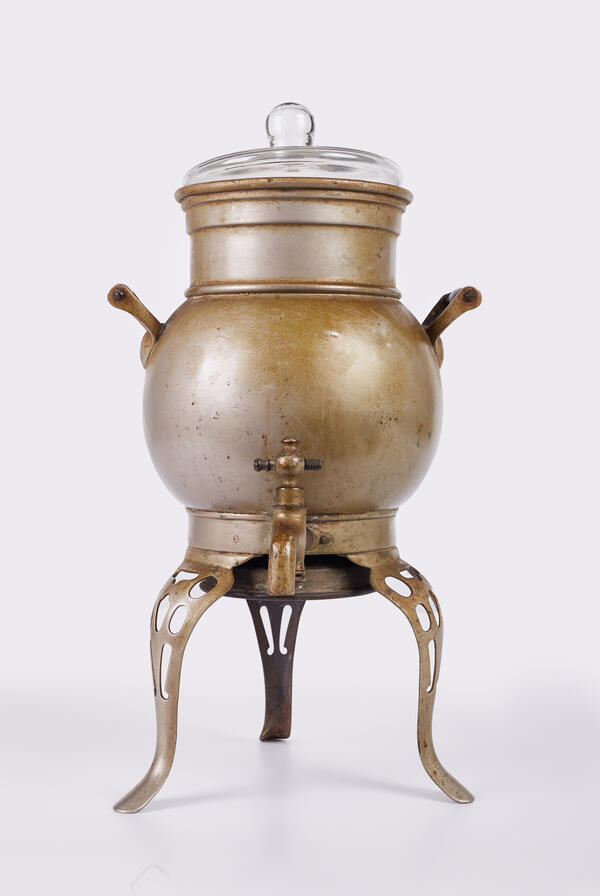
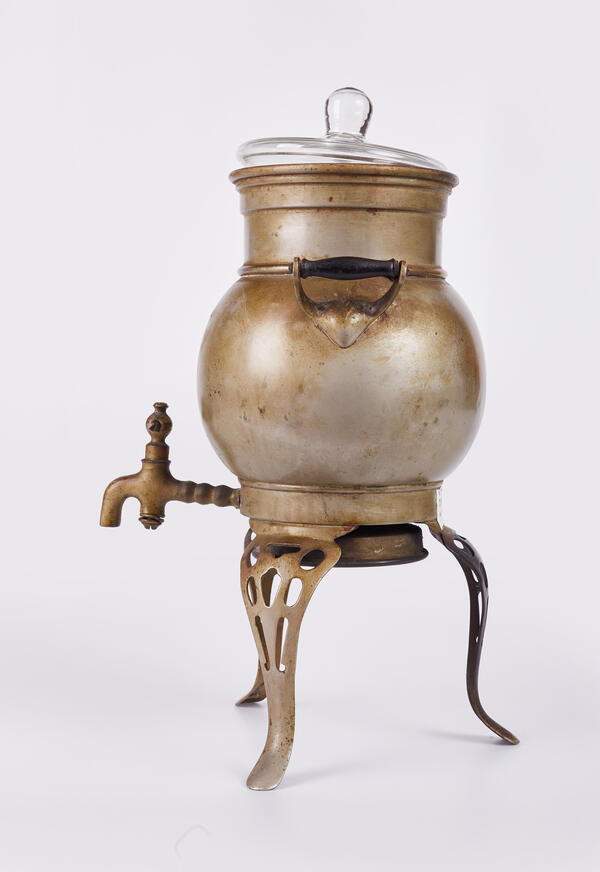
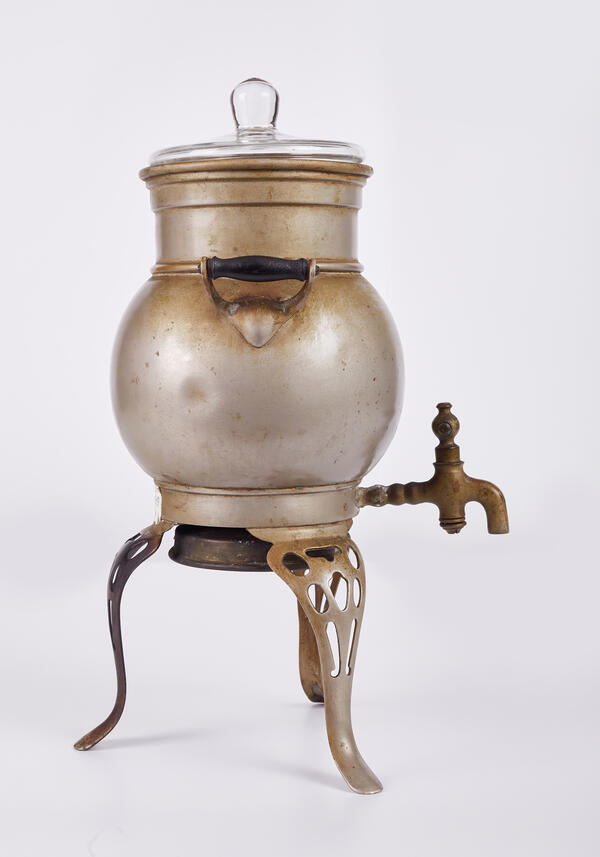
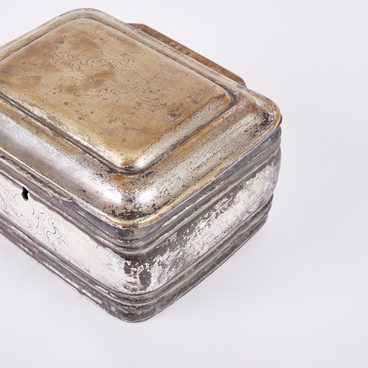
The Zheleznodorozhny Local Lore Museum presents a bouillotte samovar.
The sphere-shaped bouillotte is narrowed at the top and has a wide curved spout, ear-shaped handles and a glass lid. Under the lid is a removable cylindrical mesh container for coffee or tea leaves. At the bottom of the body are three curved legs, which are very light due to holes made in the metal. The bouillotte bears the stamp “BTZ”. The estimated production date is the early 20th century.
There are different versions as to how bouillottes came about. Some researchers believe that the name came from the English verb to boil, others — the French verb boullir, which means “to boil” (bouillotte — “teapot”, “hot-water bag”). In Russia, this samovar companion became widespread during the reign of Catherine II. The small vessel on a stand with an alcohol lamp was usually placed on a table when it was already filled with hot water. Using the flame of an alcohol lamp, the water in the bouillotte was maintained at a boil until the samovar, refilled with cold water, began to boil. Bouillottes always came in handy, given that samovars at tea parties were usually refilled more than once.
Bouillottes were mostly common in the homes of
metropolitan aristocrats, although they were also widely used by the middle
class. Along with tea, Russian people began to drink coffee, which was a
serious competitor to tea for quite some time. Coffee beans were expensive
back then, so only the rich could afford this noble drink. The coffee making
process itself was very interesting. Instead of heating and blowing into the
samovar outside and then carrying it into the house, a bouillotte coffee maker
was placed right in the living room on a small table. Hot water was poured into
it, an alcohol burner was lit, and the water began to slowly boil. The
water-steam mixture rose up through a tube and then passed through a mesh
container with ground coffee. The transparent glass lid made it possible to
observe the process and control the stages of making coffee. The drink prepared
in a bouillotte using an alcohol burner remained hot all evening, and it could
be poured through
a tap into small cups for guests. In fact, the bouillotte coffee maker was the
predecessor of the modern drip coffee maker. It can be considered even better
since it also had properties of a thermo pot.