A prayer book is a collection of prayers or prayer hymns, and texts with which people appeal to God. They were composed by the holy fathers, theologians, psalmists and ascetics. Regular repetition of them forms the basis of the spiritual life of an Orthodox Christian.
Such a book includes the texts of morning and evening prayers, prayers for preparation for Communion and Confession, prayers to Jesus Christ, the Most Holy Theotokos, the Guardian Angel, and others.
The Museum Complex of Kuybyshev displays the “Prayer Book”, released in 1914. The place of its origin is unknown, since the page with the metadata has been lost.
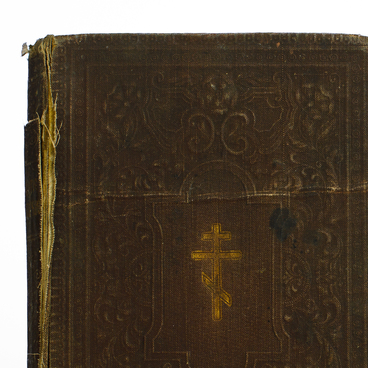
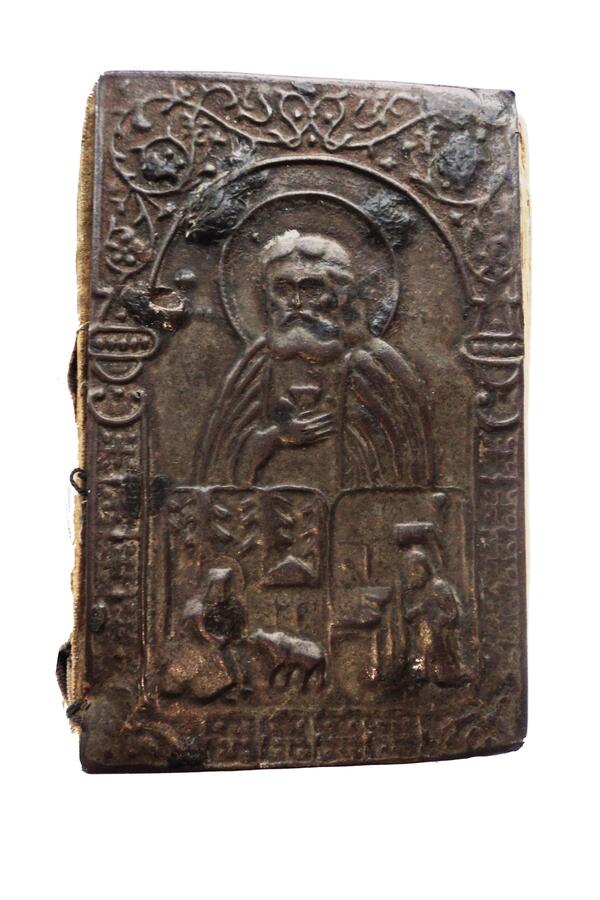
The book consists of covers, binding and paper pages. The cover pages are made of copper alloy sheets. Relief images of saints are stamped on them. The top one features a half-length image of St. Seraphim of Sarov — a great ascetic and miracle-worker. The saint’s right hand is pressed against his chest. Above his head is a halo, a symbol of holiness.
Two canonical episodes from the hagiography of St. Seraphim of Sarov are depicted below the image. On the left is the episode “Feeding the Bear”. His hagiography says that animals and birds often came to his monastic cell. A popular legend appeared according to which there was a bear among the animals that visited the saint. Therefore, Seraphim of Sarov is often depicted in icons as an old man hand feeding the predator.
The repose (death) of Seraphim of Sarov is depicted on the right.
The hagiography mentions that candles were always burning in his cell, he prayed often and a lot. Saint Seraphim said: “As long as I am alive, there will be no fire, and when I die, my end will be revealed by fire.” When Seraphim died kneeling at the icon of the Mother of God, a fire started in his cell from the burning candles. This episode is also often featured in iconographic depictions of Seraphim of Sarov.
A knee-length image of St. Theodosius of Uglich, Archbishop of Chernihiv, a zealot of Orthodoxy in Little Russia, is stamped on the bottom cover. The saint is dressed in accordance with his rank. The saint’s head is surrounded by a halo. In his left hand he holds a bishop’s staff, and his right hand is raised in a blessing gesture.
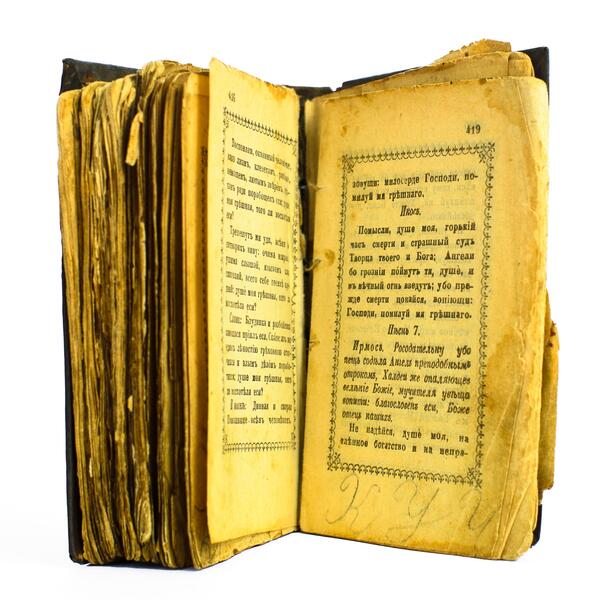
The text of the book is typographically printed in black ink on white paper. The book has 575 pages, each with an ornamental black frame.
Such a book includes the texts of morning and evening prayers, prayers for preparation for Communion and Confession, prayers to Jesus Christ, the Most Holy Theotokos, the Guardian Angel, and others.
The Museum Complex of Kuybyshev displays the “Prayer Book”, released in 1914. The place of its origin is unknown, since the page with the metadata has been lost.
The book consists of covers, binding and paper pages. The cover pages are made of copper alloy sheets. Relief images of saints are stamped on them. The top one features a half-length image of St. Seraphim of Sarov — a great ascetic and miracle-worker. The saint’s right hand is pressed against his chest. Above his head is a halo, a symbol of holiness.
Two canonical episodes from the hagiography of St. Seraphim of Sarov are depicted below the image. On the left is the episode “Feeding the Bear”. His hagiography says that animals and birds often came to his monastic cell. A popular legend appeared according to which there was a bear among the animals that visited the saint. Therefore, Seraphim of Sarov is often depicted in icons as an old man hand feeding the predator.
The repose (death) of Seraphim of Sarov is depicted on the right.
The hagiography mentions that candles were always burning in his cell, he prayed often and a lot. Saint Seraphim said: “As long as I am alive, there will be no fire, and when I die, my end will be revealed by fire.” When Seraphim died kneeling at the icon of the Mother of God, a fire started in his cell from the burning candles. This episode is also often featured in iconographic depictions of Seraphim of Sarov.
A knee-length image of St. Theodosius of Uglich, Archbishop of Chernihiv, a zealot of Orthodoxy in Little Russia, is stamped on the bottom cover. The saint is dressed in accordance with his rank. The saint’s head is surrounded by a halo. In his left hand he holds a bishop’s staff, and his right hand is raised in a blessing gesture.
The text of the book is typographically printed in black ink on white paper. The book has 575 pages, each with an ornamental black frame.