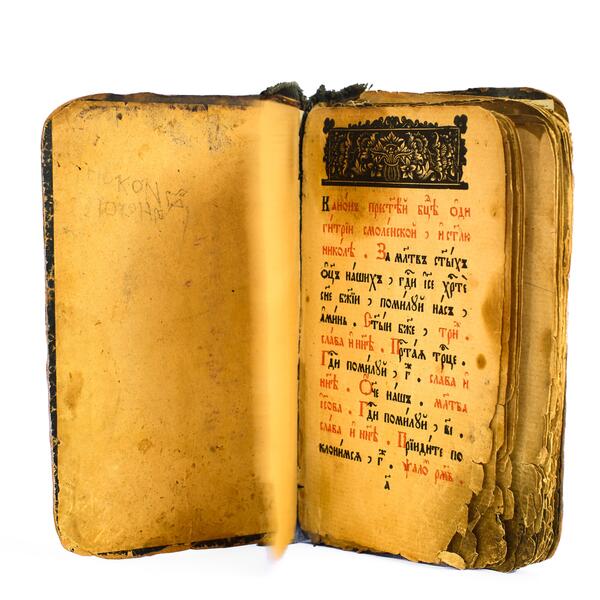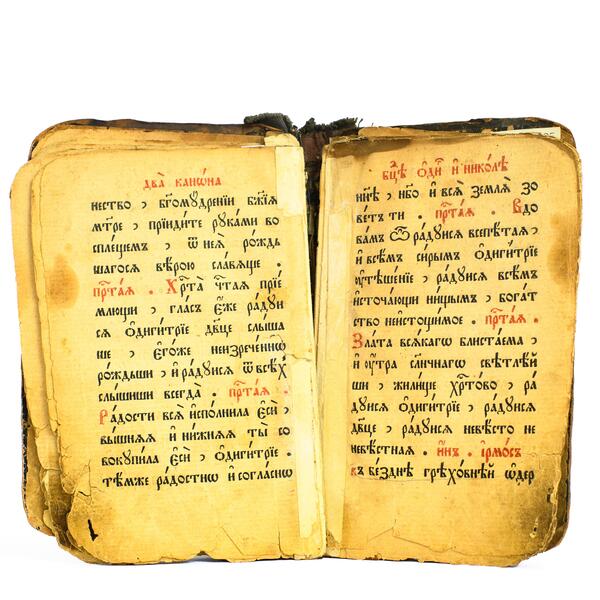
The book “Two Canons: to the Smolensk Icon of the Most Holy Mother of God Hodegetria and Saint Nicholas” from the collection of the Museum Complex of Kuybyshev was released in 1911. This canon, a prayer hymn, is dedicated to the glorification of the Mother of God Hodegetria, or Our Lady of the Way, and St. Nicholas the Wonderworker, the splendid servant of the Lord.
As a genre, the canon appeared in the mid-7th century. The first canonical texts for addressing God and saints were written by Saints Andrew of Crete and John of Damascus. Authors of liturgical works were called hymnographers.
There are different canonical texts. Some are intended to glorify a holiday or a saint. Others are written for reading or singing on different occasions: for example, when praying for the deceased, the canon “For the One Who Died” is read; in preparation for the main sacrament of the Eucharist — Communion — the penitential canon is read before confession, and so on.
The pages of the book are typographically printed on expensive white paper, which is called laid paper. The book contains 32 pages with prayers in the Old Slavonic language. The text is printed in two colors: black and red. Engraved ornamental headpieces are placed on the first and last sheets. There are no illustrations in the book.
Judging by the inscriptions on the flyleaf and the pages of the canon, it can be assumed that the book had at least two owners.
As a genre, the canon appeared in the mid-7th century. The first canonical texts for addressing God and saints were written by Saints Andrew of Crete and John of Damascus. Authors of liturgical works were called hymnographers.
The сanon is a collection of prayers and songs. Reading — or, in the church tradition, singing — of the canon is part of the matins (morning), compline (after-supper) and midnight prayers, and some other services. The canon is read out according to special rules: in a particular order, on certain days and in a special sequence. It is no coincidence that the word “canon” is usually interpreted by people to mean “rule, norm”.
There are different canonical texts. Some are intended to glorify a holiday or a saint. Others are written for reading or singing on different occasions: for example, when praying for the deceased, the canon “For the One Who Died” is read; in preparation for the main sacrament of the Eucharist — Communion — the penitential canon is read before confession, and so on.
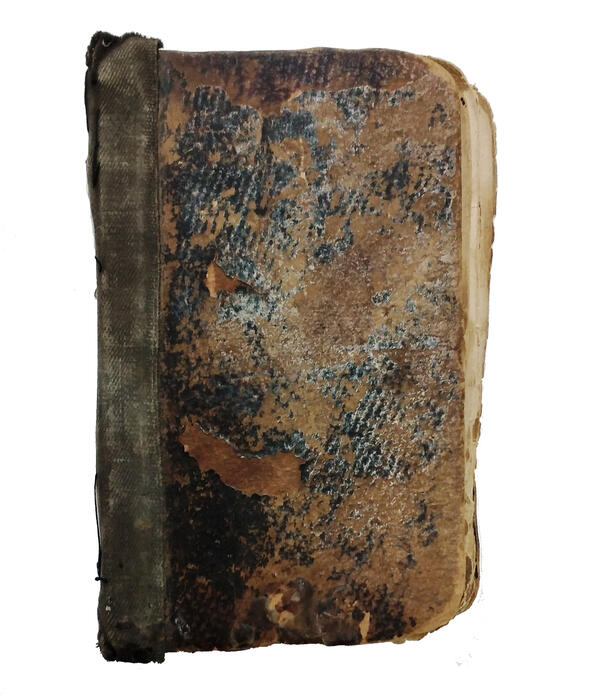
The book “Two Canons…” was printed in Moscow in the Christian Printing House at the Transfiguration Almshouse. The cover of the brochure is made of cardboard wrapped in black paper. The original spine was lost, the new one was hand-made by the owner himself: a piece of gray fabric was sewn to the original attachment point of the spine with threads.
The pages of the book are typographically printed on expensive white paper, which is called laid paper. The book contains 32 pages with prayers in the Old Slavonic language. The text is printed in two colors: black and red. Engraved ornamental headpieces are placed on the first and last sheets. There are no illustrations in the book.
Judging by the inscriptions on the flyleaf and the pages of the canon, it can be assumed that the book had at least two owners.