#1
Stamp, Aёr, Skouphos
#2
#21
Stamp
#4
A metal stamp with a long handle was used to make prOsphora — special church bread that priests gave at the Divine Liturgy to parishioners. The bread consisted of two parts: they were baked separately and then joined together. The lower half embodied the earthly human nature, and the upper half symbolized the spiritual divine one. On top, there was an imprint with Christian symbols made with a special stamp.
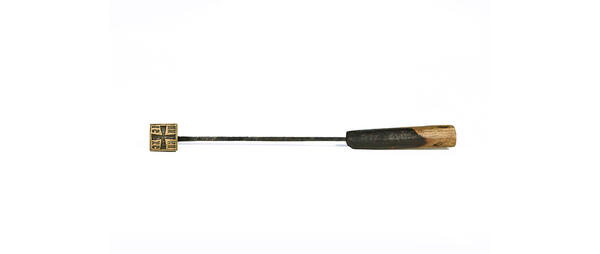
The exhibit from the collection of the Bishop’s House is made of copper. The square-shaped seal is attached to the long round handle by a metal fastener. The part that is used to leave the imprint has an embossed image of the cross. Above its bars we can see short inscriptions — “IC”, “XC”, “NИ”, “KA”. They are abbreviations of a Greek phrase, which means “Jesus Christ the Victorious.”
The dough for the prosphora was made from wheat flour, salt, yeast, and holy water. It was thought that the yeast symbolized the life-giving power of the Holy Spirit, and the holy water represented the grace of God. The round shape of these loaves was intended to remind of eternity and infinite divine love. The proshora bread was baked once a year, on Holy Thursday before Easter. It was believed that on that day, on the eve of his execution, Christ made the first communion in the world. The breads were prepared in special bakeries at churches or monasteries, separately from ordinary food, because they were considered sacred.
The leavened bread is still used in that part of the service, which deals with the Nativity of the Blessed Virgin Mary and Christ, and then the suffering and death of the Savior. After the service, the priest breaks the bread into small pieces and gives them to the congregation. It is believed that such a sacred gift helps to get rid of illnesses and strengthen one’s faith. The remains of the bread are usually taken home and eaten on an empty stomach on the day when they cannot come to church.
At all times, the church bread was treated with special reverence. It was not to be thrown away or given to animals. If this bread went stale, it had to be taken to the temple, where it was burned with prayer, and the ashes were out into running water, or buried in places where people did not walk.
The exhibit from the collection of the Bishop’s House is made of copper. The square-shaped seal is attached to the long round handle by a metal fastener. The part that is used to leave the imprint has an embossed image of the cross. Above its bars we can see short inscriptions — “IC”, “XC”, “NИ”, “KA”. They are abbreviations of a Greek phrase, which means “Jesus Christ the Victorious.”
The dough for the prosphora was made from wheat flour, salt, yeast, and holy water. It was thought that the yeast symbolized the life-giving power of the Holy Spirit, and the holy water represented the grace of God. The round shape of these loaves was intended to remind of eternity and infinite divine love. The proshora bread was baked once a year, on Holy Thursday before Easter. It was believed that on that day, on the eve of his execution, Christ made the first communion in the world. The breads were prepared in special bakeries at churches or monasteries, separately from ordinary food, because they were considered sacred.
The leavened bread is still used in that part of the service, which deals with the Nativity of the Blessed Virgin Mary and Christ, and then the suffering and death of the Savior. After the service, the priest breaks the bread into small pieces and gives them to the congregation. It is believed that such a sacred gift helps to get rid of illnesses and strengthen one’s faith. The remains of the bread are usually taken home and eaten on an empty stomach on the day when they cannot come to church.
At all times, the church bread was treated with special reverence. It was not to be thrown away or given to animals. If this bread went stale, it had to be taken to the temple, where it was burned with prayer, and the ashes were out into running water, or buried in places where people did not walk.
#5
Полное наименование предмета: Stamp for making prosphora
Дата создания: between 1890 and 1917
Техника: casting
Место создания: Russia
Место создания: Russia
Владелец коллекции: Bishop’s House
Размеры: 43×3,4×3,4 cm
Размеры: 43×3,4×3,4 cm
Номер в Госкаталоге: 3547374
#6
Orange velvet aёr
#15
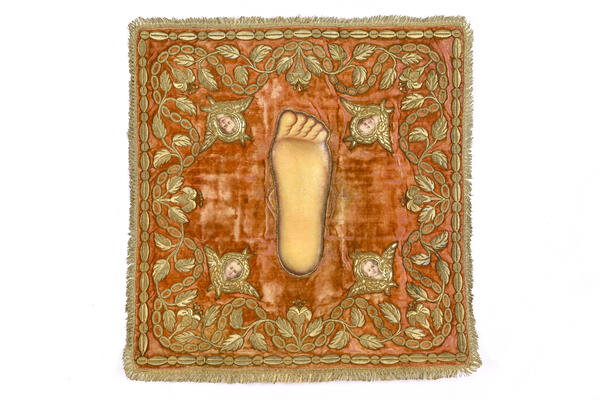
Aёr
#8
In the Orthodox Church, an aёr is a small square veil that is used during the liturgy. It covers the sacred vessels for the sacraments — the diskos and chalice, as well as the Blessed Sacrament, that is, wine and bread for communion. The name “aёr” is often associated with the fact that the fabric covers the surface in the same way that air surrounds the earth. In addition, the veils for the Blessed Sacrament symbolize the blankets of the newborn Christ and the funeral shroud that wrapped his body after his execution on the cross.
The aёr can be large and small. It is traditionally sewn from expensive fabrics, for example, brocade or velvet. The front surface is decorated with embroidery, gold and silver threads, and pearls. Parishioners often present such items as a gift to the church.
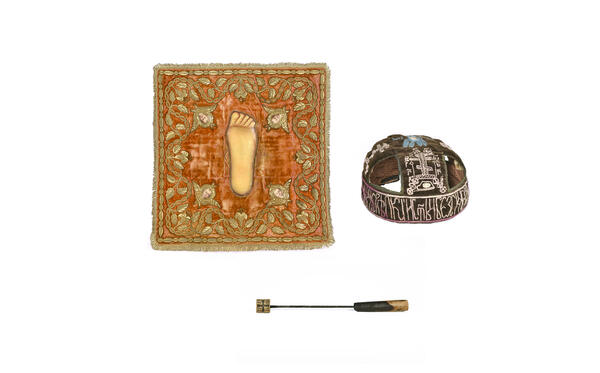
The aёr from the Tobolsk Historical and Architectural Museum-Reserve is made of orange velvet and has a square shape. In the center of the front part, the foot of the Mother of God is depicted. It is a sign of her invisible presence in the temple. Images of angels are embroidered around it on four sides. There is a floral ornament with lily buds on the edges of the aёr. These flowers represent the Annunciation of the Blessed Virgin Mary — the moment from the Gospel when an angel appeared to her and informed her that her son would become the Savior of mankind.
A chain is depicted among the branches and leaves of the floral pattern, intertwining with them. Along the perimeter, the veil is decorated with a narrow strip of ornament, in which circles and ovals alternate. The item is bordered by a gold brocade fringe with tassels. The aёr lining is made of blue silk.
The patterns on the veil are made in the gold embroidery technique. Women were specially trained to make it in the monastery embroidery workshops. Most often, such embroidery was done by women from noble families who decided to go into a convent. The vestments of priests and details of church decoration were embellished with gold embroidery: banners, shrouds, bags for prosphora, and other items. Women from the royal and grand-ducal houses — wives, daughters and sisters of rulers — were also often engaged in such needlework.
The aёr can be large and small. It is traditionally sewn from expensive fabrics, for example, brocade or velvet. The front surface is decorated with embroidery, gold and silver threads, and pearls. Parishioners often present such items as a gift to the church.
The aёr from the Tobolsk Historical and Architectural Museum-Reserve is made of orange velvet and has a square shape. In the center of the front part, the foot of the Mother of God is depicted. It is a sign of her invisible presence in the temple. Images of angels are embroidered around it on four sides. There is a floral ornament with lily buds on the edges of the aёr. These flowers represent the Annunciation of the Blessed Virgin Mary — the moment from the Gospel when an angel appeared to her and informed her that her son would become the Savior of mankind.
A chain is depicted among the branches and leaves of the floral pattern, intertwining with them. Along the perimeter, the veil is decorated with a narrow strip of ornament, in which circles and ovals alternate. The item is bordered by a gold brocade fringe with tassels. The aёr lining is made of blue silk.
The patterns on the veil are made in the gold embroidery technique. Women were specially trained to make it in the monastery embroidery workshops. Most often, such embroidery was done by women from noble families who decided to go into a convent. The vestments of priests and details of church decoration were embellished with gold embroidery: banners, shrouds, bags for prosphora, and other items. Women from the royal and grand-ducal houses — wives, daughters and sisters of rulers — were also often engaged in such needlework.
#9
Полное наименование предмета: Orange velvet aёr
Дата создания: between 1850 and 1910
Техника: gold embroidery
Место создания: Russia
Дата создания: between 1850 and 1910
Техника: gold embroidery
Место создания: Russia
Владелец коллекции: Bishop’s House
Размеры: 49,5×48 cm
Номер в Госкаталоге: 3495073
#10
Skouphos (the headdress of a nun in the form of a cap with a cross-shaped bottom)
#16
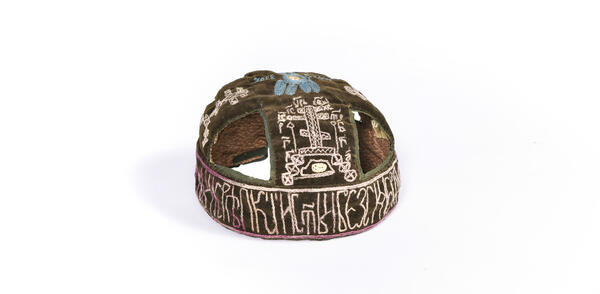
Skouphos
#12
In the Orthodox tradition, a skouphos is a casual headdress of monks and nuns. The variants for men were traditionally sewn of soft black cloth, caps for women could vary in shade and shape depending on local traditions. They were embroidered with Christian symbols or initial lines of prayers. There was little decoration, and the colors of the fabric were usually dark.
The skouphos from the Bishop’s House collection used to belong to a nun. It was made of dark velvet and decorated with embroidery. At the base of the cap — the so-called “ochelie” — is a fragment of the Christian prayer called “Trisagion”:
The skouphos from the Bishop’s House collection used to belong to a nun. It was made of dark velvet and decorated with embroidery. At the base of the cap — the so-called “ochelie” — is a fragment of the Christian prayer called “Trisagion”:
#17
Holy God, Holy Mighty, Holy Immortal, have mercy on us.
#18
There is a small slit at the bottom in the back — its edges are trimmed to prevent the fabric from crumbling over time.
Wide strips of fabric, which intersect at the top, reach the rim. The upper part is decorated with embroidery depicting a six-winged seraph, one of the highest angels, one of the closest to God in Christian tradition. On the front of the skouphos is a depiction of the Cross of Calvary with the instruments of the Passion — a spear and a cane with a sponge, by means of which Jesus was drunk with vinegar. Next to the cross you can see the letters “IC” and “XC”, short for “Jesus Christ”. There are also the silhouettes of the towers of Jerusalem, and at the foot of the schematically depicted Calvary, there is a skull, which symbolizes the ashes of the forefather Adam.
On the right and left sides of the skouphos are embroidered eight-pointed Orthodox crosses, and on the back of the head is a four-pointed cross. The cap has a light cotton lining.
Nuns traditionally wore the skouphos only on top of the “apostolnik” — a large cloth veil with an opening for the face. It evenly covered the shoulders, chest, and back, often reaching down to the waist. Traditionally these veils were made from black fabric, but some nuns wore white ones. It was allowed, for example, to those who worked in the church or monastery bakery making the holy bread. Later, the headdresses worn by the Sisters of Mercy were based on this design.
Wide strips of fabric, which intersect at the top, reach the rim. The upper part is decorated with embroidery depicting a six-winged seraph, one of the highest angels, one of the closest to God in Christian tradition. On the front of the skouphos is a depiction of the Cross of Calvary with the instruments of the Passion — a spear and a cane with a sponge, by means of which Jesus was drunk with vinegar. Next to the cross you can see the letters “IC” and “XC”, short for “Jesus Christ”. There are also the silhouettes of the towers of Jerusalem, and at the foot of the schematically depicted Calvary, there is a skull, which symbolizes the ashes of the forefather Adam.
On the right and left sides of the skouphos are embroidered eight-pointed Orthodox crosses, and on the back of the head is a four-pointed cross. The cap has a light cotton lining.
Nuns traditionally wore the skouphos only on top of the “apostolnik” — a large cloth veil with an opening for the face. It evenly covered the shoulders, chest, and back, often reaching down to the waist. Traditionally these veils were made from black fabric, but some nuns wore white ones. It was allowed, for example, to those who worked in the church or monastery bakery making the holy bread. Later, the headdresses worn by the Sisters of Mercy were based on this design.
#13
Полное наименование предмета: Skouphos (the headdress of a nun in the form of a cap with a cross-shaped bottom)
Дата создания: the 19th century
Техника: sewing chain stitch
Место создания: Russia
Дата создания: the 19th century
Техника: sewing chain stitch
Место создания: Russia
Владелец коллекции: Bishop’s House
Размеры: Diameter — 16.5 cm
Размеры: Diameter — 16.5 cm
Номер в Госкаталоге: 3496895
#19
Ministry of Culture of the Russian Federation
read morehide
00:00
00:00
1x
0
 Point your smartphone camera to open in the app
Open in app
Share