Font
Color
Graphics
Изображение точки

To see AR mode in action:

1. Install ARTEFACT app for iOS or Android;

2. Find the exhibition «Permanent Exhibition of the Zlatoust Museum»

3. Push the «Augmented reality» button and point your phone's camera at the exhibit;

Скрыть точки интересаПоказать точки интереса
Показать в высоком качестве

Black cuirass, Polished cuirass

0
Open in app
#1
Black cuirass
#3
In the 19th century, along with combat bladed weapons, protective armor items — cuirasses — were made at the Zlatoust Arms Factory. The unique production began in 1836. Cuirasses were in service with the heavy cavalry of European armies.

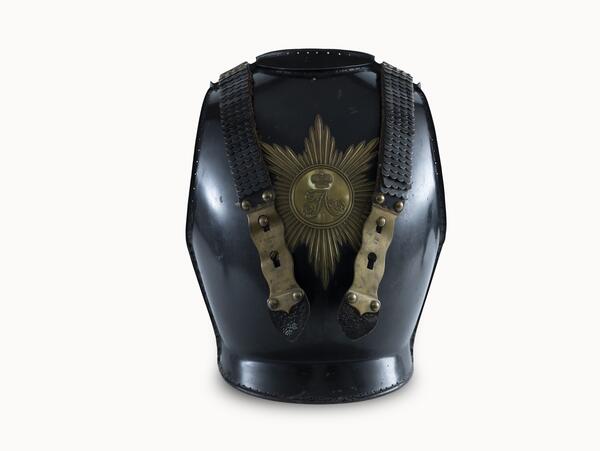
The Zlatoust City Museum of Local Lore exhibits a cuirass, which was made at the Zlatoust Arms Factory in the 1840s for officers of the Life Guards of the Cavalier Guard Regiment.

The regiment was formed in the Russian army in 1800 as a successor of the company (and the corps) of cavalry guards. Since 1804, the regiment had its own orchestra of 25 musicians. The cavalry guards had their combat debut in November 1805 during the battle of Austerlitz. The battle cost the regiment a third of its officers and 226 lower ranks.

The armor from the museum’s collection was designed by the famous Russian mining engineer and metallurgist Pavel Petrovich Anosov. It was made by stamping. The cuirass consists of front and back parts, connected by shoulder straps. The straps are covered with decorative copper plates — the so-called “scales”.

The front surface of the armor was covered with black lacquer. In the center of the front part of the steel breastplate, there is a chased eight-pointed star of the Order of St. Andrew the Apostle the First-Called with the monogram “A” below the imperial crown. That was the first order established in Russia; it was considered the highest honor in the Russian Tsardom and later in the Russian Empire.

Later, in the second half of the 19th century, Russian cuirasses were repeatedly modified; their shape, design, and material were improved. As part of the dress uniform, cuirasses were used in four regiments of the heavy cavalry of the Life Guards of the Russian Empire up until 1917.

The Russian cuirasses made of premium steel were not only of a quality equal to their foreign-made analogs but often surpassed them in performance. Along with cuirasses, steel uniform helmets for cuirassiers were also made in Zlatoust.
#2
Name: Black cuirass
Date of creation: 1844
Number in the State catalog: 18304206
Place of creation: Zlatoust, the Russian Empire
Technique: steel, copper, leather, fabric, gilding, bluing, etching
Dimensions: 58×40 cm
#5
Polished cuirass
#7
In the 19th century, along with combat blade weapons, pieces of armor — cuirasses — were made at the Zlatoust Arms Factory. This unique production began in 1836. Cuirasses were in service with the heavy cavalry of European armies. In the Russian Empire, the first cuirassier regiment had been formed in the first half of the 18th century.

In the 19th century, a craftsman named Sprenger arrived in Russia from Klingenthal to establish the production of cuirasses at the Sestroretsk plant. The initial attempt failed, and the manufacture of cuirasses was re-assigned to the Zlatoust Arms Factory.

Under the guidance of the French craftsman, by December 1836, eight cuirasses were created. Manufacturing experiments continued until 1838: the foreign craftsman caught a cold and died after a short illness. Pavel Petrovich Anosov, who from the very beginning had been looking closely at Sprenger’s work, overtook the craft.

Anosov was preoccupied with the strength of the cuirasses and the production technology. The designer assumed that the hard armor should be made taking into account, as much as possible, the height and build of the person to wear it. The cuirasses made according to the technology of Pavel Anosov were manufactured as follows: sheets of steel and iron were folded so that the number of layers reached 30. All that was welded in the same way as refined steel. That is how the front parts of the armor were made.

The backs of the cuirasses were made from 1/3 raw steel and 2/3 soft iron, as they were supposed to protect against blade weapons. This cuirass is a testament to one of the achievements of the great Russian metallurgist Pavel Petrovich Anosov, who, in the early 19th century, created the world’s best bulletproof armor.

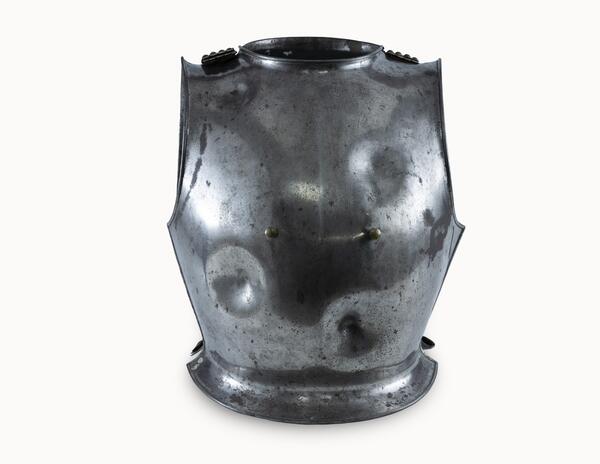
Both parts of the cuirass of the 1837 model were polished and interconnected with wide shoulder straps, which were decorated with a set of copper plates. The front of the cuirass has four rounded dents of different depths — these are traces left by bullets during testing. Such pieces of protective armor were only manufactured in Zlatoust; the cuirasses remained in service with the heavy cavalry of the Russian guard until the beginning of the 20th century.
#6
Name: Polished cuirass
Author: Anosov Pavel
Date of creation: 1854
Number in the State catalog: 16815404
Place of creation: Zlatoust, the Russian Empire
Technique: steel, copper, leather, fabric, stamping, planishing
Dimensions: 59×48 cm
#4
read morehide
00:00
00:00
1x

Black cuirass, Polished cuirass

0
Point your smartphone camera to open in the app
Share
VkontakteOdnoklassnikiTelegram
Share on my website
Copy linkCopied
Copy
Open in app
To see AR mode in action:
  1. Install ARTEFACT app for 
  2. iOS or Android;
  3. Find and download the «Paintings in Details» exhibition
  4. Push the «Augmented reality» button and point your phone's camera at the painting;
  5. Watch what happens on your phone screen whilst you flip through the pictures.
 
We use Cookies
Cookies on the Artefact Website. We use cookies to ensure that we give you the best experience on our website. If you continue without changing your settings, we'll assume that you are happy to receive all cookies on the Artefact website. However, if you would like to, you can change your cookie settings at any time.
Learn more about cookie useHide
Content is available only in Russian

X

Нашли опечатку?...

%title%%type%