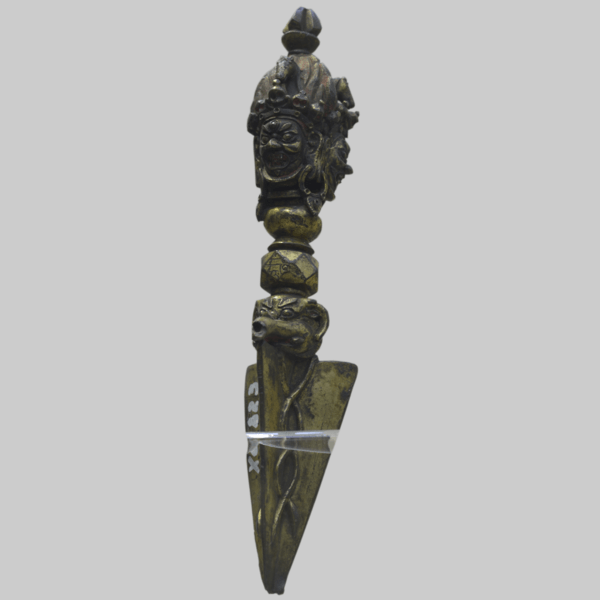
The museum displays a ritual triangular dagger with a handle in the form of a three-faced god. The handle of the dagger is sculptural. At the junction of the handle with the blade there is an elephant’s head with a slightly open mouth, from which a red tongue is visible. Above it two details are attached — one trapezoidal with rhombic edges, the other hemispherical rounded.
Above the rounded detail, the head of a three-faced Buddhist deity with raised up and dyed red hair rises. Above the head is a necklace of human skulls, above each face are horse heads. The hair is interconnected in the form of a stylized image of a fiery blaze. Above it is a cone-shaped knob. The expression god’s face is fierce, he has a bulging third eye on the forehead. The ears of the faces are connected by rings.
The dagger appertains to the Buddhist ritual object ‘phurba’ — a magical, sacred weapon. Usually its hilt was in the form of the head of an angry deity with a triangular blade. Most likely, its purpose was to perform healing rituals, as well as various rites. It is believed that the object appeared during the Vedic era, but some experts speak of its existence even in pre-Vedic times.
The knob of the dagger’s handle with a wedge is the shape of horse’s head, or rather, the evil Tibetan deity Hayagriva, who was considered in Hinduism to be the embodiment of the god Vishnu. Also, this part of the dagger was decorated with symbols of immortality and the head of a Makara with snakes — a monster with a crocodile torso. The ritual object was used for spells and for the extermination of demons: sorcerers stabbed with it, repeating certain words, whose material embodiment was the dagger itself.
In other words, the knife used for rituals was intended to exorcise spirits of evil energy. Phurba was a symbol of the destruction of existing ideas about a person and attachment to one’s own self. It also shattered illusions about what the real world looks like and what it is. In some rituals of Tantric Buddhism, phurba acted as a weapon with which it was possible to subdue the forces that interfere with the teaching. With the help of phurba, the practicing yogi literally nailed their symbolic images to the ground.
The dagger entered the funds of the Amur Regional Museum of Local Lore in 1982.
Above the rounded detail, the head of a three-faced Buddhist deity with raised up and dyed red hair rises. Above the head is a necklace of human skulls, above each face are horse heads. The hair is interconnected in the form of a stylized image of a fiery blaze. Above it is a cone-shaped knob. The expression god’s face is fierce, he has a bulging third eye on the forehead. The ears of the faces are connected by rings.
The dagger appertains to the Buddhist ritual object ‘phurba’ — a magical, sacred weapon. Usually its hilt was in the form of the head of an angry deity with a triangular blade. Most likely, its purpose was to perform healing rituals, as well as various rites. It is believed that the object appeared during the Vedic era, but some experts speak of its existence even in pre-Vedic times.
The knob of the dagger’s handle with a wedge is the shape of horse’s head, or rather, the evil Tibetan deity Hayagriva, who was considered in Hinduism to be the embodiment of the god Vishnu. Also, this part of the dagger was decorated with symbols of immortality and the head of a Makara with snakes — a monster with a crocodile torso. The ritual object was used for spells and for the extermination of demons: sorcerers stabbed with it, repeating certain words, whose material embodiment was the dagger itself.
In other words, the knife used for rituals was intended to exorcise spirits of evil energy. Phurba was a symbol of the destruction of existing ideas about a person and attachment to one’s own self. It also shattered illusions about what the real world looks like and what it is. In some rituals of Tantric Buddhism, phurba acted as a weapon with which it was possible to subdue the forces that interfere with the teaching. With the help of phurba, the practicing yogi literally nailed their symbolic images to the ground.
The dagger entered the funds of the Amur Regional Museum of Local Lore in 1982.