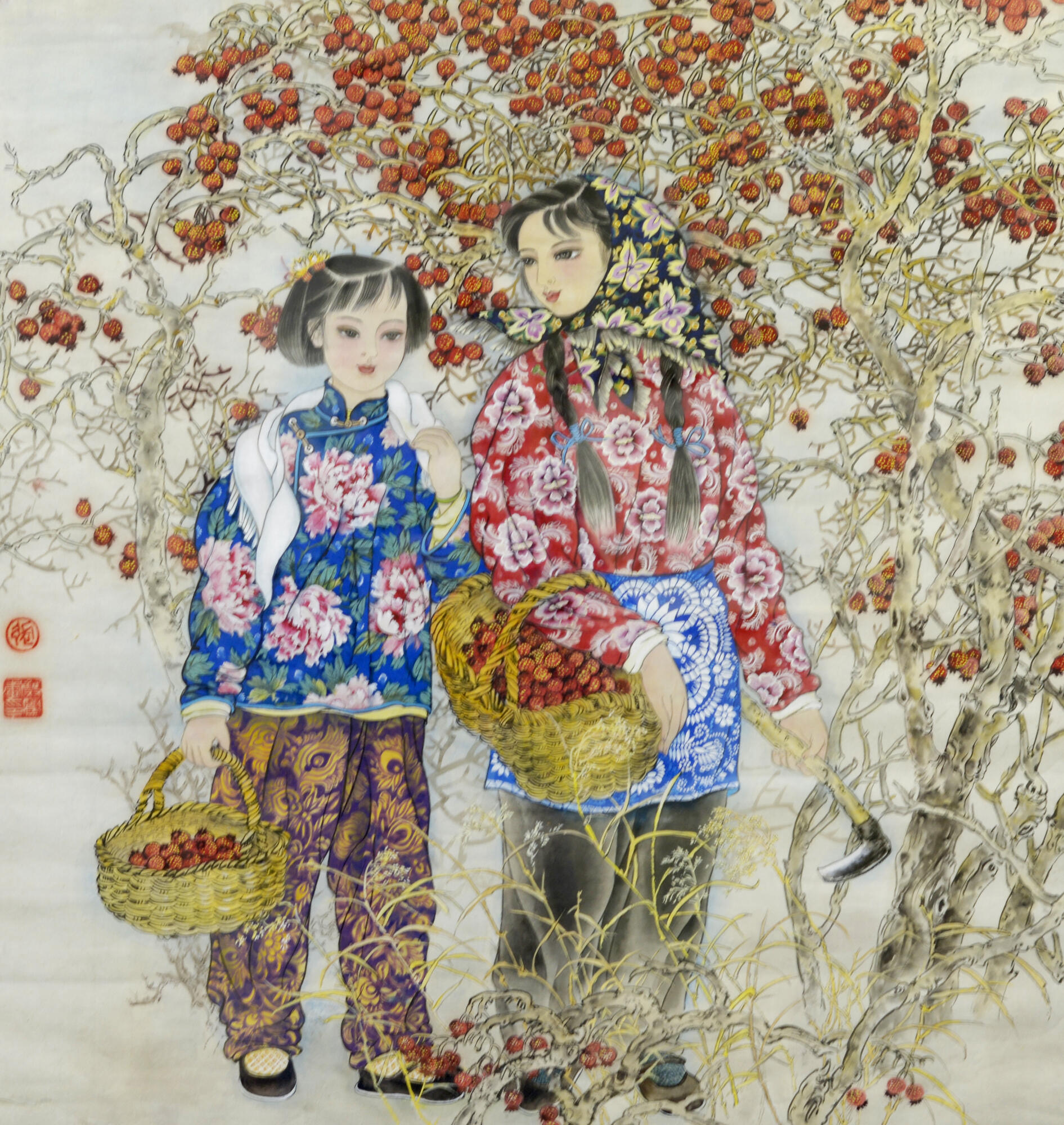


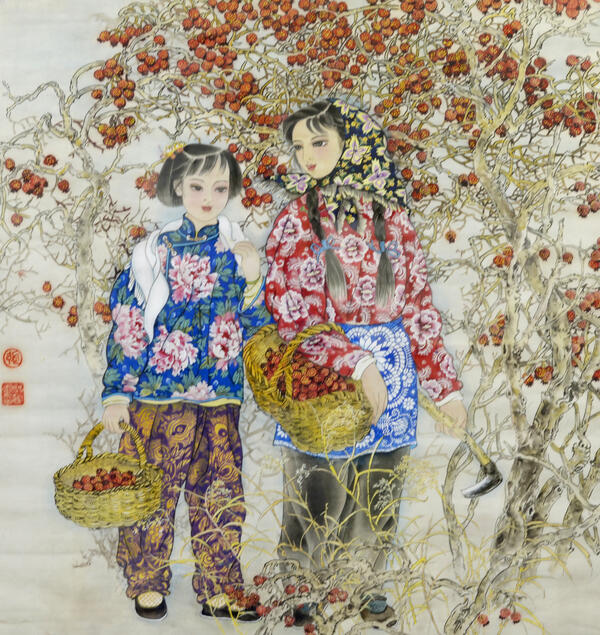
In the picture, in front of of tall bushes with ripe red berries, two girls, apparently Chinese, are depicted in full growth. They are wearing multi-colored suits. The one to the left and shorter has a short haircut, trousers and a shirt embroidered with bright colors, a white scarf thrown over her shoulders. The second girl looks a little older, her hair is braided, the trousers are dark, over which she is wearing either an apron or a skirt; the shirt and skirt are colored with patterns. In her left hand she has a tool for tilting branches so that it is easily to pick berries. Each girl has a wicker basket in her hand, two-thirds full of these berries.
They talk peacefully, standing by a bush with clearly traced fruits and gray crooked branches. There is no earth or sky in the picture, the milky-white background sets off bright colors. On the left along the edge of the sheet there are two red seals — this is how the master marked his works with a kind of signature.
Chinese painting is laconic, expressive contours and lucid composition. Almost all works are usually flat with no light and shade. It should be noted that artists paint all their works without sketches.
There are several main genres in Chinese painting — landscapes with rivers and mountains, images of birds and flowers, animalistic views and portraits.
Chinese art, which can be considered traditional, has several styles — xieyi and gongbi. The second concept has a lot of interpretations. So, ‘gong’ is translated as ‘graceful’ or ‘careful’, ‘bi’ — ‘writing’ or ‘instrument’ with which it is written. Together they mean ‘careful writing’. Accuracy in the description of details, drawing of elements throughout the picture are distinctive features of this style.
While painting, the masters used special mineral paints which gave the canvas richness, making it decorative. Since these artists decorated the interior of the imperial palaces and other nobility with painting, gongbi is generally accepted as a court style. This style is especially popular when painting in the genre of ‘birds and flowers’ and less often used in landscape painting.
Xieyi is a free style of painting. It is not the resemblance with a real object that is important here, but how a person sees it, the transfer of the emotional state of the master himself. It is in this version that the mood of the artist is extremely important, because the result of the work will depend on it. It is almost impossible to copy such works. There are no clear lines and no detail in xieyi, strokes lie freely, made with a wide brush. Therefore, this style is called ‘rough brush’. The paintings are done in black and white ink. They do not look as pompous as the works of gongbi, but at the same time they are more lively and sincere.
The scroll painting was donated to the Amur Regional Museum by the author of the work Zhao Yu Chun in August 2002 after an exhibition of Chinese artists in the city of Dalian.
They talk peacefully, standing by a bush with clearly traced fruits and gray crooked branches. There is no earth or sky in the picture, the milky-white background sets off bright colors. On the left along the edge of the sheet there are two red seals — this is how the master marked his works with a kind of signature.
Chinese painting is laconic, expressive contours and lucid composition. Almost all works are usually flat with no light and shade. It should be noted that artists paint all their works without sketches.
There are several main genres in Chinese painting — landscapes with rivers and mountains, images of birds and flowers, animalistic views and portraits.
Chinese art, which can be considered traditional, has several styles — xieyi and gongbi. The second concept has a lot of interpretations. So, ‘gong’ is translated as ‘graceful’ or ‘careful’, ‘bi’ — ‘writing’ or ‘instrument’ with which it is written. Together they mean ‘careful writing’. Accuracy in the description of details, drawing of elements throughout the picture are distinctive features of this style.
While painting, the masters used special mineral paints which gave the canvas richness, making it decorative. Since these artists decorated the interior of the imperial palaces and other nobility with painting, gongbi is generally accepted as a court style. This style is especially popular when painting in the genre of ‘birds and flowers’ and less often used in landscape painting.
Xieyi is a free style of painting. It is not the resemblance with a real object that is important here, but how a person sees it, the transfer of the emotional state of the master himself. It is in this version that the mood of the artist is extremely important, because the result of the work will depend on it. It is almost impossible to copy such works. There are no clear lines and no detail in xieyi, strokes lie freely, made with a wide brush. Therefore, this style is called ‘rough brush’. The paintings are done in black and white ink. They do not look as pompous as the works of gongbi, but at the same time they are more lively and sincere.
The scroll painting was donated to the Amur Regional Museum by the author of the work Zhao Yu Chun in August 2002 after an exhibition of Chinese artists in the city of Dalian.