Font
Color
Graphics
Изображение точки

To see AR mode in action:

1. Install ARTEFACT app for iOS or Android;

2. Find the exhibition «Pogar: The Last City of Magdeburg Law»

3. Push the «Augmented reality» button and point your phone's camera at the exhibit;

Скрыть точки интересаПоказать точки интереса
Показать в высоком качестве

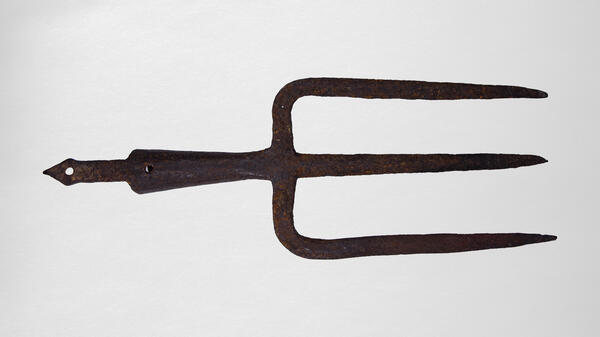
Cossack trident

Creation period
17th century
Place of сreation
Pogar
Dimensions
45x17 cm
Technique
forging
1
Open in app
#1
Cossack trident
#2
A trident is an ancient stabbing weapon. It has a long shaft, crowned by an iron tip with three barbs. The trident was made like a fishing tool — a gaff. Each barb of the gaff, unlike the trident, ended with a point and had serrations that held the fish. A gaff was used for fishing in spring: during the spawning season pikes, common carps and pike perches were caught directly from the shore. Also in winter, people were used to hit fish in the ice-hole with it. Gaffs with two barbs were called “sadovya” or “sandovya”.

The trident was used in the same way as a spear: to strike the enemy with it or to take away the weapon.
 
The Pogar people used tridents in battle when they fought against the Polish nobility (the minor landed gentry).

In 1648, Bogdan Khmelnitsky, hetman of the Zaporizhian Sich, gathered Cossack armies on left-bank Ukraine for a rebellion against years of Polish rule. In June 1648, Cossacks occupied Pogar and Pochep. On 23 July, provincial governors of Sevsk (100 km from Pogar) informed Moscow about the events,

#6
4000 Cossacks are coming to Starodub and Pochep, and in the Novgorod uyezd they, the Cossacks, took the Pogar fortress and Poles and Jews and spilled the blood of their 70 families.
#5
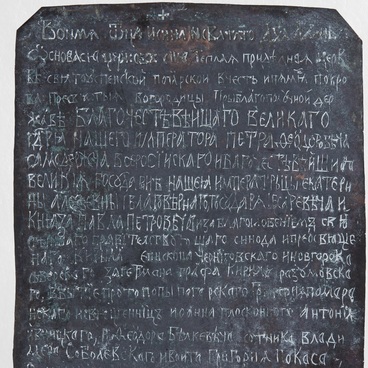
The residents of Pogar supported the Cossacks from the Zaporizhian Sich. In addition to tridents, in the fights, they used improvised tools like scythes and axes. That time there was a mass “Cossack-conversion” of the population: everyone who supported the rebels could become a Cossack and join the army. However, even ordinary citizens, who did not become Cossacks, carried “shablas” (sabers) and kept battle tridents in their dwellings. Later the citizens of Pogar took an oath of allegiance to Tsar Alexei Mikhailovich Romanov in February 1654, when Ukraine became part of Russia. 462 people took the oath: a colonel, a clerk, an esaul (Cossack captain), a standard-bearer (Cossack rank equal to second lieutenant), 24 atamans (title of the supreme military commanders of the Cossack armies), 344 Cossacks, a headman and 89 petty bourgeois.

The trident, which is presented in the Radogoshch museum, was kept in the Cossack family Kraevoy as a family relic. One of the representatives of the Cossack family donated this trident to the collection.
#4
read morehide
00:00
00:00
1x

Cossack trident

Creation period
17th century
Place of сreation
Pogar
Dimensions
45x17 cm
Technique
forging
1
Point your smartphone camera to open in the app
Share
VkontakteOdnoklassnikiTelegram
Share on my website
Copy linkCopied
Copy
Open in app
To see AR mode in action:
  1. Install ARTEFACT app for 
  2. iOS or Android;
  3. Find and download the «Paintings in Details» exhibition
  4. Push the «Augmented reality» button and point your phone's camera at the painting;
  5. Watch what happens on your phone screen whilst you flip through the pictures.
 
We use Cookies
Cookies on the Artefact Website. We use cookies to ensure that we give you the best experience on our website. If you continue without changing your settings, we'll assume that you are happy to receive all cookies on the Artefact website. However, if you would like to, you can change your cookie settings at any time.
Learn more about useHide
Content is available only in Russian

X

Нашли опечатку?...

%title%%type%