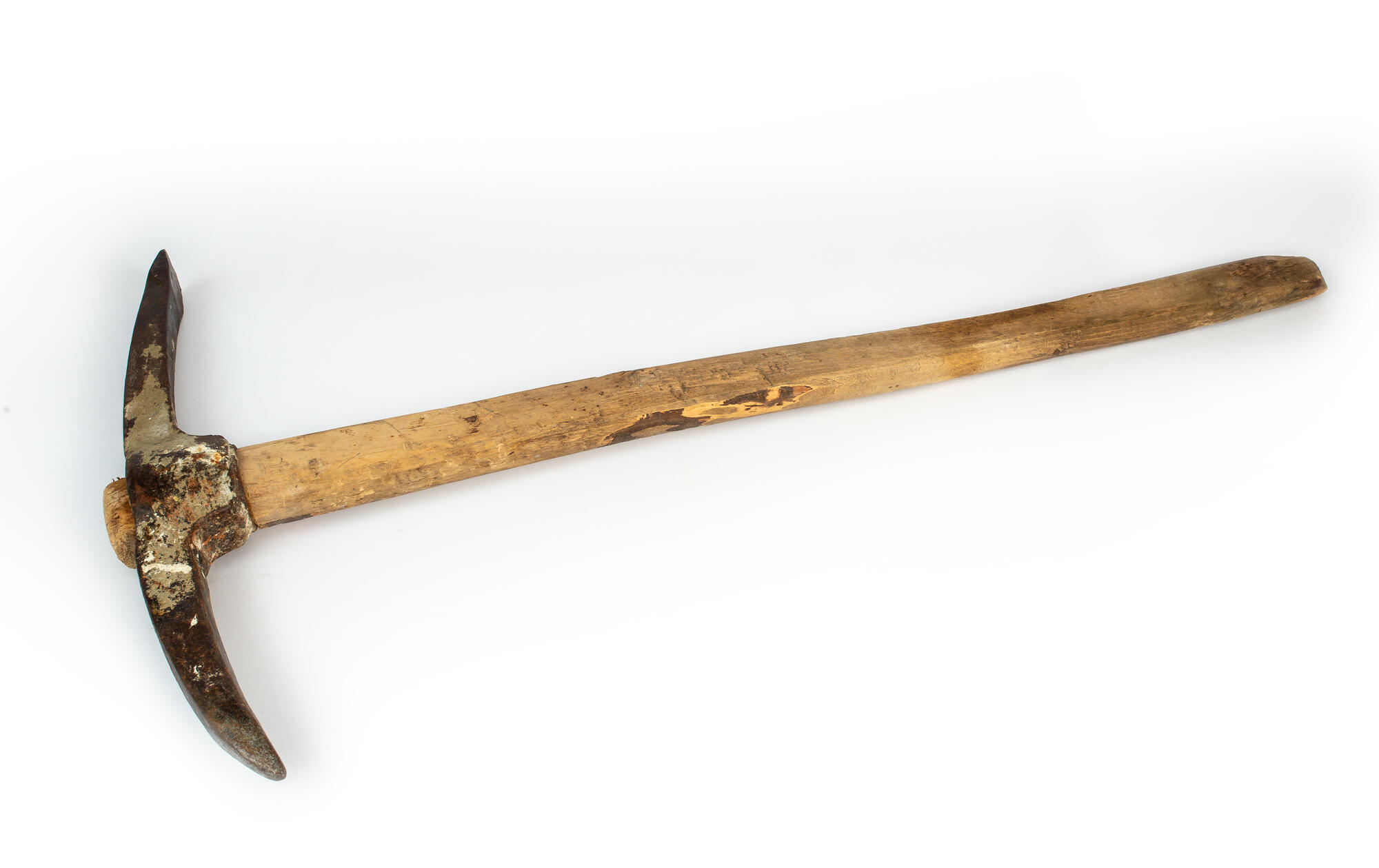


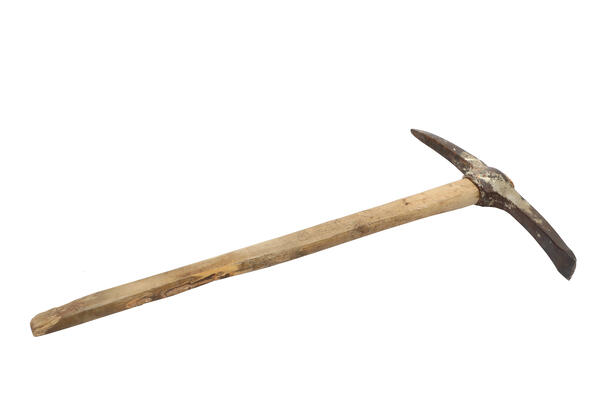
The collection of the Verkhnyaya Pyshma Historical Museum contains a pickaxe — a tool that was used to split concrete, natural and artificial stones, or to break up dense soil. It was also called a pick.
The tool consists of a long wooden handle and a metal working part. One of its ends is a sharp pointed end — it was used to break hard rock or soil. On the other is hoe, which was used to shape the soil.
The pick from the exhibition was used during the construction of the Pyshminsky Copper Electrolytic Plant in the 1930s — 1940s. The decision to start production in the Urals was made by the USSR Labor and Defense Council on July 27, 1928. According to the plan, the plant was to become the largest enterprise in Europe and produce copper, copper powder, foil, selenium and other products. In September 1928, a construction site was chosen — it was the village of Mednyy mine (now it is called Verkhnyaya Pyshma).
The Pyshminsky Copper Electrolytic Plant was built manually: there were not enough horse-drawn carriages, and there were no trucks in those days. Therefore, workers dug the soil with picks and shovels, and then took it away in wheelbarrows. The first facilities, furnaces and cranes were completed in July 1934, and production was launched in August.
At the same time, the first test samples of the metal appeared: on August 26, 1934, the plant produced the first copper cathode, and on September 6, 1934 — copper wirebars. In December 1935, the People’s Commissariat of Heavy Industry officially stated that the Pyshminsky Copper Electrolytic Plant had been put into operation.
The plant has become the main enterprise in town — creating jobs and leading to the appearance of a railway in the village of Medny mine. Later, new factories were opened and the mines of the Pyshminsko-Klyuchevsky copper mine, which had been flooded during the Civil War, started working again.
Gradually, the volume of production at the plant grew: in the 1940s, it processed about 70% of all blister copper in the USSR. In 1979, the plant became the only enterprise in the country that produced copper electrolytic powder. It was used to assemble cars, factories and machine tools.
Today the Pyshminsky Copper Electrolytic Plant is called ‘Uralelectromed’, and employs more than seven thousand residents of Verkhnyaya Pyshma.
The tool consists of a long wooden handle and a metal working part. One of its ends is a sharp pointed end — it was used to break hard rock or soil. On the other is hoe, which was used to shape the soil.
The pick from the exhibition was used during the construction of the Pyshminsky Copper Electrolytic Plant in the 1930s — 1940s. The decision to start production in the Urals was made by the USSR Labor and Defense Council on July 27, 1928. According to the plan, the plant was to become the largest enterprise in Europe and produce copper, copper powder, foil, selenium and other products. In September 1928, a construction site was chosen — it was the village of Mednyy mine (now it is called Verkhnyaya Pyshma).
The Pyshminsky Copper Electrolytic Plant was built manually: there were not enough horse-drawn carriages, and there were no trucks in those days. Therefore, workers dug the soil with picks and shovels, and then took it away in wheelbarrows. The first facilities, furnaces and cranes were completed in July 1934, and production was launched in August.
At the same time, the first test samples of the metal appeared: on August 26, 1934, the plant produced the first copper cathode, and on September 6, 1934 — copper wirebars. In December 1935, the People’s Commissariat of Heavy Industry officially stated that the Pyshminsky Copper Electrolytic Plant had been put into operation.
The plant has become the main enterprise in town — creating jobs and leading to the appearance of a railway in the village of Medny mine. Later, new factories were opened and the mines of the Pyshminsko-Klyuchevsky copper mine, which had been flooded during the Civil War, started working again.
Gradually, the volume of production at the plant grew: in the 1940s, it processed about 70% of all blister copper in the USSR. In 1979, the plant became the only enterprise in the country that produced copper electrolytic powder. It was used to assemble cars, factories and machine tools.
Today the Pyshminsky Copper Electrolytic Plant is called ‘Uralelectromed’, and employs more than seven thousand residents of Verkhnyaya Pyshma.