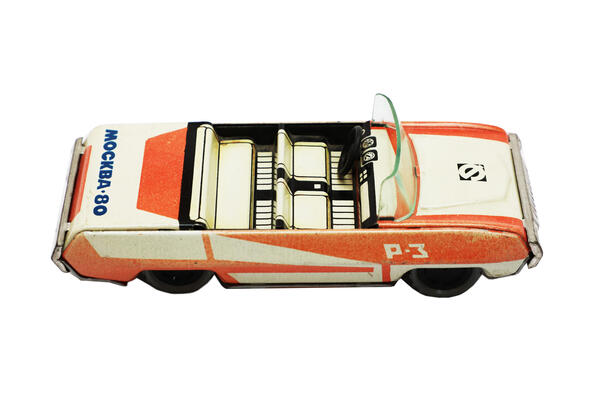
The toy cabriolet was made at the Verkhnyaya Pyshma factory ‘Raduga’ in 1980. Its release was meant to coincide with the Summer Olympic Games, which were held in Moscow. Previously, the souvenir toy was housed in the factory museum, and when it closed, the exhibit was transferred to the collection of the Verkhnyaya Pyshma Historical Museum.
The manufacturing of children’s toys in Verkhnyaya Pyshma began after the war. In 1952, according with the decision of the Council of Ministers of the RSFSR, a new production facility was built at the Verkhnyaya Pyshma metal plant, where metal toys were assembled. The first batch was produced two years later — in 1954.
In 1964, the Verkhnyaya Pyshma metal plant merged with the Nevyansk plant — the new enterprise was called the “Raduga” company. It soon became the leader as far as production in the region was concerned. The number of employees also increased: almost every family in the city had a member who worked at “Raduga”.
The business grew rapidly and by the 1970s it needed more space. So, the old buildings were reconstructed, and new facilities were built nearby: instrumental, mechanical repair, construction and heat engineering workshops. Also, a garage, a gas boiler room and a mechanized warehouse for raw materials and blanks appeared. Thanks to the new premises, the factory expanded its assortment and began to manufacture glass Christmas tree decorations.
In the 1980s, “Raduga” became famous throughout the country. In 1981, its team received the Order of the Badge of Honor for the early completion of the tenth five-year plan. The award was presented by the future first president of Russia, Boris Yeltsin, who came to Verkhnyaya Pyshma. In 1984, “Raduga” took part in the international exhibition in Leipzig and in the Exhibition of Achievements of the National Economy in Moscow.
By 1985, the factory already employed more than two thousand people. Nine apartment buildings, a swimming pool “Ichthyander” and a kindergarten were built for the staff.
After the collapse of the Soviet Union, the demand for “Raduga” metal toys fell — they were too expensive and could not withstand the competition with their Chinese counterparts. The factory became part of the Ural Mining and Metallurgical Company and stopped producing children’s toys. Until the exhibition was closed, the factory museum had housed more than 300 copies from the former assortment of ‘Raduga’.
The manufacturing of children’s toys in Verkhnyaya Pyshma began after the war. In 1952, according with the decision of the Council of Ministers of the RSFSR, a new production facility was built at the Verkhnyaya Pyshma metal plant, where metal toys were assembled. The first batch was produced two years later — in 1954.
In 1964, the Verkhnyaya Pyshma metal plant merged with the Nevyansk plant — the new enterprise was called the “Raduga” company. It soon became the leader as far as production in the region was concerned. The number of employees also increased: almost every family in the city had a member who worked at “Raduga”.
The business grew rapidly and by the 1970s it needed more space. So, the old buildings were reconstructed, and new facilities were built nearby: instrumental, mechanical repair, construction and heat engineering workshops. Also, a garage, a gas boiler room and a mechanized warehouse for raw materials and blanks appeared. Thanks to the new premises, the factory expanded its assortment and began to manufacture glass Christmas tree decorations.
In the 1980s, “Raduga” became famous throughout the country. In 1981, its team received the Order of the Badge of Honor for the early completion of the tenth five-year plan. The award was presented by the future first president of Russia, Boris Yeltsin, who came to Verkhnyaya Pyshma. In 1984, “Raduga” took part in the international exhibition in Leipzig and in the Exhibition of Achievements of the National Economy in Moscow.
By 1985, the factory already employed more than two thousand people. Nine apartment buildings, a swimming pool “Ichthyander” and a kindergarten were built for the staff.
After the collapse of the Soviet Union, the demand for “Raduga” metal toys fell — they were too expensive and could not withstand the competition with their Chinese counterparts. The factory became part of the Ural Mining and Metallurgical Company and stopped producing children’s toys. Until the exhibition was closed, the factory museum had housed more than 300 copies from the former assortment of ‘Raduga’.