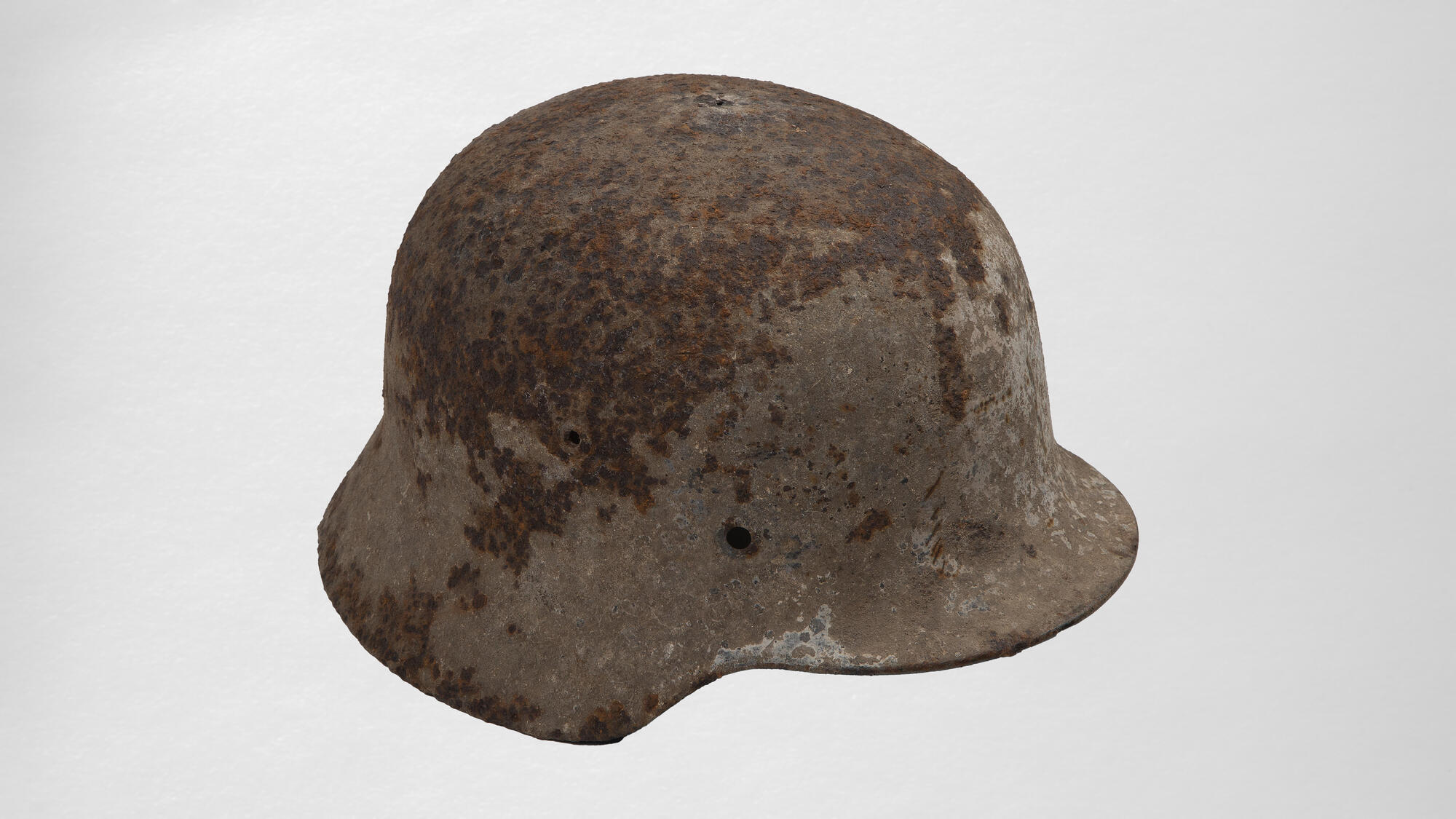


The collection of the Zimovniki Museum of Local History houses a German M42 helmet — a soldier’s headdress of the times of the Great Patriotic War.
The first M42 helmets were produced on August 1, 1942. They differed from the previous M35 and M40 models in a few details. First, on the outside, the edges of the new helmet were bent outward, and not inward, as before. They were left practically unprocessed. Secondly, the composition of the steel used for making helmets had changed — molybdenum and manganese were excluded. Instead, these impurities were used in arms production.
Industrial enterprises were busy during the war years, and helmets began to be produced in a faster and easier way. This affected their quality — the surface became softer and easier deformed.
Inside the headdress, there was a leather balaclava, which had been used in German helmets since 1931. It had several petals that were connected at the top with a string. It was equipped with a leather chinstrap with a buckle, its length could vary. These details made it possible to adjust the position of the helmet on the head. On the inner surface, they placed the manufacturer’s brand and indicated the size, and painted the helmet in gray-green on the outside.
Since 1942, the helmet had a cover made of protective fabric “Zeltban 31” — a cotton base, on which small geometric shapes and thin dashes were applied. They intersected with each other and resembled the ripples. Natural colors were used for the pattern: brown, dark, and light green. In winter, a white cover was attached to the helmet with a string. Soldiers sewed special fasteners for branches and leaves on “Zeltban 31” cover, and used this design for camouflage.
The M42 helmet was mass-produced until the end of 1944 or early 1945. The production stopped when most factories were captured by Soviet troops, and the remaining factories ran out of materials. The M42 headgears were used in the army until the end of the war, along with the previous M35 and M40 helmets.
The first M42 helmets were produced on August 1, 1942. They differed from the previous M35 and M40 models in a few details. First, on the outside, the edges of the new helmet were bent outward, and not inward, as before. They were left practically unprocessed. Secondly, the composition of the steel used for making helmets had changed — molybdenum and manganese were excluded. Instead, these impurities were used in arms production.
Industrial enterprises were busy during the war years, and helmets began to be produced in a faster and easier way. This affected their quality — the surface became softer and easier deformed.
Inside the headdress, there was a leather balaclava, which had been used in German helmets since 1931. It had several petals that were connected at the top with a string. It was equipped with a leather chinstrap with a buckle, its length could vary. These details made it possible to adjust the position of the helmet on the head. On the inner surface, they placed the manufacturer’s brand and indicated the size, and painted the helmet in gray-green on the outside.
Since 1942, the helmet had a cover made of protective fabric “Zeltban 31” — a cotton base, on which small geometric shapes and thin dashes were applied. They intersected with each other and resembled the ripples. Natural colors were used for the pattern: brown, dark, and light green. In winter, a white cover was attached to the helmet with a string. Soldiers sewed special fasteners for branches and leaves on “Zeltban 31” cover, and used this design for camouflage.
The M42 helmet was mass-produced until the end of 1944 or early 1945. The production stopped when most factories were captured by Soviet troops, and the remaining factories ran out of materials. The M42 headgears were used in the army until the end of the war, along with the previous M35 and M40 helmets.