


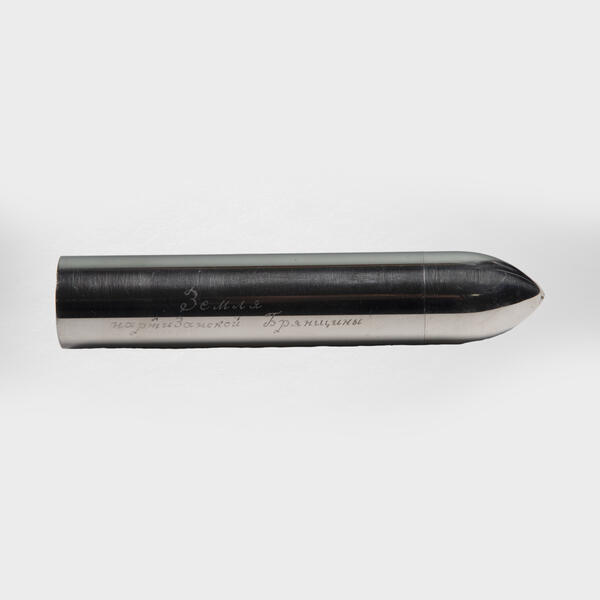
The Zimovniki Museum of Local History displays a capsule that has the soil from the Bryansk region inside. The owner of this item was Larisa Kibalova, a native of the Zimovniki district, who was in a partisan detachment and fought against German invaders near Bryansk.
The Bryansk region is close to the western border of the country. Therefore, two days after the war started in Russia, on June 24, 1941, martial law was declared in the city. All local factories began produce supplies the frontline. Moreover, Bryansk was a convenient hub to transport troops, military equipment, and ammunition.
In October, the Nazis occupied the entire Bryansk region. There they set up concentration camps, where prisoners of war and civilians were kept. Approximately 130 thousand residents were killed; another 163 thousand people were deported to Germany, where many also faced hard work, abuse, and death.
When the first German troops were in the Bryansk region, partisan detachments began to gather there. Many residents went to the forests and created their units to cause as much damage to the invaders as possible. Partisans attacked enemy troops units, damaged communication at strategically important objects, and blew up trains and bridges that led to the settlements. Moreover, they often conducted reconnaissance and found out information for the Soviet command.
Larisa Kibalova joined the Chapaev partisan detachment of the Voroshilov brigade in July 1943. She received her first task a few days later, on August 3. Kibalova had to blow up a large part of the railroad track in the direction of Polotsk — Voropayevo. This operation is now known as the “rail war”.
Partisans made fuses, discussed all the details of the operation, and set out. At midnight, demolitionists dispersed to their designated areas. Larisa Kibalova remembered the operation for the rest of her life. She told how she crawled on her knees, shoveled the ground, and fixed the shells, and her partner fired them. The operation was successful. When the group gathered in a certain place, it turned out there were no victims — only the wounded.
The Bryansk region is close to the western border of the country. Therefore, two days after the war started in Russia, on June 24, 1941, martial law was declared in the city. All local factories began produce supplies the frontline. Moreover, Bryansk was a convenient hub to transport troops, military equipment, and ammunition.
In October, the Nazis occupied the entire Bryansk region. There they set up concentration camps, where prisoners of war and civilians were kept. Approximately 130 thousand residents were killed; another 163 thousand people were deported to Germany, where many also faced hard work, abuse, and death.
When the first German troops were in the Bryansk region, partisan detachments began to gather there. Many residents went to the forests and created their units to cause as much damage to the invaders as possible. Partisans attacked enemy troops units, damaged communication at strategically important objects, and blew up trains and bridges that led to the settlements. Moreover, they often conducted reconnaissance and found out information for the Soviet command.
Larisa Kibalova joined the Chapaev partisan detachment of the Voroshilov brigade in July 1943. She received her first task a few days later, on August 3. Kibalova had to blow up a large part of the railroad track in the direction of Polotsk — Voropayevo. This operation is now known as the “rail war”.
Partisans made fuses, discussed all the details of the operation, and set out. At midnight, demolitionists dispersed to their designated areas. Larisa Kibalova remembered the operation for the rest of her life. She told how she crawled on her knees, shoveled the ground, and fixed the shells, and her partner fired them. The operation was successful. When the group gathered in a certain place, it turned out there were no victims — only the wounded.


