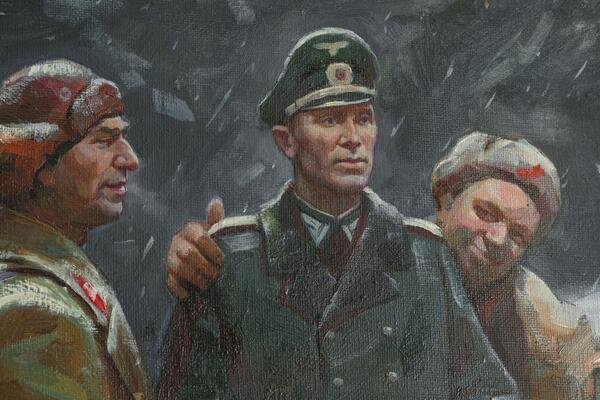
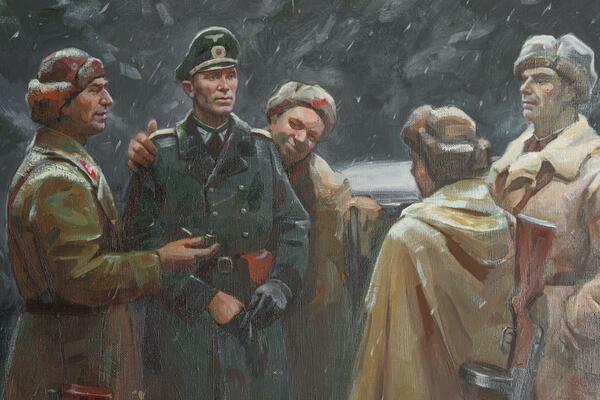
Since 1981, the Museum of Intelligence Officer Nikolai Kuznetsov has held in its collection the painting “On a Special Assignment” by the renowned artist and former partisan Grigory Grigoryevich Ponomarenko.
The painting depicts a forest landscape. To one side stands a car belonging to the partisan unit, while the foreground captures a pivotal moment: Nikolai Ivanovich Kuznetsov, disguised as a German officer, receives final instructions from the unit commander, Dmitry Nikolaevich Medvedev, and the head of intelligence, Alexander Alexandrovich Lukin.
Before the war, Grigory Ponomarenko completed two years of study at the Penza Art College. In 1939, he was drafted into the Red Army and served in Transbaikalia. When the Great Patriotic War began, he fought near Orsha, was seriously wounded, and twice escaped from German captivity.
With deep gratitude, Grigory Ponomarenko later recalled the compassionate locals who risked their lives to help the fugitives — some shared potatoes, others gave clothing, and an elderly groom even heated a bathhouse for them.
After a month of wandering through enemy-occupied territory, Ponomarenko and his comrades joined the partisan unit “The Winners” (Pobediteli). The commander, Dmitry Nikolaevich Medvedev, personally interviewed each newcomer. For Grigory, meeting the fit, confident colonel — dressed in full uniform — was a revelation: German captors had convinced prisoners that Moscow had already fallen. Thus began a new chapter in Ponomarenko’s war — the partisan struggle.
The partisans lived in the dense Tsuman Forest, sheltering in makeshift huts and warming themselves around campfires. In his very first battle, Ponomarenko acquired a rifle. By the summer of 1942, in recognition of his combat service, Medvedev himself presented him with a new machine gun during a formal assembly — an honor delivered from the “Mainland” (Soviet-controlled territory) and considered the highest distinction within the unit.
“The Winners” unit carried out sabotage operations across the Rovno and Lvov regions. Their main base was located near Rovno — the city the Nazis had designated as the capital of occupied Ukraine. In spring 1942, the unit numbered just 75 fighters; by February 1944, it had grown into a formidable force of over 7,000 partisans. They derailed enemy trains, blew up bridges, and destroyed communication hubs.
Beyond his combat duties, Grigory Ponomarenko also sketched portraits of his comrades. December 1943 remained especially vivid in his memory: it was then that he drew a portrait of Nikolai Ivanovich Kuznetsov — the legendary spy and fearless intelligence officer.
In 1944, “The Winners” linked up with the advancing Red Army. Ponomarenko continued fighting as part of the 8th Guards Airborne Battalion. On April 19, 1945, he was seriously wounded on the Oder River and met Victory Day in a hospital.
He was awarded the Order of the Patriotic War (Second Class), the Order of the Red Star, and numerous medals — honors that stand as a testament to those tragic yet glorious years. Yet for the artist, his most enduring legacy was his wartime drawings, which forever preserved the faces and daily lives of his fellow partisans. Several of these works, identified after the war, were later used as illustrations in Dmitry Medvedev’s memoir “Strong in Spirit”.