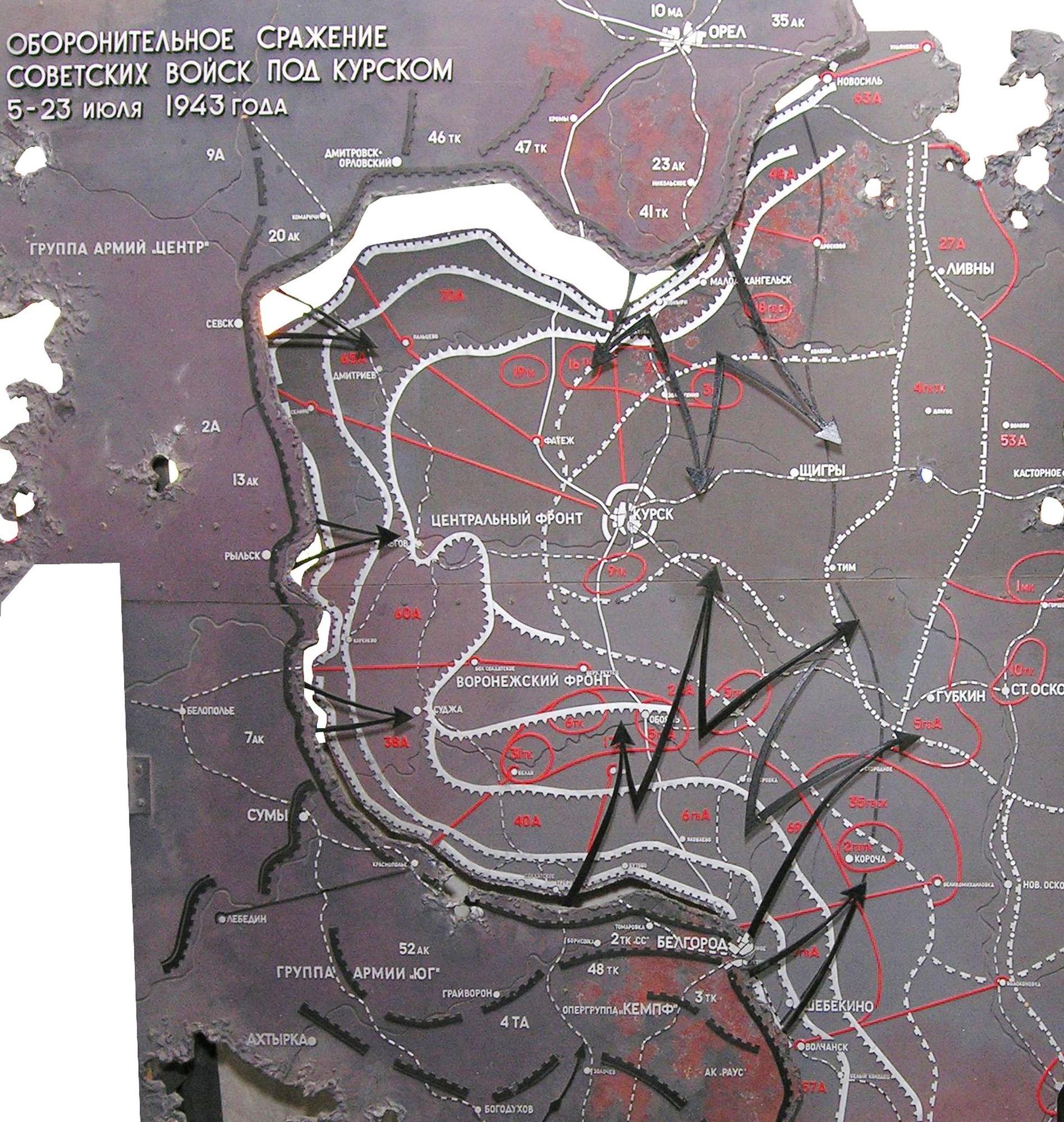


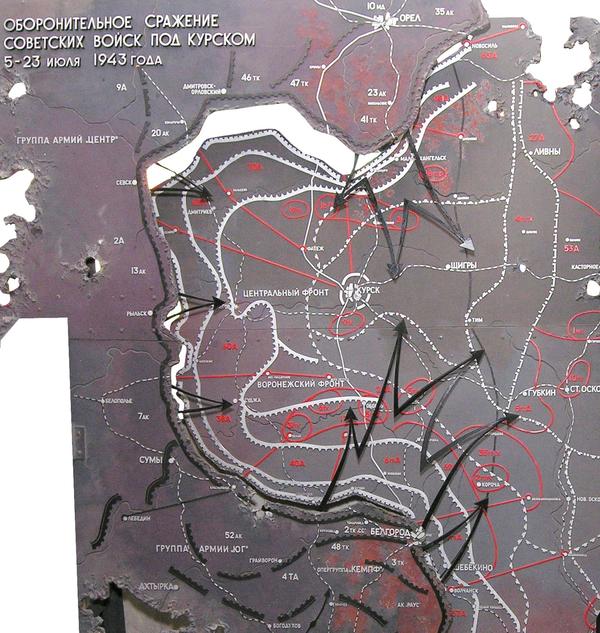
The Great Patriotic War lasted for 1418 days, 50 of which were incurred in the Battle of Kursk. This monumental battle had two stages. The first stage was when the Soviet command was taking defensive position, aiming to bleed their enemy white. The second one was when the command launched a counteroffensive, cutting the German storm troops to pieces. The events that happened from July 5-23, 1943 in the Kursk Bulge were immortalized on this presented base map.
This work is executed in three colors associated with war. Red symbolizes the bloodshed and long-awaited victory, grey symbolizes the smoke clouds and ashes that remain after the battle, as well as the soldier’s coats and frontline dirt. The third color, black, symbolizes grief, mourning, and the fires of ravaged settlements.
The masters of Painting and Decorating Works of Saint Petersburg used metal and wood during the map’s creation. The decorators used an imitation of damaged tank armor as the background, and made accents with sharp metallic arrows as a vibe strengthening technique.
In the spring of 1943, the Red Army formed the so-called Kursk Salient during the battle near the city of the same namesake. The Germans considered it to be a valuable opportunity to demolish Soviet forces, and they concentrated about 50 divisions near Kursk. Two assault teams were formed among them: the 9th Field Army of General Model (approaching from Orel’s side), and the 4th Panzer Army of General Hoth in tandem with Kempf task element (approaching from Belgorod’s side).
The primary objective of the fascists on the Kursk Bulge was to surround and destroy the Soviet forces. For this purpose, the Germans developed an offensive operation called Citadel. The Soviet command figured the enemy’s plan out in time, and decided to concentrate on defense, precisely estimating their attack vectors and their primary objective. In the spring of 1943, the frontlines turned silent; both sides geared up for the battles to come.
The task to hold the defensive line near Kursk was assigned to the Voronezh Front and the Central Front with parts of the Steppe Front armies joining them. The total amount of Soviet forces near Kursk exceeded 1.63 million soldiers and officers, which built eight defense lines. About 27,000 cannons and mortar squads, over 5,000 tanks and self-propelled artillery weapons, and up to 3,000 combat aviation forces were summoned for their defense.
The Red Army managed to turn the tide of the Battle of Kursk and overrun the enemies by launching the counteroffensive in time. This was only made possible with the heroism of Soviet warriors and the experience obtained in previous military operations (the Battle of Moscow and the Battle of Stalingrad had already been concluded by then).
This work is executed in three colors associated with war. Red symbolizes the bloodshed and long-awaited victory, grey symbolizes the smoke clouds and ashes that remain after the battle, as well as the soldier’s coats and frontline dirt. The third color, black, symbolizes grief, mourning, and the fires of ravaged settlements.
The masters of Painting and Decorating Works of Saint Petersburg used metal and wood during the map’s creation. The decorators used an imitation of damaged tank armor as the background, and made accents with sharp metallic arrows as a vibe strengthening technique.
In the spring of 1943, the Red Army formed the so-called Kursk Salient during the battle near the city of the same namesake. The Germans considered it to be a valuable opportunity to demolish Soviet forces, and they concentrated about 50 divisions near Kursk. Two assault teams were formed among them: the 9th Field Army of General Model (approaching from Orel’s side), and the 4th Panzer Army of General Hoth in tandem with Kempf task element (approaching from Belgorod’s side).
The primary objective of the fascists on the Kursk Bulge was to surround and destroy the Soviet forces. For this purpose, the Germans developed an offensive operation called Citadel. The Soviet command figured the enemy’s plan out in time, and decided to concentrate on defense, precisely estimating their attack vectors and their primary objective. In the spring of 1943, the frontlines turned silent; both sides geared up for the battles to come.
The task to hold the defensive line near Kursk was assigned to the Voronezh Front and the Central Front with parts of the Steppe Front armies joining them. The total amount of Soviet forces near Kursk exceeded 1.63 million soldiers and officers, which built eight defense lines. About 27,000 cannons and mortar squads, over 5,000 tanks and self-propelled artillery weapons, and up to 3,000 combat aviation forces were summoned for their defense.
The Red Army managed to turn the tide of the Battle of Kursk and overrun the enemies by launching the counteroffensive in time. This was only made possible with the heroism of Soviet warriors and the experience obtained in previous military operations (the Battle of Moscow and the Battle of Stalingrad had already been concluded by then).