#1
Kamelaukion, Crucifixion, Mandyas
#2
#15
Kamelaukion
#4
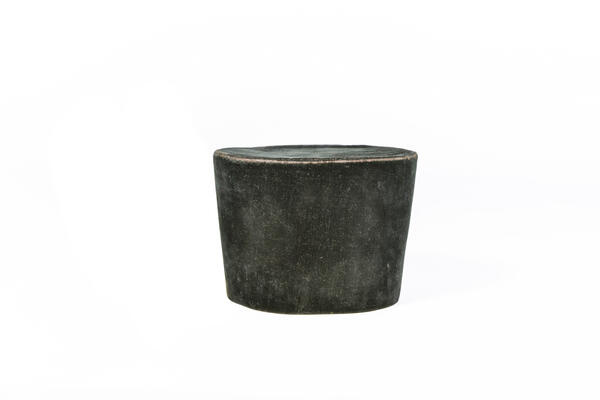
In the Orthodox Church, a kamelaukion is a high brimless headdress on a stiff cardboard base. It has the shape of a cylinder and slightly flares at the top. The name comes from a Greek word that meant “camel”: the first hats of this kind were made of camel wool.
A kamelaukion is a part of everyday vestments worn by monks and priests. It is associated with Christ’s crown of thorns. Most often, these headdresses are black, but there are also other colors. For example, metropolitans wear white caps of this type.
The kamelaukion from the Bishop’s House collection was made of black pile textile, the lining was made of dark brown material. To keep the shape of the headdress, a cardboard frame was placed inside; the bottom was also made stiff.
The first kamelaukions of Orthodox clergy appeared in the 17th century and replaced skufias — soft headdresses, over which a hood was sometimes worn. Defenders of old traditions opposed the innovation that the Russians adopted from the Greeks, but gradually kamelaukions became a common part of the vestments. And in 1798, this headdress became a church award: the purple kamelaukion was given for special merits and diligent religious service. For the secular, that is, non-monastic clergy, this was the only opportunity to get this headdress: in all other cases, it was only for monks.
During the divine service, the priests are in the temple with their heads covered almost all the time. They take their kamelaukions off only at the most solemn moments: when they prepare bread and wine for communion, read the Gospel, and offer hymns of praise to Christ or the Mother of God. In such cases, the headdress is put aside or held in the left hand — it depends on the specific moment of the liturgy. All these rules are prescribed in the statute of the clergy and are strictly followed at every service.
Everyday kamelaukions are sewn with black crepe — a fabric that almost does not crumple and remains neat for a long time. From behind, basting is sewn to it — a long black mantle that descends on the back.
A kamelaukion is a part of everyday vestments worn by monks and priests. It is associated with Christ’s crown of thorns. Most often, these headdresses are black, but there are also other colors. For example, metropolitans wear white caps of this type.
The kamelaukion from the Bishop’s House collection was made of black pile textile, the lining was made of dark brown material. To keep the shape of the headdress, a cardboard frame was placed inside; the bottom was also made stiff.
The first kamelaukions of Orthodox clergy appeared in the 17th century and replaced skufias — soft headdresses, over which a hood was sometimes worn. Defenders of old traditions opposed the innovation that the Russians adopted from the Greeks, but gradually kamelaukions became a common part of the vestments. And in 1798, this headdress became a church award: the purple kamelaukion was given for special merits and diligent religious service. For the secular, that is, non-monastic clergy, this was the only opportunity to get this headdress: in all other cases, it was only for monks.
During the divine service, the priests are in the temple with their heads covered almost all the time. They take their kamelaukions off only at the most solemn moments: when they prepare bread and wine for communion, read the Gospel, and offer hymns of praise to Christ or the Mother of God. In such cases, the headdress is put aside or held in the left hand — it depends on the specific moment of the liturgy. All these rules are prescribed in the statute of the clergy and are strictly followed at every service.
Everyday kamelaukions are sewn with black crepe — a fabric that almost does not crumple and remains neat for a long time. From behind, basting is sewn to it — a long black mantle that descends on the back.
#21
Полное наименование предмета: Kamelaukion — a priest’s headdress
Дата создания: the 19th century
Техника: sewing
Место создания: Russia
Владелец коллекции: Bishop’s House
Размеры: 23×19 cm
Номер в Госкаталоге: 12452205
Дата создания: the 19th century
Техника: sewing
Место создания: Russia
Владелец коллекции: Bishop’s House
Размеры: 23×19 cm
Номер в Госкаталоге: 12452205
#7
Crucifixion
#16
Crucifixion
#9
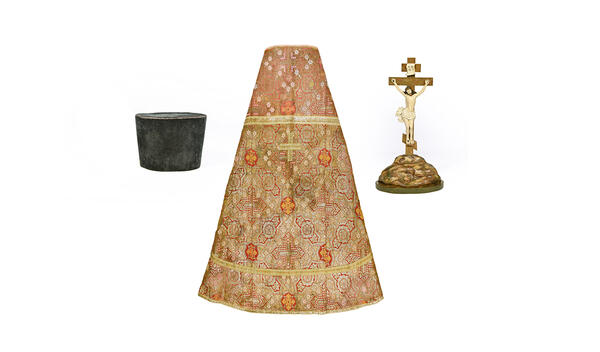
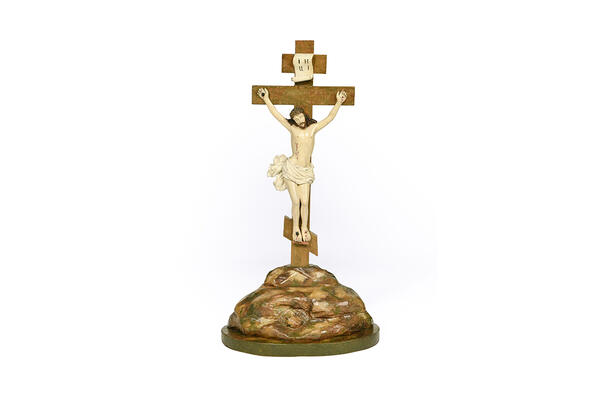
The carved wooden sculpture “Crucifixion” was made by an unknown master in the late 18th or early 19th century. The front side of the composition is three-dimensional, the reverse is flat: probably, the sculpture was placed close to the wall or it was suspended. The base is in the form of a low rocky hill and it symbolizes Calvary — the mountain on which, according to Holy Scripture, Jesus Christ was crucified.
The cross is eight-pointed — this is the most frequent variant of a cross in the Orthodox tradition. It is believed that besides the two main crossbeams, the instrument of execution of Christ had two shorter, additional ones: the slanting one was at the bottom, under the feet of the Savior, and the straight one was nailed above his head. There was a plaque on it with an inscription in three languages: “Jesus the Nazarene, the King of the Jews The sculptor placed the scroll with the first letters of this phrase above Christ’s head.
The image of Jesus is made in the technique typical of small sculpture. Unlike most church statues of the 18th century, where details were outlined only roughly, the creator of this work tried to convey the anatomy of the human body as accurately as possible. His Christ has thin arms, a sunken abdomen and ribs showing through the skin. His head is bowed down and his eyes are closed. His thighs are covered by a broad strip of white cloth. The artist made some folds with a thin chisel. Drops of blood are painted scarlet, they drip from the wounds on his hands, feet, head and under his ribs.
Wooden Orthodox sculpture was especially popular in the northern territories of Russia. In contrast to icon painting, there were far fewer characters: most often artists depicted Jesus in prison or on the cross, the Mother of God, St. John the Evangelist and Nicholas the Wonderworker. There were also statues of local Siberian saints: Metropolitan Philaret, St John, St Innocent, St Philotheus and others.
In some provinces, it was customary that the statues did not have traditional Byzantine features, but looked like those indigenous peoples who lived there. The figures of Christ with noticeable Bashkir or Komi-Permyak features have survived to this day.
The vestments of the sculptures were most often carved from a single piece of wood. But sometimes parishioners decorated them — they sewed clothes and shoes for the statues and donated precious crowns to the church.
The cross is eight-pointed — this is the most frequent variant of a cross in the Orthodox tradition. It is believed that besides the two main crossbeams, the instrument of execution of Christ had two shorter, additional ones: the slanting one was at the bottom, under the feet of the Savior, and the straight one was nailed above his head. There was a plaque on it with an inscription in three languages: “Jesus the Nazarene, the King of the Jews The sculptor placed the scroll with the first letters of this phrase above Christ’s head.
The image of Jesus is made in the technique typical of small sculpture. Unlike most church statues of the 18th century, where details were outlined only roughly, the creator of this work tried to convey the anatomy of the human body as accurately as possible. His Christ has thin arms, a sunken abdomen and ribs showing through the skin. His head is bowed down and his eyes are closed. His thighs are covered by a broad strip of white cloth. The artist made some folds with a thin chisel. Drops of blood are painted scarlet, they drip from the wounds on his hands, feet, head and under his ribs.
Wooden Orthodox sculpture was especially popular in the northern territories of Russia. In contrast to icon painting, there were far fewer characters: most often artists depicted Jesus in prison or on the cross, the Mother of God, St. John the Evangelist and Nicholas the Wonderworker. There were also statues of local Siberian saints: Metropolitan Philaret, St John, St Innocent, St Philotheus and others.
In some provinces, it was customary that the statues did not have traditional Byzantine features, but looked like those indigenous peoples who lived there. The figures of Christ with noticeable Bashkir or Komi-Permyak features have survived to this day.
The vestments of the sculptures were most often carved from a single piece of wood. But sometimes parishioners decorated them — they sewed clothes and shoes for the statues and donated precious crowns to the church.
#22
Полное наименование предмета: Sculpture “Crucifixion”
Дата создания: the late 18th — early 19th century
Техника: carving, painting
Владелец коллекции: Bishop’s House
Дата создания: the late 18th — early 19th century
Техника: carving, painting
Владелец коллекции: Bishop’s House
Размеры: 68×33×4,5 cm
Номер в Госкаталоге: 12228641
Номер в Госкаталоге: 12228641
#11
Mandyas
#17
Mandyas
#13
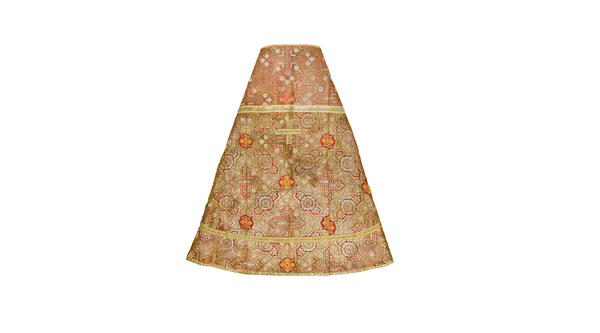
A mandyas, or phelonion, is a traditional outer garment of the Orthodox priests, which they put on before divine service. It is a bell-shaped sleeveless cape. In the Russian Orthodox Church, a mandyas should have a high standing collar. The item is long at the back and goes down below the knees. The front part is waist-long. There is also a so-called small phelonion, short on all sides: it is worn only during consecration.
The mandyas from the Bishop’s House collection was sewn from brocade based on red silk. This material did not crumple, did not wear out for a long time, and looked solemn. The surface of the mandyas is woven with gold and silver threads, which form a complex ornament: floral patterns, four-pointed crosses, and rhombuses. There is an equilateral cross with four arms on the back of the cape. The bottom of the robe is sewn with a gold band.
In Orthodoxy, the phaelonion symbolizes an armor of faith, love, and righteousness, which every true Christian is believed to have. The color of the vestment varies depending on the occasion on which the service was performed. On Christmas, Epiphany, Transfiguration, and Ascension, priests wear white vestments. During the Great Lent, which lasts from Maslenitsa to Easter, a black robe is usually worn. During the services in honor of the Virgin, the clergy wear blue mandyases: this color is traditionally associated with the Mother of God, since it embodies her purity and innocence. The main festive color in Orthodoxy is red. It symbolizes life, so clothes of this shade are worn during Easter services.
The cape is worn over an inner cassock — a long, spacious robe, most often white. The vestments are complemented by epimanikia — a kind of cuffs. Priests also wear an epitrachelion around their neck (a long wide ribbon), a belt made of the same fabric as the mandyas, and a pectoral cross. The attire is also supplemented with church awards — an epigonation, a kamelaukion, or a miter. The priests' vestments are usually kept in the altar; sometimes a separate room is set aside for them in the temple and called the sacristy.
The mandyas from the Bishop’s House collection was sewn from brocade based on red silk. This material did not crumple, did not wear out for a long time, and looked solemn. The surface of the mandyas is woven with gold and silver threads, which form a complex ornament: floral patterns, four-pointed crosses, and rhombuses. There is an equilateral cross with four arms on the back of the cape. The bottom of the robe is sewn with a gold band.
In Orthodoxy, the phaelonion symbolizes an armor of faith, love, and righteousness, which every true Christian is believed to have. The color of the vestment varies depending on the occasion on which the service was performed. On Christmas, Epiphany, Transfiguration, and Ascension, priests wear white vestments. During the Great Lent, which lasts from Maslenitsa to Easter, a black robe is usually worn. During the services in honor of the Virgin, the clergy wear blue mandyases: this color is traditionally associated with the Mother of God, since it embodies her purity and innocence. The main festive color in Orthodoxy is red. It symbolizes life, so clothes of this shade are worn during Easter services.
The cape is worn over an inner cassock — a long, spacious robe, most often white. The vestments are complemented by epimanikia — a kind of cuffs. Priests also wear an epitrachelion around their neck (a long wide ribbon), a belt made of the same fabric as the mandyas, and a pectoral cross. The attire is also supplemented with church awards — an epigonation, a kamelaukion, or a miter. The priests' vestments are usually kept in the altar; sometimes a separate room is set aside for them in the temple and called the sacristy.
#23
Полное наименование предмета: A priest’s mandyas made of brocade
Дата создания: the 19th century
Техника: machine work, gold embroidery
Место создания: the village of Leushi, Kondinsky district
Владелец коллекции: Bishop’s House
Дата создания: the 19th century
Техника: machine work, gold embroidery
Место создания: the village of Leushi, Kondinsky district
Владелец коллекции: Bishop’s House
Размеры: Длина — 135 см
Номер в Госкаталоге: 3495160
Номер в Госкаталоге: 3495160
#19
Ministry of Culture of the Russian Federation
read morehide
00:00
00:00
1x
Kamelaukion, Crucifixion, Mandyas
Collection
0
 Point your smartphone camera to open in the app
Open in app
Share