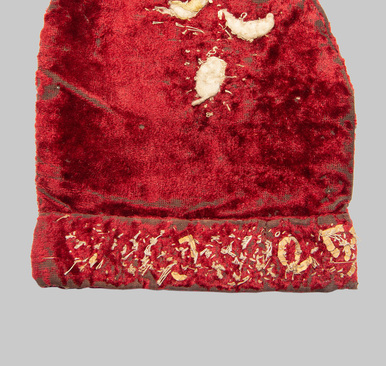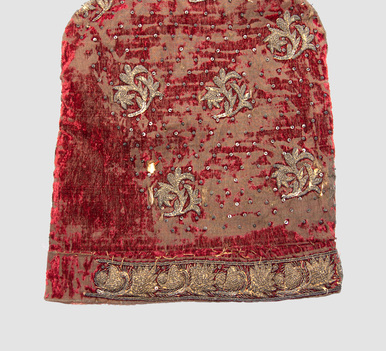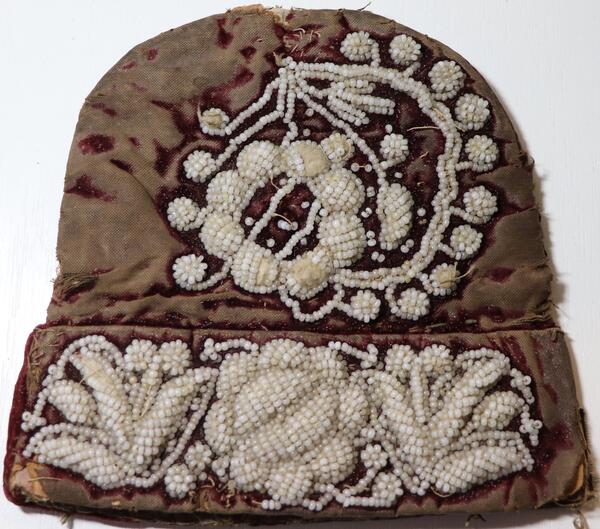
The traditional women’s headdress of the Kazan Tatar women, the kalfak, was borrowed by the Siberian Tatars in the middle of the 19th century and became quite widespread. The earliest surviving kalfak dates back to the 18th century, and scientists believe that the headdress had appeared even earlier. The kalfak turned out to be the most stable item of the national costume, and it is still worn today. In modern everyday life, kalfaks that look like skullcaps called takyya are the most popular ones, especially with older women.
In the pre-revolutionary period, kalfaks were brought to Siberia from Kazan and Orenburg, and were also made by Siberian Tatars. Three categories of kalfaks can be distinguished based on the items that existed among Siberian Tatars and were preserved in the museum’s collection: girls’ kalfaks, women’s kalfaks (which differed from girls’ ones by having a solid rim) and small kalfaks — small headdresses, which became popular primarily among urban Tatars at the turn of the 20th century. Kalfaks could be covered by scarves, shawls, and cloaks.
Despite certain differences between these types of kalfaks, they have significant similarities in the way they are decorated. Patterns used on kalfaks are predominantly floral in nature. They are embroidered with gold, pearls, beads, and “sinel” embroidery, inlaid with semi-precious stones, and trimmed with small silver coins. The frontal part of a small kalfak or the top of a large kalfak was decorated with a border in the form of a single branch called the “golden feather” (“altyn kaury”). This is a flexible continuous pattern on the surface of the kalfak, curving towards the back of the head. The central branch of the “feather” was embroidered, absorbing various elements: flowers, buds and double leaves, shamrocks, palmettes, antennae turned in different directions, petals wriggling and bent backwards, pea pods, peas, and stamens. Another pattern was an undulating shoot on the crown of the kalfak. It was sometimes called the “flowering shrub”, and contained indirect images of birds, squirrels, butterflies, snakes, and caterpillars.
Kalfaks with a solid rim and a flat top (“takyya kalfaks”) were also attached to the hair, closer to the forehead. They were worn by both girls and women, the latter wore them with a factory scarf: married Tatar women had to cover not only their heads, but also their necks, shoulders and backs.
In the pre-revolutionary period, kalfaks were brought to Siberia from Kazan and Orenburg, and were also made by Siberian Tatars. Three categories of kalfaks can be distinguished based on the items that existed among Siberian Tatars and were preserved in the museum’s collection: girls’ kalfaks, women’s kalfaks (which differed from girls’ ones by having a solid rim) and small kalfaks — small headdresses, which became popular primarily among urban Tatars at the turn of the 20th century. Kalfaks could be covered by scarves, shawls, and cloaks.
Despite certain differences between these types of kalfaks, they have significant similarities in the way they are decorated. Patterns used on kalfaks are predominantly floral in nature. They are embroidered with gold, pearls, beads, and “sinel” embroidery, inlaid with semi-precious stones, and trimmed with small silver coins. The frontal part of a small kalfak or the top of a large kalfak was decorated with a border in the form of a single branch called the “golden feather” (“altyn kaury”). This is a flexible continuous pattern on the surface of the kalfak, curving towards the back of the head. The central branch of the “feather” was embroidered, absorbing various elements: flowers, buds and double leaves, shamrocks, palmettes, antennae turned in different directions, petals wriggling and bent backwards, pea pods, peas, and stamens. Another pattern was an undulating shoot on the crown of the kalfak. It was sometimes called the “flowering shrub”, and contained indirect images of birds, squirrels, butterflies, snakes, and caterpillars.
Kalfaks with a solid rim and a flat top (“takyya kalfaks”) were also attached to the hair, closer to the forehead. They were worn by both girls and women, the latter wore them with a factory scarf: married Tatar women had to cover not only their heads, but also their necks, shoulders and backs.