The headdress of a Tatar woman consisted of three obligatory parts. The main underdresses (volosniki) were used to gather and cover the hair. Married women had to cover all their hair and their backs, so headdresses always included volosniki and shawls. Girls had their braids descending on the back — they remained open or were covered with a special decoration (“chech tenkese”). The main (middle) headdresses — shawls — were more typical for older women. They came in different shapes and could be triangular, square, or towel-shaped. Top hats (kalfaks) were worn on top of the shawls, firmly secured them on the head. These were various bands, scarves and hats. Unmarried girls put on a hat or kalfak, which they wore with braids. It was worn as part of the set with a special decorative band (“uka chachak”), and the cone-shaped end with a tassel was leaned back or to one side.
A kalfak is a national headdress, an integral part of the classic national Tatar costume. It was richly decorated with embroidery, gold and silver threads, and beads.
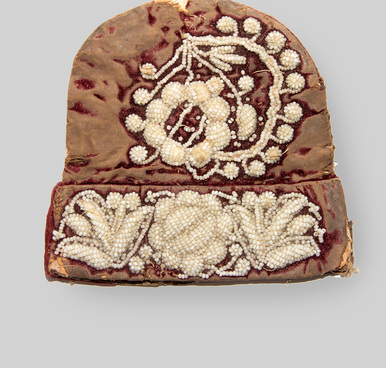
Since the 19th century, white, less often colored beads have been widely used in the ornamentation of kalfaks. By the middle of the 19th century, kalfaks become shorter, more elegant, and heavy tassels and fringes disappeared. A solid rectangular rim took on an important decorative function. Often such kalfaks were worn under a scarf or a shawl. Gradually, gold-embroidered kalfaks with a solid band become smaller. A kalfak is no longer worn on the head, but is only a kind of decoration.
At the beginning of the 20th century, Tatar women, mostly from the intelligentsia and townspeople, began to wear European clothes, but despite a decrease in size, the kalfak remained a traditional headdress that emphasized the nationality of a woman. In Soviet times, the kalfak ceased to be an everyday headdress and began to be worn only on holidays or as an element of the national stage costume. Small kalfaks are popular only on stage these days, but kalfaks like skullcaps — takyya — are still popular, and a shawl or a scarf can be worn on top.
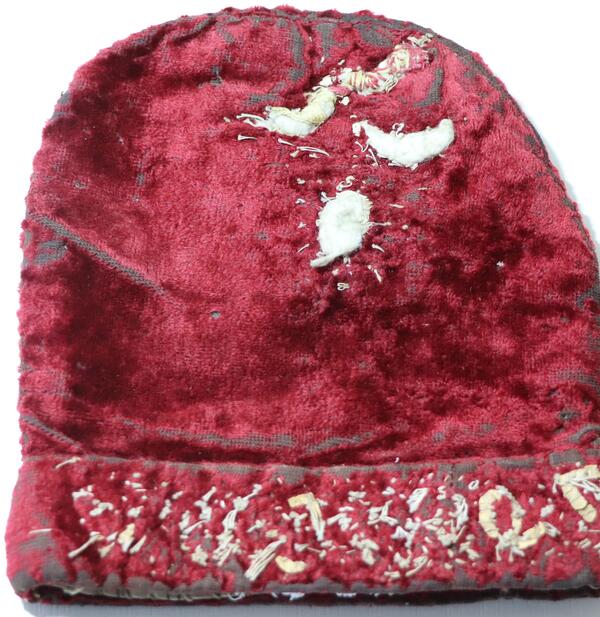
The kalfak from the museum exhibition is a soft cap of a hemispherical shape made of red velvet. On the crown there is an embroidery of a plant motif, in the forehead part along the lower edge there is a border of wave-like twigs.
A kalfak is a national headdress, an integral part of the classic national Tatar costume. It was richly decorated with embroidery, gold and silver threads, and beads.
Since the 19th century, white, less often colored beads have been widely used in the ornamentation of kalfaks. By the middle of the 19th century, kalfaks become shorter, more elegant, and heavy tassels and fringes disappeared. A solid rectangular rim took on an important decorative function. Often such kalfaks were worn under a scarf or a shawl. Gradually, gold-embroidered kalfaks with a solid band become smaller. A kalfak is no longer worn on the head, but is only a kind of decoration.
At the beginning of the 20th century, Tatar women, mostly from the intelligentsia and townspeople, began to wear European clothes, but despite a decrease in size, the kalfak remained a traditional headdress that emphasized the nationality of a woman. In Soviet times, the kalfak ceased to be an everyday headdress and began to be worn only on holidays or as an element of the national stage costume. Small kalfaks are popular only on stage these days, but kalfaks like skullcaps — takyya — are still popular, and a shawl or a scarf can be worn on top.
The kalfak from the museum exhibition is a soft cap of a hemispherical shape made of red velvet. On the crown there is an embroidery of a plant motif, in the forehead part along the lower edge there is a border of wave-like twigs.