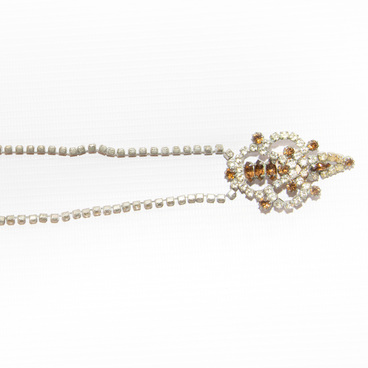
A showcase with various forms of kalfaks occupies a special place in the collection of the Embaevo Museum.
A kalfak is a Tatar girls’ and women’s headdress. The models made in two colors from separate strips of velvet were considered especially popular. It is thanks to this variation of the Tatar headdress that the “ear” technique of fabric appliqué has survived to this day: pieces of colored fabric are folded in a special way into small triangular “ears”, and then sewn together into the shape of a flower or a bud with sequins and pearls usually located in the center. With all this diversity, despite the brightness of the kalfak’s decoration, it is important to understand that it has never been an independent headdress of a Tatar girl. The kalfak retained the function of the lower headdress: it was always put on or fastened on the hair (closer to the forehead) and covered with a scarf on top. Married women wore a kalfak as an independent headdress only in front of family members or female friends.
Since the second half of the 19th century, velvet kalfaks with a solid rim have come into fashion in cities and nearby areas. At the beginning of the 20th century, the kalfak, combined with a factory scarf, was the national headdress of the Tatars.
Kalfaks vary in size, including band width, color, and decoration. From ancient times, the skill of sewing kalfaks was passed down to Tatar girls by grandmothers from generation to generation.
The kalfak from the exhibition was donated to the museum by Fanisa Maksudovna Zinnatullina, a resident of the Mullashi village in the Tyumen region. The headpiece is made of velvet and consists of two parts — a soft top and a hard rim. The upper part has a disproportionate shape. The front side is made of dark brown velvet; the reverse side is made of dark red velvet with stitched threads. On the underside there is a green chintz lining. The rim is decorated with a floral pattern in the form of alternating yellow petals using the technique of gold embroidery and interspersed with sequins.
A kalfak is a Tatar girls’ and women’s headdress. The models made in two colors from separate strips of velvet were considered especially popular. It is thanks to this variation of the Tatar headdress that the “ear” technique of fabric appliqué has survived to this day: pieces of colored fabric are folded in a special way into small triangular “ears”, and then sewn together into the shape of a flower or a bud with sequins and pearls usually located in the center. With all this diversity, despite the brightness of the kalfak’s decoration, it is important to understand that it has never been an independent headdress of a Tatar girl. The kalfak retained the function of the lower headdress: it was always put on or fastened on the hair (closer to the forehead) and covered with a scarf on top. Married women wore a kalfak as an independent headdress only in front of family members or female friends.
Since the second half of the 19th century, velvet kalfaks with a solid rim have come into fashion in cities and nearby areas. At the beginning of the 20th century, the kalfak, combined with a factory scarf, was the national headdress of the Tatars.
Kalfaks vary in size, including band width, color, and decoration. From ancient times, the skill of sewing kalfaks was passed down to Tatar girls by grandmothers from generation to generation.
The kalfak from the exhibition was donated to the museum by Fanisa Maksudovna Zinnatullina, a resident of the Mullashi village in the Tyumen region. The headpiece is made of velvet and consists of two parts — a soft top and a hard rim. The upper part has a disproportionate shape. The front side is made of dark brown velvet; the reverse side is made of dark red velvet with stitched threads. On the underside there is a green chintz lining. The rim is decorated with a floral pattern in the form of alternating yellow petals using the technique of gold embroidery and interspersed with sequins.