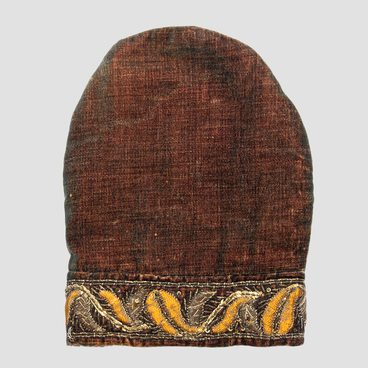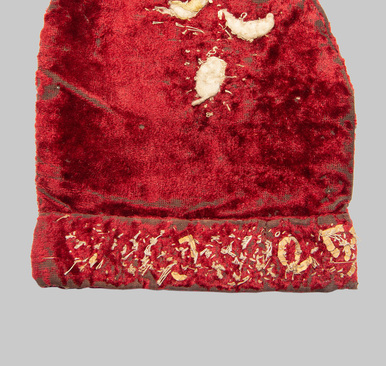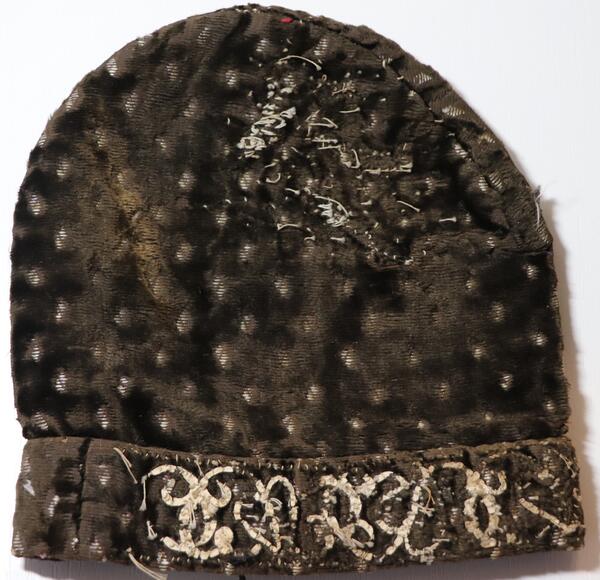
If we consider the period from the end of the 17th century to the beginning of the 20th century, then the shape, size, ornamentation of kalfaks, and the entire national Tatar costume, were constantly changing. Initially, the kalfak was a soft fabric, knitted or suede cap of a simple shape, which covered the entire head. Since the 17th century, craftswomen began to use “sinel” (embroidery with a shaggy thread producing a soft bunchy pattern) in combination with sequins, as well as the “ear” patchwork technique, when relief multi-shaded large elements of flowers were made from small pieces of fabric — folded corner (“ear”) pieces of satin ribbon. The result was amazing: double flowers looked voluminous and almost real. Then there were large velvet kalfaks with a large gold-embroidered pattern and a fringe hanging down to the very shoulders.
Since the 19th century, white, less often colored beads have been widely used in the decoration of kalfaks. By the middle of the 19th century, kalfaks become shorter, more elegant, heavy tassels and fringes disappeared. Often such shortened small kalfaks were worn under a scarf or a shawl. A solid rectangular rim took on a prominent decorative function. Gradually, gold-embroidered kalfaks with a solid rim became smaller. Kalfaks no longer covered the head, but were only a kind of decoration.
At the beginning of the 20th century, urban Tatar women began to wear European clothes, but the kalfak, despite its decrease in size, remained a traditional headdress that emphasized nationality. In Soviet times, the kalfak began to be worn only for holidays or as an element of the national stage costume, and over time it turned into almost an accessory — a hairpin. Tatar girls still wear it, but now it is much smaller.
Small kalfaks are popular only on stage these days, but kalfaks that look like skullcaps — takyya — are preferred, and one can also wear a shawl or scarf on top. The kalfak has several different forms, among which the most popular are the kalfak in the form of a skullcap and the kalfak with a pointed end.
Since the 19th century, white, less often colored beads have been widely used in the decoration of kalfaks. By the middle of the 19th century, kalfaks become shorter, more elegant, heavy tassels and fringes disappeared. Often such shortened small kalfaks were worn under a scarf or a shawl. A solid rectangular rim took on a prominent decorative function. Gradually, gold-embroidered kalfaks with a solid rim became smaller. Kalfaks no longer covered the head, but were only a kind of decoration.
At the beginning of the 20th century, urban Tatar women began to wear European clothes, but the kalfak, despite its decrease in size, remained a traditional headdress that emphasized nationality. In Soviet times, the kalfak began to be worn only for holidays or as an element of the national stage costume, and over time it turned into almost an accessory — a hairpin. Tatar girls still wear it, but now it is much smaller.
Small kalfaks are popular only on stage these days, but kalfaks that look like skullcaps — takyya — are preferred, and one can also wear a shawl or scarf on top. The kalfak has several different forms, among which the most popular are the kalfak in the form of a skullcap and the kalfak with a pointed end.