Jewelry has always been a striking feature of the Tatar national costume and matched it harmoniously. Both men and women wore jewelry galore. The pieces included large rings, signature rings, rings, belt buckles, women’s braid decorations, earrings, pendants, and other items. The exhibition “Motifs of Tatar Patterns in National Costumes” features a collection of jewelry from the 19th and 20th centuries — necklaces, bracelets, rings, and braid decorations (“chulpas”).
The main material from which jewelry was made was silver (“kumish”) of varying degrees of purity. Gold as a material for jewelry was used much less frequently, however, it was part of the jewelry sets belonging to rich Tatar women. Siberian Tatars used a characteristic combination of metal with various kinds of inserts (“kuslar”). Most often, turquoise, corals, mother-of-pearl, malachite, carnelian, amethyst, aquamarine, and ruby were used, but in general it was an imitation of natural materials in mass jewelry.
To imitate gems, jewelry glass is used — it includes calcium, borosilicate, lead, opal, frosted and mineral, as well as enamel, glass-ceramics, and technogenic waste. The popularity of jewelry glass is very high, and there are several reasons for this. Glass production is much cheaper than mining and cutting valuable crystals. The way jewelry glass looks — its brilliance, transparency, and the play of light in the facets — is comparable to gems. An important advantage of glass is its great possibilities for processing; they allow jewelers much more opportunities to embody their fantasies compared to working with gems. Glass can be painted in any shade, and shaped almost in any way.
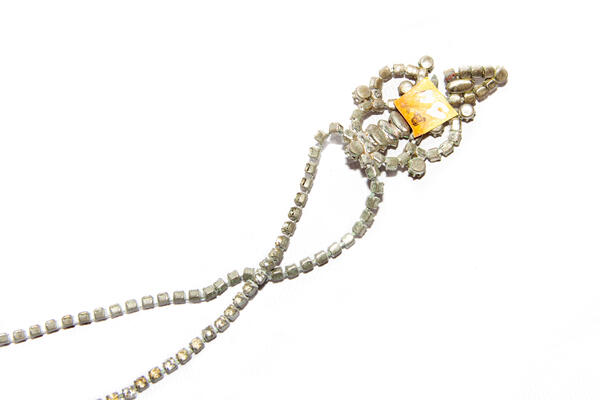
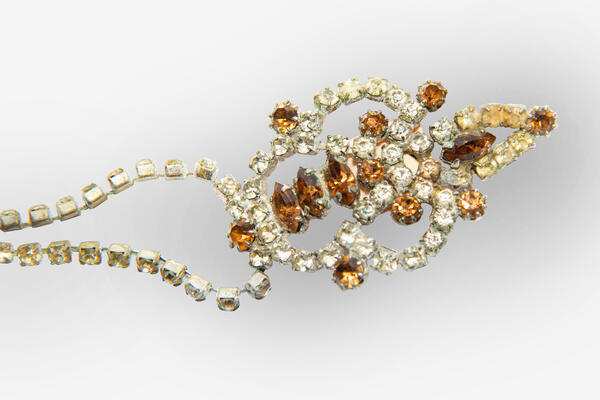
One of the adornments is a women’s necklace made of white and yellow glass beads on a lamellar base, with a clasp. In the front, the pendant has a geometric octagonal shape. The item with a clasp was worn around the neck, it looked massive, and glass stones looked much brighter than natural ones.
The necklace was donated to the museum by Khalida Sadykova, a resident of the Embaevo village, Tyumen district, Tyumen Oblast.
The main material from which jewelry was made was silver (“kumish”) of varying degrees of purity. Gold as a material for jewelry was used much less frequently, however, it was part of the jewelry sets belonging to rich Tatar women. Siberian Tatars used a characteristic combination of metal with various kinds of inserts (“kuslar”). Most often, turquoise, corals, mother-of-pearl, malachite, carnelian, amethyst, aquamarine, and ruby were used, but in general it was an imitation of natural materials in mass jewelry.
To imitate gems, jewelry glass is used — it includes calcium, borosilicate, lead, opal, frosted and mineral, as well as enamel, glass-ceramics, and technogenic waste. The popularity of jewelry glass is very high, and there are several reasons for this. Glass production is much cheaper than mining and cutting valuable crystals. The way jewelry glass looks — its brilliance, transparency, and the play of light in the facets — is comparable to gems. An important advantage of glass is its great possibilities for processing; they allow jewelers much more opportunities to embody their fantasies compared to working with gems. Glass can be painted in any shade, and shaped almost in any way.
One of the adornments is a women’s necklace made of white and yellow glass beads on a lamellar base, with a clasp. In the front, the pendant has a geometric octagonal shape. The item with a clasp was worn around the neck, it looked massive, and glass stones looked much brighter than natural ones.
The necklace was donated to the museum by Khalida Sadykova, a resident of the Embaevo village, Tyumen district, Tyumen Oblast.