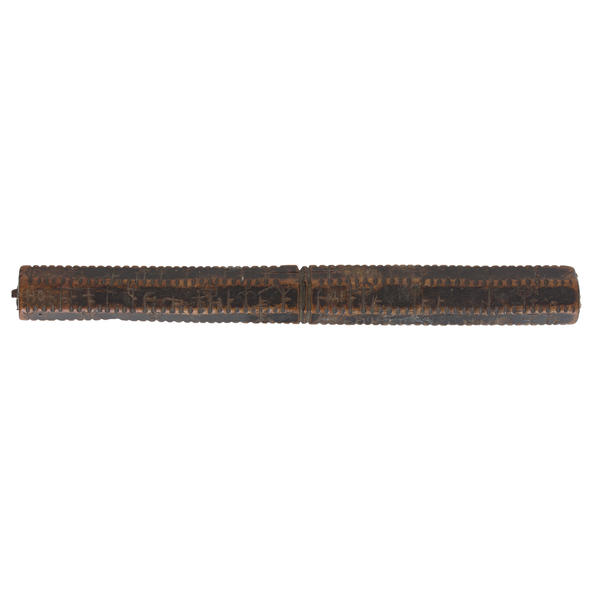
This calendar entered the museum in the early twentieth century. The origin and source of the object is unknown. It is a wooden hexagonal bar, divided by annular transverse incisions into two parts. On one end of the bar there is a small peg. On the ribs there are notches, each of which corresponds to a day of the month. Numerous symbols are carved on the faces, among which the crosses stand out most. There is also a lot of images of tridents and ‘Ͱ"-shaped symbols. On one of the faces there are letters НО (NO) and ДЕ (DE). The calendar is black.
Similar wooden calendars were very common in northern Europe. In Norway they were called primstay, in Denmark — rimstok (rim — calendar, stok — stick). In the north of Russia, they were used until the beginning of the twentieth century. they probably ended up in Siberia with the immigrants from the Russian North.
Wooden calendars were made either in the form of plates, where each plate corresponded to a month, or in the form of bars. Six or four-sided bars of various lengths (from 20 centimeters to 1 meter long) were cut out of hardwood. Hexagonal bars were divided into two parts, tetrahedral — into three. Each face corresponded to a month, and notches on the ribs to days. There was no division by weeks.
Various commemorative symbols were carved on the surfaces. Crosses of various sizes probably correspond to Christian holidays. Also, symbols marked the cycles of farming, crafts, and other events. Among the symbols are geometric figures and letters of the Old Slavonic alphabet. According to one theory, Pomorye wooden calendars can be oriented to the beginning of a fishing, and not a calendar year. So, Pomors, who went fishing to Murman, could have their calendar year beginning on March 1st, or from the time of returning — September 1st. The use of these dates by the Pomors is not accidental: at different times these were the beginning of a new year in Russia.
Since the calendars were family-owned, family dates could be marked on them, too. The number of symbols on calendars is always different. The older the calendar, the more symbols are carved on it. Wooden calendars were passed from generation to generation. Over time, when the edges were abraded, a copy would be made and continued to be used in the family. The head of the family, as a rule, was in charge of a calendar. While similar in general, each calendar is unique. Probably, for this reason, it has not yet been possible to completely decipher them. Today, wooden calendars are exhibited in various northern and Siberian museums. The collection of the Arkhangelsk Regional Museum contains seven bar-shaped calendars, including Lappish and Nenets.